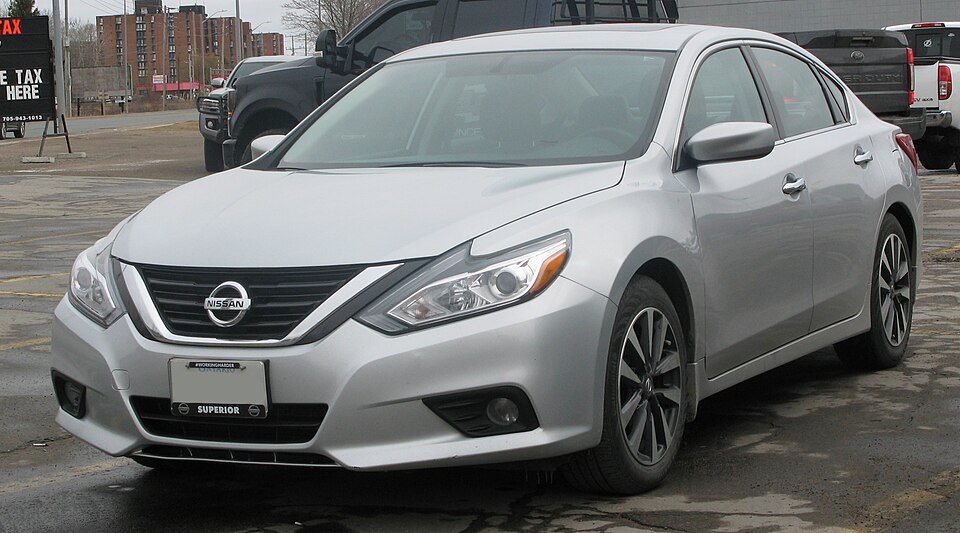
High complaint count among 27 Altima model years — 10th most.
4recalls
555complaints
28crashes
3fires
32injuries
58,000median miles
Owner complaints filed with NHTSA, not verified and not adjusted for sales. Ranking compares this model's own years only.
Does your car have an open recall? Recalls apply to specific vehicles. Only a VIN lookup on NHTSA's official site shows whether yours is affected and still unrepaired.
May 28, 2020 · NHTSA campaign 20V315000 · 1,831,818 vehicles
Problem: Nissan North America, Inc. (Nissan) is recalling certain model year 2013-2018 Nissan Altima vehicles. If the primary hood latch is inadvertently released, there is an increased likelihood that the secondary hood latch may corrode over time.
Risk: Corrosion to the secondary latch may cause it to bind and remain in the unlatched position when the hood is closed. If the primary latch is inadvertently released again and the secondary latch is not engaged, the hood could unexpectedly open while driving, increasing the risk of a vehicle crash.
Remedy & notes
Nissan will notify owners, and dealers will install a stronger release spring in the hood release lever, a warning label near the secondary hood latch, and an OwnerÂs Manual addendum card with instructions on how to lubricate and maintain the secondary hood latch mechanism, free of charge. Owner notification letters were mailed June 30, 2021. Owners may contact Nissan customer service at 1-800-867-7669. Note: Recall 16V-029 remains open for any unremedied 2013-2015 Altimas and this recall applies to all vehicles covered by 16V-029 even if those repairs have already been performed.
Owners may also contact the National Highway Traffic Safety Administration Vehicle Safety Hotline at 1-888-327-4236 (TTY 1-800-424-9153), or go to www.safercar.gov.
Latches/locks/linkages
Dec 19, 2018 · NHTSA campaign 18V915000 · 341,003 vehicles
Problem: Nissan North America, Inc. (Nissan) is recalling certain 2015-2017 Altima vehicles, previously remedied under recall number 17V-040. The door latch-lock cable may not have been routed properly in the rear door when the remedy was applied. As a result, the cable may interfere with the window regulator causing the rear passenger door to unlatch and inadvertently open without warning when the window is lowered.
Risk: If the rear passenger door opens while the vehicle is moving, the rear passengers have an increased risk of injury.
Remedy & notes
Nissan will notify owners, and dealers will secure the latch-lock cables in the correct position using the new remedy procedure, free of charge. The recall began February 5, 2019. Owners may contact Nissan customer service at 1-800-647-7669.
Owners may also contact the National Highway Traffic Safety Administration Vehicle Safety Hotline at 1-888-327-4236 (TTY 1-800-424-9153), or go to www.safercar.gov.
Latches/locks/linkages
Jan 18, 2017 · NHTSA campaign 17V040000 · 341,005 vehicles
Problem: Nissan North America, Inc. (Nissan) is recalling certain 2015-2017 Altima vehicles. The rear door latch/lock cable on the vehicles may have been improperly routed. As a result, lowering a rear window may inadvertently cause that door to unlatch and open.
Risk: If the rear passenger doors inadvertently open while the vehicle is in motion, it may increase the risk of injury to the rear passengers.
Remedy & notes
Nissan will notify owners, and dealers will correct the rear door latch/lock cable routing, free of charge. The recall began on February 16, 2017. Owners may contact Nissan customer service at 1-800-647-7261.
Owners may also contact the National Highway Traffic Safety Administration Vehicle Safety Hotline at 1-888-327-4236 (TTY 1-800-424-9153), or go to www.safercar.gov.
Problem: Nissan North America, Inc. (Nissan) is recalling certain model year 2016-2017 Nissan Maxima, 2013-2016 Nissan Altima, NV200, LEAF, Sentra, and Pathfinder, 2014-2016 Nissan NV200 Taxi, Infiniti QX60, QX60 Hybrid, and Q50 Hybrid, 2014-2017 Nissan Rogue and Infiniti Q50, 2015-2016 Nissan Murano, Murano Hybrid, and Chevrolet City Express, 2014-2015 Nissan Pathfinder Hybrid, and 2013 Infiniti JX35 vehicles. In these vehicles, the front seat passenger Occupant Classification System (OCS) may incorrectly classify an adult passenger as a child or classify the seat as empty despite it being occupied. As a result, the passenger frontal air bag may be turned off and not deploy in the event of a crash.
Risk: If the passenger frontal air bag does not deploy as intended in the event of a crash, the passenger is at an increased risk of injury.
Remedy & notes
Nissan will notify their owners. Chevrolet City Express owners will be notified by General Motors. Dealers will reprogram the Air Bag Control Unit (ACU) and OCS Electronic Control Unit (ECU) in Altima, Maxima, Murano, Rogue, and Sentra vehicles, and replace the OCS ECU in LEAF, NV200, NV200 Taxi, Pathfinder, Infiniti Q50, JX35, and QX60 and Chevrolet City Express vehicles, free of charge. Interim notices were sent to owners on May 31, 2016. Owners will receive a second notice when remedy parts become available. Owners may contact Nissan customer service at 1-800-867-7669, Infiniti customer service at 1-888-833-3216 or Chevrolet customer service at 1-800-222-1020.
Owners may also contact the National Highway Traffic Safety Administration Vehicle Safety Hotline at 1-888-327-4236 (TTY 1-800-424-9153), or go to www.safercar.gov.
Recall text as published by NHTSA and the manufacturer.
Owner complaints filed with NHTSA; one complaint can name several areas. Not verified by NHTSA.
Complaints by year filed
NHTSA investigations
Desiccated Air Bag Inflator Rupture
EA21002 · opened Sep 17, 2021 · open
Summary
From 2000 through 2017, Takata produced millions of air bag inflators using two types of phase-stabilized ammonium nitrate ("PSAN") propellant -- propellant 2004 and propellant 2004L. After prolonged exposure to high temperature cycles and humidity, inflators using propellant 2004 can degrade, causing the propellant to burn too quickly when ignited. The rapid burning can cause the inflator to rupture during deployment, potentially causing serious or even fatal injury to vehicle occupants. See 2016 Blomquist Report at www.nhtsa.gov/sites/nhtsa.gov/files/documents/expert_report-hrblomquist.pdf.Consequently, all frontal inflators using propellant 2004 that do not contain a "desiccant" (a substance that traps and holds moisture) in US vehicles are under recall. These "non-desiccated" inflators either have been or are required to be replaced.In some cases, the remedy part for these recalled inflators was, or will be, an inflator using either propellant 2004 or 2004L that does contain a desiccant. None of these "desiccated" remedy parts (which were installed in older model year vehicles) are currently under recall for a degradation concern. Certain subsets of desiccated PSAN inflators using propellant 2004 for use as original equipment, however, have been recalled for a degradation concern. All Takata inflators produced with propellant 2004L contain desiccant, and none of these desiccated inflators using propellant 2004L are under recall for a degradation concern. There have been n…
Rear Suspension Control Arm Failure
EA19002 · opened Jul 29, 2019 · closed Jun 16, 2025
Summary
On July 29, 2019, the Office of Defects Investigation (ODI) opened EA19002 to investigate instances of alleged rear lower control arm failures in 2013-2018 Nissan Altima and 2016-2018 Nissan Maxima vehicles. At the time the investigation was opened ODI had 91 consumer complaints alleging rear lower control arm failures in the subject vehicles.ODI was concerned about these complaints because many of them alleged an increased steering effort or loss of vehicle control.At the time these complaints were received, ODI was also aware of a proactive service campaign addressing 2013 Nissan Altima in salt-belt states for a similar concern. Since opening the investigation, ODI has confirmed, based on consumer complaints, warranty data, and testing conducted by Nissan and ODI, that owners of the subject vehicles are experiencing a corroded bushing at one of three mounting points of the control arm to the rear subframe.ODI has also confirmed that drivers become aware of the problem because of sound and abnormal vibrations. In addition, the failure mileage is typically over 113,000 miles at the time of failure.In conjunction with Nissan and VRTC, ODI participated in testing to assess the potential safety consequence of a bushing failure.It was found the Vehicle Dynamic Control system allows the driver to maintain vehicle control in the event of a bushing failure.With between 7 to 13 years of field exposure, ODI is aware of only one low speed crash allegation describing minor contact with …
Rear Suspension Control Arm Failure
PE18013 · opened Dec 1, 2018 · closed Aug 21, 2019
Summary
PE18-013 was opened on December 1, 2018, with 4 complaints to ODI alleging incidents of the lower control arm fracturing at a connection point to the vehicle chassis due to corrosion. ODI has received an additional 87 complaints since the PE was opened. During PE18-013, Nissan indicated model years 2013-2018 shared a common rear lower control arm design. Nissan provided complaint and warranty data regarding 48 incidents of the subject failure. The majority of the complaints are from vehicles registered in salt belt states. There have been no crashes, injuries, or fatalities confirmed as of this date. Nissan advised that it has conducted testing to assess safety risk. Nissan states that due to low incident rate, high detectability, and low risk of adverse vehicle dynamics, it does not believe the subject lower control arm failure poses an unreasonable risk to motor vehicle safety.This preliminary evaluation has been upgraded to Engineering Analysis (EA) 19-002. During the EA, ODI will continue to collect and analyze complaint and field data in its efforts to fully assess the scope and frequency of the alleged defect. More importantly, ODI will also seek additional information and data regarding the potential safety consequences of rear lower control arm failure, both from evidence collected from field failures and through more rigorous and comprehensive vehicle testing to be conducted by either Nissan and/or NHTSA.The ODI reports (VOQs) cited above can be viewed at NHTSA.gov u…
2016 vs. other Nissan Altima years
Owner complaints by model year; the darker bar is the 2016. Click a bar to switch year.
Questions
Does the 2016 Nissan Altima have recalls?
Yes — NHTSA lists 4 recall campaigns covering the 2016 Nissan Altima, the latest from May 28, 2020 (latches/locks/linkages). A recall applies to specific vehicles: enter your VIN at nhtsa.gov/recalls to see whether yours is affected and still open.
What are the most common problems with the 2016 Nissan Altima?
Owner complaints filed with NHTSA most often mention power train (235), engine (86), unknown or other (81). Complaints are consumer reports and are not verified by NHTSA.
 Recalls by Model