2013 Honda Accord recalls and problems

The 2013 Honda Accord has 5 recalls and 1,427 owner complaints on file with NHTSA; the most reported problem area is steering.

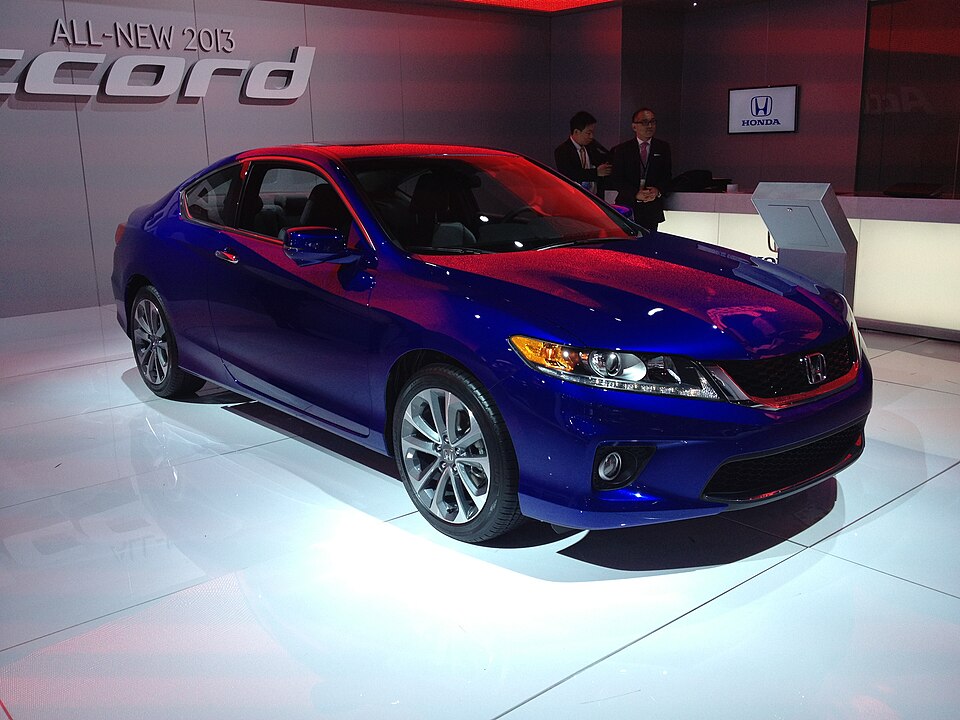
2013 Honda Accord
Photo: 2013 Honda Accord by Sarah Larson from Ann Arbor, MI, USA, CC BY 2.0, via Wikimedia Commons
How the 2013 compares
Fewest complaintsMost complaints

Highest complaint count among 27 Accord model years — 4th most.

5recalls
1,427complaints
67crashes
9fires
59injuries
45,000median miles

Owner complaints filed with NHTSA, not verified and not adjusted for sales. Ranking compares this model's own years only.

Does your car have an open recall?
Recalls apply to specific vehicles. Only a VIN lookup on NHTSA's official site shows whether yours is affected and still unrepaired.
Check your VIN →

5 recalls

Power Train

Jun 19, 2025 · NHTSA campaign 25V422000 · 72,256 vehicles

Problem: Honda (American Honda Motor Co.) is recalling certain 2013 Honda Accord vehicles equipped with a 4-cylinder engine and a continuously-variable transmission. The affected vehicles were originally sold, or ever registered, in Connecticut, Delaware, District of Columbia, Illinois, Indiana, Iowa, Kentucky, Maine, Maryland, Massachusetts, Michigan, Minnesota, Missouri, New Hampshire, New Jersey, New York, Ohio, Pennsylvania, Rhode Island, Vermont, Virginia, West Virginia, and Wisconsin. The driveshaft may corrode and break, due to damage from road salt or other contaminants.

Risk: A broken driveshaft can result in a loss of drive power, or a vehicle rollaway when the vehicle is in park without the parking brake applied. Both scenarios can increase the risk of a crash or injury.

Remedy

Dealers will inspect and replace the driveshaft assemblies as necessary, free of charge. Owner notification letters were mailed August 11, 2025. Owners may contact Honda's customer service at 1-888-234-2138. Honda's number for this recall is OM2. This recall expands previous recall number 20V769.

Fuel System

Dec 18, 2023 · NHTSA campaign 23V858000 · 2,490,460 vehicles

Problem: Honda (American Honda Motor Co.) is recalling certain 2013-2023 Honda Accord, Civic Coupe, Civic Sedan, Civic Hatchback, Civic Type R, CR-V, HR-V, Ridgeline, Odyssey, Acura ILX, MDX, MDX Hybrid, RDX, RLX, TLX, 2019-2022 Honda Insight, Passport, 2020 Honda CR-V Hybrid, 2018-2019 Honda Clarity PHEV, Fit, and 2015-2020 Honda Accord Hybrid, Pilot, Acura NSX vehicles. The fuel pump inside the fuel tank may fail.

Risk: Fuel pump failure can cause an engine stall while driving, increasing the risk of a crash.

Remedy & notes

Dealers will replace the fuel pump module, free of charge. Owner letters were mailed September 6, 2024. Owners may contact Honda customer service at 1-888-234-2138. Honda's numbers for this recall are KGC and KGD. This recall is an expansion of NHTSA recall numbers 21V-215 and 20V-314.

Owners may also contact the National Highway Traffic Safety Administration Vehicle Safety Hotline at 1-888-327-4236 (TTY 1-800-424-9153), or go to www.nhtsa.gov.

Power Train

Dec 10, 2020 · NHTSA campaign 20V769000 · 235,034 vehicles

Problem: Honda (American Honda Motor Co.) is recalling certain 2013-2015 Accord vehicles equipped with a 4-cylinder engine and a continuously-variable transmission that were originally sold, or ever registered, in Connecticut, Delaware, District of Columbia, Illinois, Indiana, Iowa, Kentucky, Maine, Maryland, Massachusetts, Michigan, Minnesota, Missouri, New Hampshire, New Jersey, New York, Ohio, Pennsylvania, Rhode Island, Vermont, Virginia, West Virginia, and Wisconsin. The drive shafts were assembled with a lubricant that may have degraded the drive shafts' protective coating, making it more susceptible to damage from road salt or other contaminants, and potentially cause it to break.

Risk: A broken drive shaft may cause a sudden loss of drive power. The vehicle could also roll away if the parking brake has not been applied before the vehicle has been exited. Either condition can increase the risk of a crash or injury.

Remedy & notes

Honda will notify owners, and dealers will inspect the drive shafts, replacing both the left and right drive shafts, if necessary, free of charge. The recall began February 4, 2021. Owners may contact Honda customer service at 1-888-234-2138.

Owners may also contact the National Highway Traffic Safety Administration Vehicle Safety Hotline at 1-888-327-4236 (TTY 1-800-424-9153), or go to www.safercar.gov.

Electrical System

Jun 29, 2017 · NHTSA campaign 17V418000 · 1,148,550 vehicles

Problem: Honda (American Honda Motor Co.) is recalling certain 2013-2016 Honda Accord vehicles. The case for the battery sensor, part of the battery management system, may allow water to get in, potentially causing an electrical short.

Risk: An electrical short increases the risk of a fire.

Remedy & notes

Honda will notify owners, and dealers will replace the sensor, free of charge. Dealers will perform an interim remedy of applying adhesive to the case to prevent water intrusion. The recall began November 8, 2017. Owners may contact American Honda Customer Support Center at 1-888-234-2138. Honda's number for this recall is KG0.

Owners may also contact the National Highway Traffic Safety Administration Vehicle Safety Hotline at 1-888-327-4236 (TTY 1-800-424-9153), or go to www.safercar.gov.

Fuel System

Jul 8, 2013 · NHTSA campaign 13V297000 · 1,659 vehicles

Problem: American Honda Motor Co., Inc. (Honda) is recalling certain model year 2013 Accord vehicles that are Low-Emission Vehicle (LEV) II rated that were manufactured January 15, 2013, through April 5, 2013. The fuel tank neck may be out of specification causing the fuel pump to not properly seal to the fuel tank.

Risk: An insufficent seal may led to a fuel leak which increases the risk of a fire.

Remedy & notes

Honda will notify owners, and dealers will replace the fuel tank, nut and O-ring gasket free of charge. The recall began during August 2013. Honda's recall number is JA9. Owners may contact Honda at 1-310-783-2000.

Owners may also contact the National Highway Traffic Safety Administration's Vehicle Safety Hotline at 1-888-327-4236 (TTY: 1-800-424-9153), or go to www.safercar.gov.

Recall text as published by NHTSA and the manufacturer.

What owners complain about

Owner complaints filed with NHTSA; one complaint can name several areas. Not verified by NHTSA.

Complaints by year filed

2012: 7 complaints20122013: 124 complaints2014: 107 complaints20142015: 125 complaints2016: 100 complaints20162017: 133 complaints2018: 135 complaints20182019: 97 complaints2020: 87 complaints20202021: 154 complaints1542022: 75 complaints20222023: 88 complaints2024: 87 complaints20242025: 70 complaints2026: 38 complaints202638

NHTSA investigations

Desiccated Air Bag Inflator Rupture

EA21002 · opened Sep 17, 2021 · open
Summary

From 2000 through 2017, Takata produced millions of air bag inflators using two types of phase-stabilized ammonium nitrate ("PSAN") propellant -- propellant 2004 and propellant 2004L. After prolonged exposure to high temperature cycles and humidity, inflators using propellant 2004 can degrade, causing the propellant to burn too quickly when ignited. The rapid burning can cause the inflator to rupture during deployment, potentially causing serious or even fatal injury to vehicle occupants. See 2016 Blomquist Report at www.nhtsa.gov/sites/nhtsa.gov/files/documents/expert_report-hrblomquist.pdf.Consequently, all frontal inflators using propellant 2004 that do not contain a "desiccant" (a substance that traps and holds moisture) in US vehicles are under recall. These "non-desiccated" inflators either have been or are required to be replaced.In some cases, the remedy part for these recalled inflators was, or will be, an inflator using either propellant 2004 or 2004L that does contain a desiccant. None of these "desiccated" remedy parts (which were installed in older model year vehicles) are currently under recall for a degradation concern. Certain subsets of desiccated PSAN inflators using propellant 2004 for use as original equipment, however, have been recalled for a degradation concern. All Takata inflators produced with propellant 2004L contain desiccant, and none of these desiccated inflators using propellant 2004L are under recall for a degradation concern. There have been n…

Loss of Direction Control

EA21001 · opened May 6, 2021 · closed Aug 25, 2023
Summary

On May 6, 2021, the Office of Defects Investigation (ODI) opened Engineering Analysis (EA21-001) to assess a sudden loss of steering control, in Model Year (MY) 2013-2015 Honda Accord vehicles. Consumers alleged while driving the steering wheel would pull to the left or the right independently. Steering pull may pose a risk of loss of directional control. Honda stated that they believed the inadvertent steering input was caused by a loose magnet located within the electronic power steering (EPS) system. Due to poor formulation of the adhesive, this magnet can become loose and move up to 2 degrees around the steering column. When the magnet moves, the torque sensor generates a signal that results in unwanted steering in either direction. Honda stated the steering force required to maintain directional control with a loose magnet is a maximum of 3-pound feet. The maximum force of the unwanted steering input can be overcome by the driver and is similar to driving on grooved pavement.The Vehicle Research Test Center (VRTC) sent over 4,000 questionnaires to 2013-2015 Honda Accord vehicle owners. Of the 637 responses, 58 consumers experienced unwanted steering. Consumers experiencing unwanted steering did not report difficulties maintaining directional control. There were no crashes or injuries reported to VRTC. Testing done by VRTC was not able to reproduce the allegations. Analysis of all relevant data indicates that the subject condition has a relatively low failure rate. The po…

Loss of Direction Control

DP20005 · opened Nov 23, 2020 · closed May 7, 2021
Summary

The Office of Defects Investigation (ODI) received a petition dated October 19, 2020 requesting an investigation of an alleged defect in the steering system in Model Year (MY) 2013 Honda Accord vehicles. The petitioner alleges that MY2013 Honda accord vehicles are experiencing a sudden loss of steering control as the vehicle veers from its intended path of travel. The petitioner further alleges that this deviation from the intended path of travel occurs without warning or driver input while operating the vehicle under normal driving conditions. The petition itself can be reviewed at NHTSA.gov under ODI Number 11349961.On November 23, 2020, ODI opened a Defect Petition (DP20-005) to evaluate whether to grant or deny the petition. ODI sent two Information Request (IR) letters to Honda requesting information on steering anomalies in MY2013 Honda Accord vehicles and later MY2014-2015 Honda Accord vehicles.ODI performed extensive analysis on the information obtained from Honda as well as information in NHTSA's database.Based on ODI's review of the applicable materials, including responses to the IR letters sent to Honda, Vehicle Owner Questionnaires (VOQ) and Early Warning Reporting data, NHTSA has decided to grant the petition. ODI has opened an Engineering Analysis (EA21-001) to assess the scope, frequency and potential safety related consequences of the alleged defect, a sudden loss of steering control.The ODI complaints cited above can be viewed at www.NHTSA.gov under the foll…

Electrical overstress

EA19001 · opened Apr 19, 2019 · closed Sep 19, 2024 · led to recall 20V024
Summary

The Office of Defects Investigation (ODI) opened this investigation to determine if the failure of airbags to deploy during severe crashes, in certain vehicles, was the result of a safety related defect.  During the investigation a complex failure was studied that can result in non-deployment of subject vehicle air bags and other restraint system devices in severe crash events. The subject vehicles may be equipped with an airbag control unit (ACU) for the supplemental restraint system (SRS) Electronic Control Unit (ECU) manufactured by ZF-TRW.  The ECU receives signals from crash sensors mounted in the vehicle and deploys the vehicle air bags and seat belt pretensioners in accordance with manufacturer design specifications.  The ECU in the subject vehicles contains a model DS84 application-specific integrated circuit (ASIC) which controls the communication of the crash sensor signal, firing commands (i.e., when to deploy the airbag(s) and/or pretensioners), and fault information (e.g., diagnostic trouble codes). In September 2016, FCA announced recall 16V-668 for certain model year (MY) 2010 to 2014 Chrysler, Dodge and Jeep products manufactured with the subject ZF-TRW ACU.  In this recall, FCA discussed an EOS condition that resulted in a failure of the subject DS84 ASIC, which caused air bag non-deployment.  FCA noted that the defect condition had only been observed in vehicles equipped with sensor harnessing routed across the front of the vehicle.  Other FCA vehicles…

Electric Power Steering Failure

PE14033 · opened Nov 4, 2014 · closed Oct 6, 2015
Summary

The Office of Defects Investigation (ODI) opened PE14-033 to investigate 24 complaints alleging loss of power steering while driving in model year (MY) 2013 Honda Accord vehicles equipped with electric power steering (EPS).Analysis of service data for the original 24 complaints and 33 additional complaints received after PE14-033 was opened found that 85 percent of the vehicles with diagnostic trouble codes available to identify the faulty component had a code indicating torque sensor failure (DTC 53).In its response to ODI's information request letter for PE14-033, Honda identified two manufacturing process conditions that may have affected the quality of some early production torque sensors.Analysis of warranty returns and manufacturing processes determined that a relatively small number of torque sensors were potentially affected by the conditions, which were corrected by the supplier (Bourns) relatively early in production.Analysis of warranty data indicates that both conditions were early-life failure concerns and most of the affected sensors have already failed, resulting in a cumulative failure rate of less than 0.2 percent.Of the 20 VOQ's that appear to be related to torque sensor failure, 6 reported failure dates in 2013, 12 in 2014, and just 2 to date in 2015.ODI's analysis identified 2 minor crashes with no injuries that may have been related to torque sensor failure in the subject vehicles.This investigation is closed because the low failure rate and a declining t…

2013 vs. other Honda Accord years

Owner complaints by model year; the darker bar is the 2013. Click a bar to switch year.

Questions

Does the 2013 Honda Accord have recalls?

Yes — NHTSA lists 5 recall campaigns covering the 2013 Honda Accord, the latest from Jun 19, 2025 (power train). A recall applies to specific vehicles: enter your VIN at nhtsa.gov/recalls to see whether yours is affected and still open.

What are the most common problems with the 2013 Honda Accord?

Owner complaints filed with NHTSA most often mention steering (499), electrical system (417), engine (186). Complaints are consumer reports and are not verified by NHTSA.