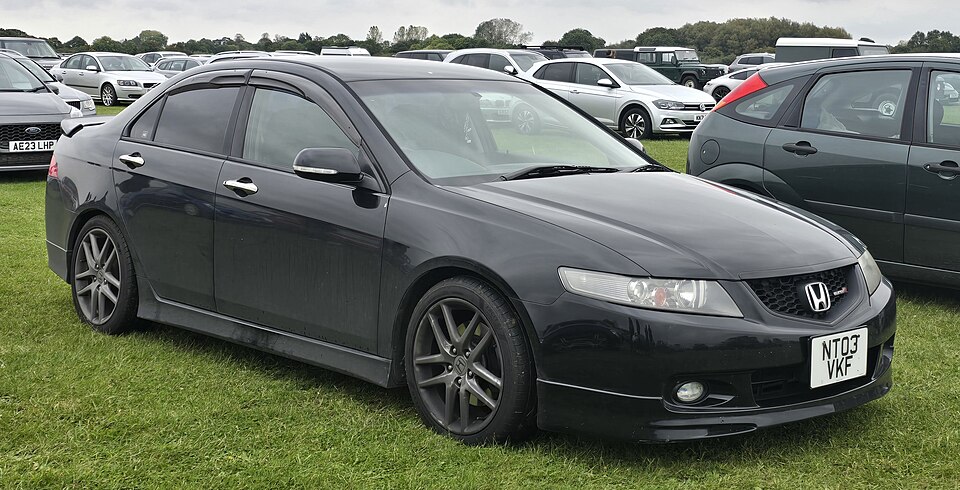
2003 Honda Accord recalls and problems

The 2003 Honda Accord has 13 recalls and 1,987 owner complaints on file with NHTSA; the most reported problem area is power train.

2003 Honda Accord
Photo: 2003 Honda Accord by Calreyn88, CC BY-SA 4.0, via Wikimedia Commons
How the 2003 compares
Fewest complaintsMost complaints

Highest complaint count among 27 Accord model years — the most of any year.

13recalls
1,987complaints
153crashes
18fires
149injuries
88,000median miles

Owner complaints filed with NHTSA, not verified and not adjusted for sales. Ranking compares this model's own years only.

Does your car have an open recall?
Recalls apply to specific vehicles. Only a VIN lookup on NHTSA's official site shows whether yours is affected and still unrepaired.
Check your VIN →

13 recalls

Air Bags

Jun 27, 2019 · NHTSA campaign 19V501000 · 1,657,752 vehicles

Problem: Honda (American Honda Motor Co.) is recalling certain 2003-2006 Acura MDX, 2005-2012 RL, 2003-2007 Honda Accord, 2001-2005 Civic, 2003-2005 Civic Hybrid, 2001-2005 Civic GX NGV, 2002-2006 CR-V, 2003-2011 Element, 2007-2008 Fit, 2002-2004 Odyssey, 2003-2008 Pilot, and 2006-2014 Ridgeline vehicles. The vehicles are equipped with passenger frontal air bag inflators assembled as a recall remedy part or replacement service part, that may explode due to propellant degradation occurring after long-term exposure to high absolute humidity, temperature and temperature cycling.

Risk: An inflator explosion may result in sharp metal fragments striking the driver or other occupants resulting in serious injury or death.

Remedy & notes

Honda will notify owners, and dealers will replace the passenger frontal airbag inflator, free of charge. The recall began August 12, 2019. Owners may contact Honda customer service at 1-888-234-2138. Honda's numbers for this recall are E5D and X5C.

Owners may also contact the National Highway Traffic Safety Administration Vehicle Safety Hotline at 1-888-327-4236 (TTY 1-800-424-9153), or go to www.safercar.gov.

Air Bags

Jun 27, 2019 · NHTSA campaign 19V499000 · 3,947 vehicles

Problem: Honda (American Honda Motor Co.) is recalling certain 2003 Acura 3.2CL, 2002-2003 3.2TL, 2003-2006 MDX, 2001-2007 Honda Accord, 2001-2005 Civic, 2003-2005 Civic Hybrid, 2001-2005 Civic GX NGV, 2002-2006 CR-V, 2003-2011 Element, 2002-2004 Odyssey, 2003-2008 Pilot and 2006 Ridgeline vehicles. These vehicles are equipped with driver frontal air bag inflators assembled as a recall remedy part or replacement service part, that may explode due to propellant degradation occurring after long-term exposure to high absolute humidity, temperature and temperature cycling.

Risk: An inflator explosion may result in sharp metal fragments striking the driver or other occupants resulting in serious injury or death.

Remedy & notes

Honda will notify owners, and dealers will replace the driver frontal air bag inflator, free of charge. The recall began August 12, 2019. Owners may contact Honda customer service at 1-888-234-2138. Honda's numbers for this recall are Q5A and Y58.

Owners may also contact the National Highway Traffic Safety Administration Vehicle Safety Hotline at 1-888-327-4236 (TTY 1-800-424-9153), or go to www.safercar.gov.

Air Bags

Mar 6, 2019 · NHTSA campaign 19V182000 · 1,101,534 vehicles

Problem: Honda (American Honda Motor Co.) is recalling specific 2003 Acura 3.2CL, 2013-2016 ILX, 2013-2014 ILX Hybrid, 2003-2006 MDX, 2007-2016 RDX, 2002-2003 3.2TL, 2004-2006, and 2009-2014 TL, 2010-2013 ZDX and 2001-2007 and 2009 Honda Accord, 2001-2005 Civic, 2003-2005 Civic Hybrid, 2001-2005 Civic GX NGV, 2002-2007 and 2010-2011 CR-V, 2003-2011 Element, 2007 Fit, 2002-2004 Odyssey, 2003-2008 Pilot, and 2006-2014 Ridgeline vehicles. The affected vehicles received a replacement driver air bag inflator as part of a previous Takata inflator recall remedy or a replacement driver air bag module containing the same inflator type as a service part. Due to a manufacturing error, in the event of a crash necessitating deployment of the driver frontal air bag, these inflators may explode.

Risk: An explosion of an inflator within the driver frontal air bag module may result in sharp metal fragments striking the driver, front seat passenger or other occupants resulting in serious injury or death.

Remedy & notes

Honda will notify owners, and dealers will replace the driver's air bag inflator with an alternate inflator, free of charge. The recall began April 10, 2019. Honda owners may contact customer service at 1-888-234-2138. Honda's number for this recall is O41. Acura owners may contact customer service at 1-888-234-2138. Acura's number for this recall is U40.

Owners may also contact the National Highway Traffic Safety Administration Vehicle Safety Hotline at 1-888-327-4236 (TTY 1-800-424-9153), or go to www.safercar.gov.

Air Bags

Apr 26, 2018 · NHTSA campaign 18V268000 · 1,335 vehicles

Problem: Honda (American Honda Motor Co.) is recalling certain 2003-2012 Honda Accord and Pilot, 2010 Accord Crosstour, 2001-2011 Civic, 2002-2011 CR-V, 2003-2004, 2006-2008 and 2011 Element, 2007 and 2009-2013 Fit, 2010-2012 Insight, 2002-2004 Odyssey, and 2012 Ridgeline vehicles. The front passenger air bag may have been installed incorrectly during replacement.

Risk: An incorrectly installed air bag may deploy improperly in the event of a crash, increasing the risk of injury.

Remedy & notes

Honda will notify owners, and dealers will inspect and, if necessary, replace the passenger frontal air bag module assembly, free of charge. The recall began June 22, 2018. Owners may contact Honda customer service at 1-888-234-2138. Honda's numbers for this recall are K1P, and M1O.

Owners may also contact the National Highway Traffic Safety Administration Vehicle Safety Hotline at 1-888-327-4236 (TTY 1-800-424-9153), or go to www.safercar.gov.

Air Bags

Mar 30, 2017 · NHTSA campaign 17V220000 · 37,421 vehicles

Problem: Honda (American Honda Motor Co.) is recalling certain 2003 Honda Accord Coupe vehicles, equipped with a four-cylinder engine. If the passenger frontal air bag module has been replaced, such as after a crash necessitating frontal air bag deployment, the replacement air bag module may include a Takata air bag inflator. These inflators may rupture due to propellant degradation occurring after long-term exposure to lower absolute humidity, temperature and temperature cycling.

Risk: An inflator rupture may result in metal fragments striking the driver or other occupants resulting in serious injury or death.

Remedy & notes

Honda will notify owners, and dealers will inspect the vehicle and replace any Takata inflator used in the passenger frontal air bag module, free of charge. The recall is expected to begin May 1, 2017. Owners may contact Honda customer service at 1-888-234-2138. Honda's number for this recall is KF0.

Owners may also contact the National Highway Traffic Safety Administration Vehicle Safety Hotline at 1-888-327-4236 (TTY 1-800-424-9153), or go to www.safercar.gov.

Air Bags

Jun 15, 2015 · NHTSA campaign 15V370000 · 3,498,481 vehicles

Problem: Honda (American Honda Motor Co.) is recalling certain model year 2001-2005 Honda Civic vehicles manufactured March 21, 2000, to January 20, 2005, 2001-2004 Honda Civic GX vehicles manufactured June 14, 2000, to August 19, 2004, 2003-2005 Honda Civic Hybrid vehicles manufactured February 24, 2002, to January 18, 2005, 2003-2007 Honda Accord vehicles manufactured February 21, 2002, to August 28, 2007, 2002-2004 Honda CR-V vehicles, 2002-2003 Honda Odyssey vehicles manufactured June 19, 2001, to July 12, 2003, 2003 Acura MDX vehicles manufactured September 19, 2002, to June 19, 2003, 2003 Honda Element vehicles manufactured June 25, 2002, to July 31, 2003, and 2003 Honda Pilot vehicles manufactured November 26, 2001, to August 21, 2003. The affected vehicles have a passenger side frontal air bag that may be susceptible to moisture intrusion which, over time, could cause the inflator to rupture upon its deployment.

Risk: In the event of a crash necessitating deployment of the passenger's frontal air bag, the inflator could rupture with metal fragments striking the passenger seat occupant or other occupants possibly causing serious injury or death.

Remedy & notes

Honda will notify owners, and dealers will replace the passenger air bag inflator, free of charge. The recall began on July 1, 2015. Owners may contact Honda customer service at 1-888-234-2138. Honda's numbers for this recall are JU4, JU5, JU6, and JU7. Note: Vehicles that have already received a replacement passenger air bag inflator as part of the recall remedy for an earlier campaign such as 14V353 or 14V700 (Honda recall numbers S95, JH6, JH7, JH8, JH9, JJ0, JJ1, JJ2, JJ6, JM5 and JM6) are not included in this recall. However, this recall does supersede 13V132 and 14V349. Note: On December 18, 2015 Honda informed NHTSA of an expansion of this recall to include certain model year 2004 Honda CR-V vehicles in addition to additional model year 2003 CR-V vehicles.

Owners may also contact the National Highway Traffic Safety Administration Vehicle Safety Hotline at 1-888-327-4236 (TTY 1-800-424-9153), or go to www.safercar.gov.

Air Bags

May 28, 2015 · NHTSA campaign 15V320000 · 6,281,043 vehicles

Problem: Honda (American Honda Motor Co.) is recalling certain model year 2001-2007 Accord, 2001-2005 Civic, 2001-2004 Honda Civic GX, 2003-2005 Honda Civic Hybrid, 2002-2006 CR-V, 2003-2011 Element, 2002-2004 Odyssey, 2003-2008 Pilot, 2006 Ridgeline, 2003 Acura 3.2CL, 2003-2006 Acura MDX, and 2002-2003 Acura 3.2TL vehicles. The affected vehicles are equipped with a dual-stage driver frontal air bag that may be susceptible to moisture intrusion and other factors, including manufacturing variability that, over time, could cause the inflator to rupture.

Risk: In the event of a crash necessitating deployment of the driver's frontal air bag, the inflator could rupture with metal fragments striking the driver or other occupants resulting in serious injury or death.

Remedy & notes

Honda will notify owners, and dealers will replace the driver frontal air bag inflator, free of charge. The recall began on July 1, 2015. Owners may contact Honda customer service at 1-888-234-2138. Owners may contact Acura customer service at 1-800-382-2238, select option 4. Note: Vehicles that have had their driver frontal air bag replaced previously as part of a recall remedy prior to September 12, 2014 need to have their air bag replaced under this recall as well. Vehicles that, on or after September 12, 2014, received a remedy for a prior driver frontal air bag inflator recall already received an inflator of a different design, and therefore are not included in this recall and do not require additional servicing. Note: This recall fully supersedes recalls 08V-593, 09V-259, 10V-041, 11V-260, 14V-351 and 15V-153. Honda's numbers for this recall are JQ9, JR0, JR1, JR2, JR3, JR4, JR5, JR6, JR7, and JR8.

Owners may also contact the National Highway Traffic Safety Administration Vehicle Safety Hotline at 1-888-327-4236 (TTY 1-800-424-9153), or go to www.safercar.gov.

Air Bags

Nov 4, 2014 · NHTSA campaign 14V700000

Problem: American Honda Motor Co. (Honda) is recalling certain model year 2001-2005 Honda Civic, 2003-2004 Civic CNG and Element, 2002-2005 CR-V, 2002-2004 Odyssey, 2003-2005 Accord, Pilot, Civic Hybrid, and Acura MDX, 2005 Acura RL and 2006 Honda Ridgeline vehicles originally sold, or ever registered, in geographic locations associated with high absolute humidity. Specifically, vehicles sold, or ever registered, in Alabama, Florida, Georgia, Hawaii, Louisiana, Mississippi, South Carolina, Texas, Puerto Rico, U.S. Virgin Islands, Saipan, Guam, and American Samoa are addressed by this recall. Upon deployment of the passenger side frontal air bag, excessive internal pressure may cause the inflator to rupture.

Risk: In the event of a crash necessitating deployment of the passenger’s frontal air bag, the inflator could rupture with metal fragments striking the vehicle occupants potentially resulting in serious injury or death.

Remedy & notes

Honda will notify owners, and dealers will replace the passenger side air bag inflator, free of charge. The recall began January 26, 2015. Owners may contact Honda customer service at 1-800-999-1009.

Owners may also contact the National Highway Traffic Safety Administration Vehicle Safety Hotline at 1-888-327-4236 (TTY 1-800-424-9153), or go to www.safercar.gov.Note: This recall supersedes safety recall 14V-353, with the exception of vehicles originally sold, or ever registered, in California.Those vehicles will continue to be addressed, and a free remedy provided, under that safety recall campaign.This recall also includes vehicles in the specific geographic areas listed above that were included within safety recalls 13V-132 and 14V-349.

Air Bags

Jun 20, 2014 · NHTSA campaign 14V353000 · 133,207 vehicles

Problem: American Honda Motor Company, Inc.'s (Honda) is conducting a limited regional recall for certain model year 2003-2005 Accord, Civic, CR-V, Pilot and Acura MDX, model year 2003-2004 Odyssey and Element, and model year 2005 Acura RL, and 2006 Honda Ridgeline vehicles originally sold, or ever registered in California, and equipped with Takata-brand air bag inflators. Upon deployment of the passenger side frontal air bag, excessive internal pressure may cause the inflator to rupture.

Risk: In the event of a crash necessitating deployment of the passenger’s frontal air bag, the inflator could rupture with metal fragments striking the vehicle occupants potentially resulting in serious injury or death.

Remedy & notes

Honda will notify owners, and dealers will replace the inflators in all affected vehicles, free of charge. The recall is expected to begin during August 2014. Owners may contact Honda customer service at 1-800-999-1009.

Owners may also contact the National Highway Traffic Safety Administration Vehicle Safety Hotline at 1-888-327-4236 (TTY 1-800-424-9153), or go to www.safercar.gov.

Steering

May 17, 2012 · NHTSA campaign 12V222000 · 625,762 vehicles

Problem: Honda is recalling certain model year 2007 and 2008 Acura TL and model year 2003-2007 Accord V6 vehicles. In May 2012, Honda filed a defect report to recall certain model year 2007 and 2008 Acura TL vehicles. In September 2012, Honda informed the agency that it was including an additional 573,147 vehicles including certain model year 2003 through 2007 Accord V6 vehicles. The total number of vehicles being recalled is now 625,762. Prolonged under-hood and power steering fluid temperatures may cause the power steering hose to deteriorate prematurely, resulting in cracks and power steering fluid leakage.

Risk: If this occurs, power steering fluid can leak onto a hot catalytic converter, leading to smoke and possibly an under-hood fire.

Remedy & notes

Honda will notify owners, and dealers will install a new heat resistant power steering hose, free of charge. The original recall began in June 2012, and owners of those vehicles may obtain the free remedy. Sufficient parts are not yet available for owners of the vehicles covered by the September 2012 expansion, but are expected to be available in early 2013. Honda will notify owners of these vehicles beginning on October 26, 2012, and will notify these owners again when parts are available so those vehicles can be brought to dealers for applications of the free remedy. Owners may contact Honda customer service at 1-800-999-1009.

Honda's recall campaign number for the original recall is S39.Honda's recall numbers for the additional vehicles are S59 (Inspection) and S60 (Remedy).Owners may also contact the National Highway Traffic Safety Administration Vehicle Safety Hotline at 1-888-327-4236 (TTY 1-800-424-9153), or go to www.safercar.gov.

Electrical System

Aug 5, 2010 · NHTSA campaign 10V364000 · 551,498 vehicles

Problem: Honda is recalling certain model year 2003 Honda accord, civic two and four door, and model year 2003-2004 Honda element vehicles. The interlock lever of the ignition switch May unexpectedly deform, which can allow the interlock function of a vehicle with an automatic transmission to be defeated.

Original NHTSA wording

HONDA IS RECALLING CERTAIN MODEL YEAR 2003 HONDA ACCORD, CIVIC TWO AND FOUR DOOR, AND MODEL YEAR 2003-2004 HONDA ELEMENT VEHICLES. THE INTERLOCK LEVER OF THE IGNITION SWITCH MAY UNEXPECTEDLY DEFORM, WHICH CAN ALLOW THE INTERLOCK FUNCTION OF A VEHICLE WITH AN AUTOMATIC TRANSMISSION TO BE DEFEATED.

Risk: Removal of the ignition key when the gear selector of a vehicle with an automatic transmission has not been shifted to the park position can allow the vehicle to roll away, increasing the risk of a crash.

Original NHTSA wording

REMOVAL OF THE IGNITION KEY WHEN THE GEAR SELECTOR OF A VEHICLE WITH AN AUTOMATIC TRANSMISSION HAS NOT BEEN SHIFTED TO THE PARK POSITION CAN ALLOW THE VEHICLE TO ROLL AWAY, INCREASING THE RISK OF A CRASH.

Remedy & notes

Dealers will remove the original interlock pin and lever within the ignition switch, and replace them with new, designed components. This service will be performed free of charge. The safety recall began on October 7, 2010. Owners May contact Honda at 1-800-999-1009.

Honda safety recall no. R44.owners May also contact the national highway traffic safety administration's vehicle safety hotline at 1-888-327-4236 (tty 1-800-424-9153), or go to <a href=http://www.safercar.gov>http://www.safercar.gov</a> .

Visibility

Apr 11, 2008 · NHTSA campaign 08V169000 · 351,000 vehicles

Problem: Honda is recalling 351,000 my 2003 accord vehicles. If water enters the windshield wiper motor breather port, which is designed to allow the motor to vent warm air during normal operation, it can result in corrosion inside the motor housing. This can cause a failure of the electrical circuit breaker inside the motor housing.

Original NHTSA wording

HONDA IS RECALLING 351,000 MY 2003 ACCORD VEHICLES. IF WATER ENTERS THE WINDSHIELD WIPER MOTOR BREATHER PORT, WHICH IS DESIGNED TO ALLOW THE MOTOR TO VENT WARM AIR DURING NORMAL OPERATION, IT CAN RESULT IN CORROSION INSIDE THE MOTOR HOUSING. THIS CAN CAUSE A FAILURE OF THE ELECTRICAL CIRCUIT BREAKER INSIDE THE MOTOR HOUSING.

Risk: If the circuit breaker fails, it will cause the windshield wiper motor to become inoperative, which can increase the likelihood of a crash in certain conditions.

Original NHTSA wording

IF THE CIRCUIT BREAKER FAILS, IT WILL CAUSE THE WINDSHIELD WIPER MOTOR TO BECOME INOPERATIVE, WHICH CAN INCREASE THE LIKELIHOOD OF A CRASH IN CERTAIN CONDITIONS.

Remedy & notes

Dealers will inspect the windshield wiper motor for signs of corrosion. If no signs of corrosion are present, a cover will be installed over the wiper motor to prevent water from entering the wiper motor housing. If signs of corrosion damage are observed on the wiper motor, the motor will be replaced. The recall began on July 17, 2008. Owners May contact Honda at 1-800-999-1009.

Honda recall no. Q78.customers May contact the national highway traffic safety administration's vehicle safety hotline at 1-888-327-4236 (tty: 1-800-424-9153); or go to http://www.safercar.gov.

Power Train

Apr 15, 2004 · NHTSA campaign 04V176000 · 1,099,796 vehicles

Problem: On some MINI vans, sport utility and passenger vehicles, certain operating conditions can result in heat build-up between the countershaft and secondary shaft second gears in the automatic transmission, eventually leading to gear tooth chipping or gear breakage.

Original NHTSA wording

ON SOME MINI VANS, SPORT UTILITY AND PASSENGER VEHICLES, CERTAIN OPERATING CONDITIONS CAN RESULT IN HEAT BUILD-UP BETWEEN THE COUNTERSHAFT AND SECONDARY SHAFT SECOND GEARS IN THE AUTOMATIC TRANSMISSION, EVENTUALLY LEADING TO GEAR TOOTH CHIPPING OR GEAR BREAKAGE.

Risk: Gear failure could result in transmission lockup, which could result in a crash.

Original NHTSA wording

GEAR FAILURE COULD RESULT IN TRANSMISSION LOCKUP, WHICH COULD RESULT IN A CRASH.

Remedy & notes

On vehicles with 15,000 miles or less, the dealer will update the transmission with a simple revision to the oil cooler return line to increase lubrication to the second gear. On vehicles with more than 15,000 miles, the dealer will inspect the transmission to identify gears that have already experienced discoloration due to overheating. If discoloration exists, the transmission will be replaced if discoloration is not present, the dealer will perform the revision to the oil cooler return line. The recall began on April 21, 2004, for pilot, odyssey, and mdx owners. Owners of the accord vehicles will start receiving letters on June 28, 2004, and on June 29, 2004, for owners of the tl and cl vehicles. Owners should contact Honda at 1-800-999-1009 or Acura at 1-800-382-2238.

Honda recall nos. P30 (odyssey and pilot),P31 (mdx), P38 (accord) and P39 (Acura).customers can also contact the national highway traffic safety administration's auto safety hotline at 1-888-DASH-2-DOT (1-888-327-4236).

Recall text as published by NHTSA and the manufacturer.

What owners complain about

Owner complaints filed with NHTSA; one complaint can name several areas. Not verified by NHTSA.

Complaints by year filed

2002: 2 complaints20022003: 182 complaints2004: 175 complaints2005: 62 complaints20052006: 66 complaints2007: 56 complaints2008: 134 complaints20082009: 176 complaints2010: 272 complaints2722011: 209 complaints20112012: 126 complaints2013: 106 complaints2014: 95 complaints20142015: 109 complaints2016: 46 complaints2017: 45 complaints20172018: 32 complaints2019: 38 complaints2020: 14 complaints20202021: 11 complaints2022: 7 complaints2023: 12 complaints20232024: 3 complaints2025: 5 complaints2026: 4 complaints20264

NHTSA investigations

Desiccated Air Bag Inflator Rupture

EA21002 · opened Sep 17, 2021 · open
Summary

From 2000 through 2017, Takata produced millions of air bag inflators using two types of phase-stabilized ammonium nitrate ("PSAN") propellant -- propellant 2004 and propellant 2004L. After prolonged exposure to high temperature cycles and humidity, inflators using propellant 2004 can degrade, causing the propellant to burn too quickly when ignited. The rapid burning can cause the inflator to rupture during deployment, potentially causing serious or even fatal injury to vehicle occupants. See 2016 Blomquist Report at www.nhtsa.gov/sites/nhtsa.gov/files/documents/expert_report-hrblomquist.pdf.Consequently, all frontal inflators using propellant 2004 that do not contain a "desiccant" (a substance that traps and holds moisture) in US vehicles are under recall. These "non-desiccated" inflators either have been or are required to be replaced.In some cases, the remedy part for these recalled inflators was, or will be, an inflator using either propellant 2004 or 2004L that does contain a desiccant. None of these "desiccated" remedy parts (which were installed in older model year vehicles) are currently under recall for a degradation concern. Certain subsets of desiccated PSAN inflators using propellant 2004 for use as original equipment, however, have been recalled for a degradation concern. All Takata inflators produced with propellant 2004L contain desiccant, and none of these desiccated inflators using propellant 2004L are under recall for a degradation concern. There have been n…

Air Bag Inflator Rupture

EA15001 · opened Feb 24, 2015 · open · led to recall 14V668
Summary

The Office of Defects Investigation (ODI) opened PE14-016 in June 2014 based on six inflator rupture incidents involving consumer owned vehicles produced by five vehicle manufacturers.All six vehicles were operated in Florida or Puerto Rico at the time of the rupture and for the majority of their service life, and were equipped with inflators produced by Takata, a tier-one supplier of automotive air bag systems.During the course of PE14-016, ODI determined that five additional vehicle manufacturers used inflators of a similar design and vintage also supplied by Takata. No evidence of field failures was found in vehicles produced by these five additional manufacturers.Nonetheless, at ODI's insistence, all 10 vehicle manufacturers initiated a regional recall within approximately two weeks of the opening of the investigation.The regions recalled initially included Florida, Puerto Rico, Hawaii, and the U.S. Virgin Islands, areas with high absolute humidity and climatic conditions believed to be a significant factor in the inflator ruptures.As part of the recall actions, inflators removed from remedied vehicles are to be returned to Takata for testing.Takata's initial test results on passenger inflators from remedied vehicles indicated a much higher than anticipated rupture frequency for inflators returned from Florida.Accordingly ODI requested all 10 manufacturers expand the regional recalls for passenger inflators to include other geographic areas where high absolute humidity co…

Air Bag Inflator Rupture

PE14016 · opened Jun 11, 2014 · closed Mar 2, 2015 · led to recall 13V172000
Summary

The Office of Defects Investigation (ODI) opened PE14-016 in June 2014 based on six inflator rupture incidents involving consumer owned vehicles produced by five vehicle manufacturers.All six vehicles were operated in Florida or Puerto Rico at the time of the rupture and for the majority of their service life, and were equipped with inflators produced by Takata, a tier-one supplier of automotive air bag systems.During the course of PE14-016, ODI determined that five additional vehicle manufacturers used inflators of a similar design and vintage also supplied by Takata. No evidence of field failures was found in vehicles produced by these five additional manufacturers.Nonetheless, at ODI's insistence, all 10 vehicle manufacturers initiated a regional recall within approximately two weeks of the opening of the investigation.The regions recalled initially included Florida, Puerto Rico, Hawaii, and the U.S. Virgin Islands, areas with consistently high absolute humidity and climatic conditions believed to be a significant factor in the inflator ruptures.As part of the recall actions, inflators removed from remedied vehicles are to be returned to Takata for testing.Takata's initial test results on passenger inflators from remedied vehicles indicated a much higher than anticipated rupture frequency for inflators returned from Florida.Accordingly, ODI requested all 10 manufacturers expand the regional recalls for passenger inflators to include other geographic areas where high absolu…

Ignition Shift Interlock

EA09001 · opened Jan 5, 2009 · closed Oct 14, 2010 · led to recall 10V364000
Summary

On August 4, 2010, American Honda Motor Co. (Honda) submitted a Defect Information Report (DIR) to NHTSA regarding a ignition interlock defect in approximately 384,220 model year (MY) 2003 Honda Accord and Civic and MY 2003 and 2004 Honda Element vehicles with automatic transmissions (Recall 10V-364).In a September 22, 2010 supplemental DIR, Honda expanded the scope of the recall population based on manufacturing and complaint data.The total population for the complete recall is approximately 551,498 vehicles.The information listed in this closing report refers only to the subject vehicles, MY 2003 Accords with automatic transmissions.According to Honda's DIR, Under certain conditions the interlock lever of the ignition switch may unexpectedly deform, which can allow the interlock function of a vehicle with an automatic transmission to be defeated if the driver does not follow the typical shut-down procedure of shifting the gear selector to the Park position before rotating the ignition key to the off position. Removal of the ignition key when the gear selector of a vehicle with an automatic transmission has not been shifted to the Park position can allow the vehicle to roll away, increasing the risk of a crash.Honda's dealers will be instructed to inspect the ignition interlock switch and, if necessary, replace the original interlock pin and lever within the ignition switch and replace them with new, redesigned parts.This investigation is closed.

IGNITION PARK-SHIFT INTERLOCK

RQ08006 · opened Sep 8, 2008 · closed Jan 5, 2009 · led to recall 10V364000
Summary

ODI HAS RECEIVED 16 COMPLAINTS ALLEGING FAILURES OF THE IGNITION PARK-SHIFT INTERLOCK THAT ALLOWED THE IGNITION KEY TO BE REMOVED FROM THE IGNITION SWITCH WITHOUT THE TRANSMISSION BEING SHIFTED TO PARK IN MODEL YEAR (MY) 2002 AND 2003 HONDA ACCORD VEHICLES WITH AUTOMATIC TRANSMISSIONS.ELEVEN OF THE COMPLAINTS ALLEGE THAT THE FAILURE OF THE INTERLOCK RESULTED IN A ROLLAWAY CRASH.ONE OWNER ALLEGED THAT SHE WAS ALMOST INTO HER HOUSE WHEN SHE NOTICED THE CAR ROLLING OUT OF THE GARAGE AND DOWN THE DRIVEWAY AND THAT WHEN SHE TRIED TO STOP THE CAR IT ALMOST RAN OVER HER, BEFORE CRASHING INTO A CABLE BOX AT THE END OF THE DRIVEWAY.ANOTHER OWNER ALLEGED THAT THE VEHICLE ROLLED OUT OF THE DRIVEWAY AND STRUCK A TREE ACROSS THE STREET.THERE HAVE BEEN 28 COMPLAINTS MADE TO HONDA REGARDING IGNITION PARK-SHIFT INTERLOCK FAILURES IN THE SUBJECT VEHICLES, 10 OF WHICH ALLEGE ROLLAWAY CRASHES. IN OCTOBER 2003, AMERICAN HONDA MOTOR COMPANY INITIATED RECALL 03V-423 TO CORRECT AN IGNITION PARK-SHIFT INTERLOCK DEFECT IN CERTAIN MY 1999 HONDA ODYSSEY, MY 1997-99 ACURA CL, MY 1999 ACURA TL, AND MY 1998-99 HONDA ACCORD VEHICLES.IN JANUARY 2005, HONDA INITIATED ANOTHER RECALL TO ADDRESS DEFECTIVE IGNITION PARK-SHIFT INTERLOCKS (RECALL 05V-025), THIS TIME COVERING MY 1997-2001 HONDA PRELUDE, MY 1999-2000 ACURA TL, AND CERTAIN MY 1999-2002 HONDA ACCORD VEHICLES.NOT ALL MY 2002 HONDA ACCORDS WERE COVERED UNDER RECALL 05V-025.THE REMAINING MY 2002 AND ALL MY 2003 ACCORD VEHICLES ARE COVERED IN THE SCOPE OF…

2003 vs. other Honda Accord years

Owner complaints by model year; the darker bar is the 2003. Click a bar to switch year.

Questions

Does the 2003 Honda Accord have recalls?

Yes — NHTSA lists 13 recall campaigns covering the 2003 Honda Accord, the latest from Jun 27, 2019 (air bags). A recall applies to specific vehicles: enter your VIN at nhtsa.gov/recalls to see whether yours is affected and still open.

What are the most common problems with the 2003 Honda Accord?

Owner complaints filed with NHTSA most often mention power train (924), air bags (318), service brakes (170). Complaints are consumer reports and are not verified by NHTSA.