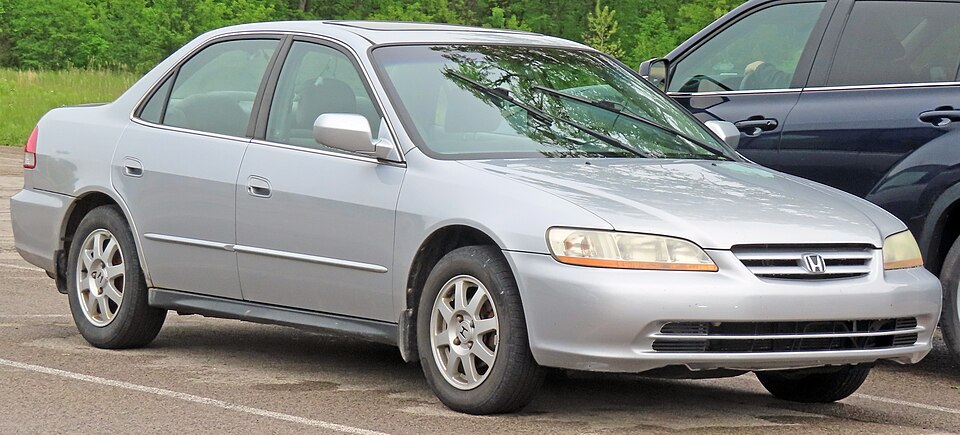
High complaint count among 27 Accord model years — 6th most.
5recalls
1,050complaints
129crashes
10fires
102injuries
88,324median miles
Owner complaints filed with NHTSA, not verified and not adjusted for sales. Ranking compares this model's own years only.
Does your car have an open recall? Recalls apply to specific vehicles. Only a VIN lookup on NHTSA's official site shows whether yours is affected and still unrepaired.
Jun 27, 2019 · NHTSA campaign 19V499000 · 3,947 vehicles
Problem: Honda (American Honda Motor Co.) is recalling certain 2003 Acura 3.2CL, 2002-2003 3.2TL, 2003-2006 MDX, 2001-2007 Honda Accord, 2001-2005 Civic, 2003-2005 Civic Hybrid, 2001-2005 Civic GX NGV, 2002-2006 CR-V, 2003-2011 Element, 2002-2004 Odyssey, 2003-2008 Pilot and 2006 Ridgeline vehicles. These vehicles are equipped with driver frontal air bag inflators assembled as a recall remedy part or replacement service part, that may explode due to propellant degradation occurring after long-term exposure to high absolute humidity, temperature and temperature cycling.
Risk: An inflator explosion may result in sharp metal fragments striking the driver or other occupants resulting in serious injury or death.
Remedy & notes
Honda will notify owners, and dealers will replace the driver frontal air bag inflator, free of charge. The recall began August 12, 2019. Owners may contact Honda customer service at 1-888-234-2138. Honda's numbers for this recall are Q5A and Y58.
Owners may also contact the National Highway Traffic Safety Administration Vehicle Safety Hotline at 1-888-327-4236 (TTY 1-800-424-9153), or go to www.safercar.gov.
Air Bags
Mar 6, 2019 · NHTSA campaign 19V182000 · 1,101,534 vehicles
Problem: Honda (American Honda Motor Co.) is recalling specific 2003 Acura 3.2CL, 2013-2016 ILX, 2013-2014 ILX Hybrid, 2003-2006 MDX, 2007-2016 RDX, 2002-2003 3.2TL, 2004-2006, and 2009-2014 TL, 2010-2013 ZDX and 2001-2007 and 2009 Honda Accord, 2001-2005 Civic, 2003-2005 Civic Hybrid, 2001-2005 Civic GX NGV, 2002-2007 and 2010-2011 CR-V, 2003-2011 Element, 2007 Fit, 2002-2004 Odyssey, 2003-2008 Pilot, and 2006-2014 Ridgeline vehicles. The affected vehicles received a replacement driver air bag inflator as part of a previous Takata inflator recall remedy or a replacement driver air bag module containing the same inflator type as a service part. Due to a manufacturing error, in the event of a crash necessitating deployment of the driver frontal air bag, these inflators may explode.
Risk: An explosion of an inflator within the driver frontal air bag module may result in sharp metal fragments striking the driver, front seat passenger or other occupants resulting in serious injury or death.
Remedy & notes
Honda will notify owners, and dealers will replace the driver's air bag inflator with an alternate inflator, free of charge. The recall began April 10, 2019. Honda owners may contact customer service at 1-888-234-2138. Honda's number for this recall is O41. Acura owners may contact customer service at 1-888-234-2138. Acura's number for this recall is U40.
Owners may also contact the National Highway Traffic Safety Administration Vehicle Safety Hotline at 1-888-327-4236 (TTY 1-800-424-9153), or go to www.safercar.gov.
Air Bags
May 28, 2015 · NHTSA campaign 15V320000 · 6,281,043 vehicles
Problem: Honda (American Honda Motor Co.) is recalling certain model year 2001-2007 Accord, 2001-2005 Civic, 2001-2004 Honda Civic GX, 2003-2005 Honda Civic Hybrid, 2002-2006 CR-V, 2003-2011 Element, 2002-2004 Odyssey, 2003-2008 Pilot, 2006 Ridgeline, 2003 Acura 3.2CL, 2003-2006 Acura MDX, and 2002-2003 Acura 3.2TL vehicles. The affected vehicles are equipped with a dual-stage driver frontal air bag that may be susceptible to moisture intrusion and other factors, including manufacturing variability that, over time, could cause the inflator to rupture.
Risk: In the event of a crash necessitating deployment of the driver's frontal air bag, the inflator could rupture with metal fragments striking the driver or other occupants resulting in serious injury or death.
Remedy & notes
Honda will notify owners, and dealers will replace the driver frontal air bag inflator, free of charge. The recall began on July 1, 2015. Owners may contact Honda customer service at 1-888-234-2138. Owners may contact Acura customer service at 1-800-382-2238, select option 4. Note: Vehicles that have had their driver frontal air bag replaced previously as part of a recall remedy prior to September 12, 2014 need to have their air bag replaced under this recall as well. Vehicles that, on or after September 12, 2014, received a remedy for a prior driver frontal air bag inflator recall already received an inflator of a different design, and therefore are not included in this recall and do not require additional servicing. Note: This recall fully supersedes recalls 08V-593, 09V-259, 10V-041, 11V-260, 14V-351 and 15V-153. Honda's numbers for this recall are JQ9, JR0, JR1, JR2, JR3, JR4, JR5, JR6, JR7, and JR8.
Owners may also contact the National Highway Traffic Safety Administration Vehicle Safety Hotline at 1-888-327-4236 (TTY 1-800-424-9153), or go to www.safercar.gov.
Electrical System
Jan 28, 2005 · NHTSA campaign 05V025000 · 486,659 vehicles
Problem: On certain passenger vehicles, the interlock operation of the ignition switch May not function properly, making it possible to turn the ignition key to the "off" position and remove the key without shifting the transmission to park.
Original NHTSA wording
ON CERTAIN PASSENGER VEHICLES, THE INTERLOCK OPERATION OF THE IGNITION SWITCH MAY NOT FUNCTION PROPERLY, MAKING IT POSSIBLE TO TURN THE IGNITION KEY TO THE "OFF" POSITION AND REMOVE THE KEY WITHOUT SHIFTING THE TRANSMISSION TO PARK.
Risk: If the driver does not shift to park before removing the key and fails to engage the parking brake, the vehicle could roll and a crash could occur.
Original NHTSA wording
IF THE DRIVER DOES NOT SHIFT TO PARK BEFORE REMOVING THE KEY AND FAILS TO ENGAGE THE PARKING BRAKE, THE VEHICLE COULD ROLL AND A CRASH COULD OCCUR.
Remedy & notes
Dealers will perform an inspection procedure that confirms interlock function. Vehicles will be updated with a redesigned interlock lever free of charge. The recall began on March 7, 2005. Owners May contact Honda at 1-800-999-1009 or Acura at 1-800-382-2238.
Honda recall nos.P68, P69.customers May also contact the national highway traffic safety administration's vehicle safety hotline at 1-888-327-4236 (tty 1-800-424-9153), or go to http://www.safercar.gov.
Engine
Aug 28, 2002 · NHTSA campaign 02V226000 · 17,551 vehicles
Problem: On certain minivans, sedans, coupes, and sport utility vehicles equipped with V6 engines, a timing belt tensioner pulley on the water pump is misaligned and could cause the timing belt to contact a bolt on the cylinder head. Eventually the belt could be damaged and fail.
Original NHTSA wording
ON CERTAIN MINIVANS, SEDANS, COUPES, AND SPORT UTILITY VEHICLES EQUIPPED WITH V6 ENGINES, A TIMING BELT TENSIONER PULLEY ON THE WATER PUMP IS MISALIGNED AND COULD CAUSE THE TIMING BELT TO CONTACT A BOLT ON THE CYLINDER HEAD. EVENTUALLY THE BELT COULD BE DAMAGED AND FAIL.
Risk: If the timing belt breaks, the engine will stall, increasing the risk of a crash.
Original NHTSA wording
IF THE TIMING BELT BREAKS, THE ENGINE WILL STALL, INCREASING THE RISK OF A CRASH.
Remedy & notes
Dealers will inspect the water pump and if it is one of the defective pumps, the water pump and timing belt will be replaced. Owner notification began August 30, 2002. Owners who take their vehicles to an authorized dealer on an agreed upon service date and do not receive the free remedy within a reasonable time should contact Honda at 1-800-999-1009 or Acura at 1-800-382-2238.
Also, customers can contact the national highway traffic safety administration's auto safety hotline at 1-888-DASH-2-DOT (1-888-327-4236).
Recall text as published by NHTSA and the manufacturer.
Owner complaints filed with NHTSA; one complaint can name several areas. Not verified by NHTSA.
Complaints by year filed
NHTSA investigations
Desiccated Air Bag Inflator Rupture
EA21002 · opened Sep 17, 2021 · open
Summary
From 2000 through 2017, Takata produced millions of air bag inflators using two types of phase-stabilized ammonium nitrate ("PSAN") propellant -- propellant 2004 and propellant 2004L. After prolonged exposure to high temperature cycles and humidity, inflators using propellant 2004 can degrade, causing the propellant to burn too quickly when ignited. The rapid burning can cause the inflator to rupture during deployment, potentially causing serious or even fatal injury to vehicle occupants. See 2016 Blomquist Report at www.nhtsa.gov/sites/nhtsa.gov/files/documents/expert_report-hrblomquist.pdf.Consequently, all frontal inflators using propellant 2004 that do not contain a "desiccant" (a substance that traps and holds moisture) in US vehicles are under recall. These "non-desiccated" inflators either have been or are required to be replaced.In some cases, the remedy part for these recalled inflators was, or will be, an inflator using either propellant 2004 or 2004L that does contain a desiccant. None of these "desiccated" remedy parts (which were installed in older model year vehicles) are currently under recall for a degradation concern. Certain subsets of desiccated PSAN inflators using propellant 2004 for use as original equipment, however, have been recalled for a degradation concern. All Takata inflators produced with propellant 2004L contain desiccant, and none of these desiccated inflators using propellant 2004L are under recall for a degradation concern. There have been n…
Air Bag Inflator Rupture
EA15001 · opened Feb 24, 2015 · open · led to recall 14V668
Summary
The Office of Defects Investigation (ODI) opened PE14-016 in June 2014 based on six inflator rupture incidents involving consumer owned vehicles produced by five vehicle manufacturers.All six vehicles were operated in Florida or Puerto Rico at the time of the rupture and for the majority of their service life, and were equipped with inflators produced by Takata, a tier-one supplier of automotive air bag systems.During the course of PE14-016, ODI determined that five additional vehicle manufacturers used inflators of a similar design and vintage also supplied by Takata. No evidence of field failures was found in vehicles produced by these five additional manufacturers.Nonetheless, at ODI's insistence, all 10 vehicle manufacturers initiated a regional recall within approximately two weeks of the opening of the investigation.The regions recalled initially included Florida, Puerto Rico, Hawaii, and the U.S. Virgin Islands, areas with high absolute humidity and climatic conditions believed to be a significant factor in the inflator ruptures.As part of the recall actions, inflators removed from remedied vehicles are to be returned to Takata for testing.Takata's initial test results on passenger inflators from remedied vehicles indicated a much higher than anticipated rupture frequency for inflators returned from Florida.Accordingly ODI requested all 10 manufacturers expand the regional recalls for passenger inflators to include other geographic areas where high absolute humidity co…
Air Bag Inflator Rupture
PE14016 · opened Jun 11, 2014 · closed Mar 2, 2015 · led to recall 13V172000
Summary
The Office of Defects Investigation (ODI) opened PE14-016 in June 2014 based on six inflator rupture incidents involving consumer owned vehicles produced by five vehicle manufacturers.All six vehicles were operated in Florida or Puerto Rico at the time of the rupture and for the majority of their service life, and were equipped with inflators produced by Takata, a tier-one supplier of automotive air bag systems.During the course of PE14-016, ODI determined that five additional vehicle manufacturers used inflators of a similar design and vintage also supplied by Takata. No evidence of field failures was found in vehicles produced by these five additional manufacturers.Nonetheless, at ODI's insistence, all 10 vehicle manufacturers initiated a regional recall within approximately two weeks of the opening of the investigation.The regions recalled initially included Florida, Puerto Rico, Hawaii, and the U.S. Virgin Islands, areas with consistently high absolute humidity and climatic conditions believed to be a significant factor in the inflator ruptures.As part of the recall actions, inflators removed from remedied vehicles are to be returned to Takata for testing.Takata's initial test results on passenger inflators from remedied vehicles indicated a much higher than anticipated rupture frequency for inflators returned from Florida.Accordingly, ODI requested all 10 manufacturers expand the regional recalls for passenger inflators to include other geographic areas where high absolu…
RUPTURING DRIVER'S AIR BAG INFLATORS
RQ09004 · opened Nov 2, 2009 · closed May 6, 2010
Summary
This RQ investigation was opened to collect and analyze additional information to better evaluate the scope and timeliness of Honda's two safety recalls addressing rupturing of the driver's side air bag inflators (08V-593 and 09V-259).In an earlier response to RMD's request for information, Honda indicated that the second recall (09V-259), essentially an expansion of the first (08V-593), was necessary since later information informed that the source of the defect was different than originally postulated, and so the scope of the vehicles affected changed. Honda indicated that it had relied on its supplier of the air bag inflators, Takata, Inc. (Takata), in studying the possible sources of the inflator ruptures and identifying the recall populations.Accordingly, RMD issued a request forinformation to Takata on November 20, 2009, and Takata provided a partial response on December 23, 2009.Takata then provided its complete response on February 19, 2010.Takata informed ODI that, after analysis of several ruptured inflators, Takata and Honda initially attributed the defect to handling of the propellant during inflator assembly that could have yielded increased moisture levels that, when coupled with thermal cycling in automobiles over time, could lead to reduced propellant density and overly aggressive combustion during air bag deployment.However, it discovered upon review of inflators returned from the 08V-593 recall campaign, some of which fell outside the manufacturing range whe…
IGNITION PARK-SHIFT INTERLOCK
RQ08006 · opened Sep 8, 2008 · closed Jan 5, 2009 · led to recall 10V364000
Summary
ODI HAS RECEIVED 16 COMPLAINTS ALLEGING FAILURES OF THE IGNITION PARK-SHIFT INTERLOCK THAT ALLOWED THE IGNITION KEY TO BE REMOVED FROM THE IGNITION SWITCH WITHOUT THE TRANSMISSION BEING SHIFTED TO PARK IN MODEL YEAR (MY) 2002 AND 2003 HONDA ACCORD VEHICLES WITH AUTOMATIC TRANSMISSIONS.ELEVEN OF THE COMPLAINTS ALLEGE THAT THE FAILURE OF THE INTERLOCK RESULTED IN A ROLLAWAY CRASH.ONE OWNER ALLEGED THAT SHE WAS ALMOST INTO HER HOUSE WHEN SHE NOTICED THE CAR ROLLING OUT OF THE GARAGE AND DOWN THE DRIVEWAY AND THAT WHEN SHE TRIED TO STOP THE CAR IT ALMOST RAN OVER HER, BEFORE CRASHING INTO A CABLE BOX AT THE END OF THE DRIVEWAY.ANOTHER OWNER ALLEGED THAT THE VEHICLE ROLLED OUT OF THE DRIVEWAY AND STRUCK A TREE ACROSS THE STREET.THERE HAVE BEEN 28 COMPLAINTS MADE TO HONDA REGARDING IGNITION PARK-SHIFT INTERLOCK FAILURES IN THE SUBJECT VEHICLES, 10 OF WHICH ALLEGE ROLLAWAY CRASHES. IN OCTOBER 2003, AMERICAN HONDA MOTOR COMPANY INITIATED RECALL 03V-423 TO CORRECT AN IGNITION PARK-SHIFT INTERLOCK DEFECT IN CERTAIN MY 1999 HONDA ODYSSEY, MY 1997-99 ACURA CL, MY 1999 ACURA TL, AND MY 1998-99 HONDA ACCORD VEHICLES.IN JANUARY 2005, HONDA INITIATED ANOTHER RECALL TO ADDRESS DEFECTIVE IGNITION PARK-SHIFT INTERLOCKS (RECALL 05V-025), THIS TIME COVERING MY 1997-2001 HONDA PRELUDE, MY 1999-2000 ACURA TL, AND CERTAIN MY 1999-2002 HONDA ACCORD VEHICLES.NOT ALL MY 2002 HONDA ACCORDS WERE COVERED UNDER RECALL 05V-025.THE REMAINING MY 2002 AND ALL MY 2003 ACCORD VEHICLES ARE COVERED IN THE SCOPE OF…
IGNITION-PARK INTERLOCK
PE05002 · opened Jan 13, 2005 · closed Feb 2, 2005 · led to recall 05V025000
Summary
THE ABOVE FAILURE REPORT COUNTS ARE FOR MODEL YEAR (MY) 1999 - 2001 HONDA ACCORD MODELS THAT WERE NOT WITHIN THE SCOPE OF A RELATED HONDA RECALL ACTION (NHTSA 03V423); THESE VEHICLES WERE INVESTIGATED BY ODI UNDER DEFECT PETITION (DP) 04-006.COMPLAINT INFORMATION FOR OTHER MODELS AND MODEL YEARS WAS NOT OBTAINED BY ODI.THE NOTED POPULATION INDICATES THE NUMBER OF VEHICLES (INCLUDING THE MY 2002 ACCORD PLUS THE PRELUDE AND TL MODELS) THAT ARE WITHIN THE SCOPE OF HONDA?S NEW RECALL (NHTSA 05V-025, HONDA P68, P69); 402,525 OF THESE WERE INVESTIGATED IN DP04-006.SEEPART 573 DOCUMENTS RELATED TO 05V-025 FOR FURTHER DETAIL ON OTHER MODELS AND MYS.ODI NOTES THAT, ACCORDING TO HONDA?S ANALYSIS, INTERLOCK SYSTEM WARRANTY RATES FOR THE TL AND PRELUDE MODELS INVOLVED IN 05V-025 ARE SIMILAR TO THOSE OF THE ACCORD MODELS.INFORMATION PROVIDED BY HONDA DURING DP04-006 INDICATES THAT CERTAIN VEHICLES CONTAINING INTERLOCK SYSTEMS MADE BY ITS JAPANESE LOCK MANUFACTURING FACILITY MAY CONTAIN DEFECTIVE INTERNAL COMPONENTS.IN COMBINATION WITH CERTAIN WEAR AND USAGE FACTORS, THIS MAY LEAD TO A CONDITION THAT PREVENTS THE SYSTEM FROM BLOCKING REMOVAL OF THE IGNITION KEY WHEN THE VEHICLE IS NOT IN PARK.IF THE DRIVER LEAVES THE TRANSMISSION IN A NON-PARK POSITION AND FAILS TO SET THE HAND BRAKE WHEN PARKING, THE VEHICLE MAY ROLL AWAY AND CRASH.INTERLOCK SYSTEMS MANUFACTURED BY HONDA?S U.S. LOCK MANUFACTURER DO NOT APPEAR TO CONTAIN THIS DEFECT AND ARE THEREFORE NOT INCLUDED IN THE RECALL ACTION. IN A…
SEAT FRAME BRACKET FAILURE
PE02072 · opened Oct 2, 2002 · closed Mar 28, 2003
Summary
THIS PE WAS OPENED BASED ON 10 CONSUMER COMPLAINTS IN THE ODI DATABASE ALLEGING THAT THE POWER ASSISTED SEATS WERE FAILING IN CERTAIN 1998-2002 HONDA ACCORD VEHICLES.FAILURES ARE CONCENTRATED IN THE 1998-99 MODEL YEAR VEHICLES.THE BRACKET THAT ATTACHES THE SEAT BOTTOM TO THE SEAT BASE IS FRACTURING DUE TO: 1-THE WELD CONDITION OF BRACKET, 2-THE DRIVERS WEIGHT, AND 3-THE IMPACT ON THE SEAT WHEN THE DRIVER ENTERS THE VEHICLE AND SITS DOWN.OVER TIME THE BRACKET THAT ATTACHES THE SEAT MAY FAIL AT THE LEFT FRONT CORNER OF THE SEAT BOTTOM.THE OTHER 3 POINTS OF ATTACHMENT OF THE SEAT BOTTOM TO THE SEAT BASE STAY ATTACHED AND THE SEAT MOVEMENT IS LIMITED.THE ATTACHMENT OF THE SEAT BOTTOM TO THE SEAT BACK DOES NOT FAIL.THE CONDITION IS MOST APPARENT DURING RAPID ACCELERATION CAUSING THE SEAT TO TILT REARWARD.ALTHOUGH A FEW COMPLAINTS REPORT CONCERN OVER LOSS OF VEHICLE CONTROL, NO LOSS OF CONTROL INCIDENTS, CRASHES OR INJURIES ARE REPORTED.IN RESPONSE TO CUSTOMER COMPLAINTS, HONDA WILL PROVIDE OWNERS OF 1998 AND SOME 1999 ACCORDS A NO-COST REINFORCEMENT FOR THE SEAT AT THE LEFT FRONT CORNER.A SAFETY-RELATED DEFECT HAS NOT BEEN IDENTIFIED AT THIS TIME AND FURTHER USE OF AGENCY RESOURCES DOES NOT APPEAR TO BE WARRANTED.ACCORDINGLY, THIS INVESTIGATION IS CLOSED.THE CLOSING OF THIS INVESTIGATION DOES NOT CONSTITUTE A FINDING BY NHTSA THAT A SAFETY-RELATED DEFECT DOES NOT EXIST.THE AGENCY WILL TAKE FURTHER ACTION IF WARRANTED BY THE CIRCUMSTANCES.
2002 vs. other Honda Accord years
Owner complaints by model year; the darker bar is the 2002. Click a bar to switch year.
Questions
Does the 2002 Honda Accord have recalls?
Yes — NHTSA lists 5 recall campaigns covering the 2002 Honda Accord, the latest from Jun 27, 2019 (air bags). A recall applies to specific vehicles: enter your VIN at nhtsa.gov/recalls to see whether yours is affected and still open.
What are the most common problems with the 2002 Honda Accord?
Owner complaints filed with NHTSA most often mention power train (478), air bags (273), structure (75). Complaints are consumer reports and are not verified by NHTSA.
 Recalls by Model