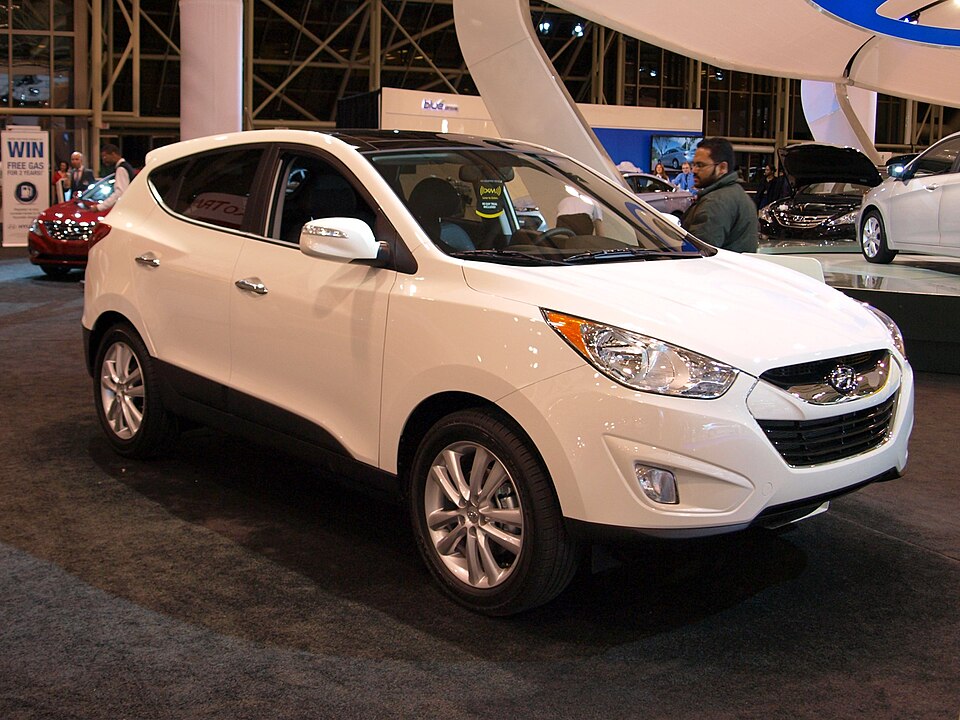
The 2011 Hyundai Tucson has 5 recalls and 124 owner complaints on file with NHTSA; the most reported problem area is engine.
Park outside warning. Owners are advised to park outside and away from buildings until the repair is done, because of a fire risk. Campaign: 23V651000.
Low complaint count among 22 Tucson model years — 15th most.
5recalls
124complaints
5crashes
3fires
7injuries
74,200median miles
Owner complaints filed with NHTSA, not verified and not adjusted for sales. Ranking compares this model's own years only.
Does your car have an open recall? Recalls apply to specific vehicles. Only a VIN lookup on NHTSA's official site shows whether yours is affected and still unrepaired.
Problem: Hyundai Motor America (Hyundai) is recalling certain 2011-2015 Elantra, Genesis Coupe, Sonata Hybrid, 2012-2015 Accent, Azera, Veloster, 2013-2015 Elantra Coupe, Santa Fe, 2014-2015 Equus, 2010-2012 Veracruz, 2010-2013 Tucson, 2015 Tucson Fuel Cell, and 2013 Santa Fe Sport vehicles. The Anti-Lock Brake System (ABS) module may leak brake fluid internally and cause an electrical short, which can result in an engine compartment fire while parked or driving.
Risk: An engine compartment fire while parked or driving can increase the risk of injury.
Remedy & notes
Owners are advised to park outside and away from structures until the recall repair is complete. Dealers will replace the ABS fuse, free of charge. Owner notification letters were mailed April 10, 2024 through October 11, 2024. Owners may contact Hyundai customer service at 1-855-371-9460. Hyundai's number for this recall is 251.
Owners may also contact the National Highway Traffic Safety Administration Vehicle Safety Hotline at 1-888-327-4236 (TTY 1-800-424-9153), or go to www.nhtsa.gov.
Engine
Feb 5, 2019 · NHTSA campaign 19V063000 · 120,000 vehicles
Problem: Hyundai Motor America (Hyundai) is recalling certain 2011-2013 Tucson vehicles. The engine oil pan may leak and, if not addressed, the loss of oil may result in engine damage.
Risk: A damaged engine can increase the risk of a fire or it can cause an engine stall, increasing the risk of a crash.
Remedy & notes
Hyundai has notified owners, and dealers will inspect for an oil pan leak, replacing it if necessary, and install an updated oil pressure switch, free of charge. The recall began August 19, 2019. Owners may contact Hyundai customer service at 1-855-371-9460. Hyundai's number for this recall is 181.
Owners may also contact the National Highway Traffic Safety Administration Vehicle Safety Hotline at 1-888-327-4236 (TTY 1-800-424-9153), or go to www.safercar.gov.
Power Train
Jan 28, 2016 · NHTSA campaign 16V057000 · 11,176 vehicles
Problem: Hyundai Motor America (Hyundai) is recalling certain model year 2011 Hyundai Tucson vehicles manufactured July 22, 2010, to October 31, 2010. The affected vehicles have a transmission fluid cooler hose that may have been improperly manufactured, resulting in a transmission fluid leak.
Risk: If enough transmission fluid leaks out, the transmission may not function properly and the vehicle may stop moving, increasing the risk of a crash.
Remedy & notes
Hyundai will notify owners, and dealers will replace the transmission fluid cooler hose, free of charge. The recall is expected to begin March 25, 2016. Owners may contact Hyundai customer service at 1-800-633-5151. Hyundai's number for this recall is 139.
Owners may also contact the National Highway Traffic Safety Administration Vehicle Safety Hotline at 1-888-327-4236 (TTY 1-800-424-9153), or go to www.safercar.gov.
Air Bags
May 13, 2014 · NHTSA campaign 14V245000 · 137,500 vehicles
Problem: Hyundai Motor Company (Hyundai) is recalling certain model year 2011-2014 Hyundai Tucson vehicles manufactured January 3, 2011, through December 23, 2013. In the affected vehicles, the air bag assembly installed in the steering wheel may come loose from its mounting.
Risk: An air bag assembly that is not properly mounted may result in an increased risk of injury to the driver in the event of a crash.
Remedy & notes
Hyundai will notify owners, and dealers will inspect and tighten the bolts that secure the driver's air bag assembly, free of charge. The recall began on May 9, 2014. Owners may contact Hyundai customer service at 1-800-633-5151. Hyundai's number for this recall is 118.
Owners may also contact the National Highway Traffic Safety Administration Vehicle Safety Hotline at 1-888-327-4236 (TTY 1-800-424-9153), or go to www.safercar.gov.
Problem: Hyundai Motor Company (Hyundai) is recalling certain model year 2006-2009 Accent, model year 2007-2011 Azera, Sonata and Sante Fe,2006-2011 Tucson, 2009-2011 Elantra Touring, 2007-2010 Elantra, 2008-2011 Veracruz, 2009-2011 Genesis, 2010-2011 Genesis Coupe, 2007-2008 Entourage, and 2006-2008 Tiburon vehicles. Originally, in April 2013, Hyundai recalled 1,059,824 model year 2007-2009 Accent and Tucson, model year 2007-2010 Elantra, model year 2007-2011 Santa Fe, model year 2008-2009 Veracruz, model year 2010-2011 Genesis Coupe, and model year 2011 Sonata vehicles. In September 2013, Hyundai informed the agency that it was adding more vehicles to this campaign, representing an additional 652,512 units. The total number of vehicles being recalled is now 1,712,336. In the affected vehicles, the stop lamp switch may malfunction. A malfunctioning stop lamp switch may cause the brake lights to not illuminate when the brake pedal is depressed or may cause an inability to deactivate the cruise control by depressing the brake pedal. Additionally, a malfunctioning stop lamp switch may also result in intermittent operation of the push-button start feature, affect the operation of the brake transmission shift interlock feature, preventing the shifter from being moved out of the PARK position and cause the Electronic Stability Control (ESC) malfunction light to illuminate.
Risk: Failure to illuminate the stop lamps during braking or inability to disengage the cruise control could increase the risk of a crash. Additionally, when the ignition is in the 'ON' position, the transmission shifter may be able to be moved out of Park without first applying the brake. This may lead to unintentional movement of the car which may increase the risk of a crash.
Remedy & notes
Hyundai will notify owners, and dealers will replace the stop lamp switch, free of charge. The safety recall began on April 22, 2013. Owners may contact Hyundai at 1-800-633-5151. Hyundai's recall campaign number is 110.
Owners may also contact the National Highway Traffic Safety Administration Vehicle Safety Hotline at 1-888-327-4236 (TTY 1-800-424-9153), or go to www.safercar.gov.
Recall text as published by NHTSA and the manufacturer.
Owner complaints filed with NHTSA; one complaint can name several areas. Not verified by NHTSA.
Complaints by year filed
NHTSA investigations
Hyundai and Kia ABS Module Fires
AQ23002 · opened Nov 17, 2023 · open
Summary
The Office of Defects Investigation (ODI) has received eight Hyundai Motor America (Hyundai) and eight Kia America, Inc. (Kia) Part 573 Recall Reports between 2016 and 2023. The combined 16 safety recalls all involve the antilock braking system (ABS) modules or Hydraulic Electronic Control Units (HECU) manufactured by the equipment supplier Mando. The Part 573 Recall Reports contain varying defect descriptions and differing remedy descriptions for the same or similar equipment supplied by Mando. Safety recalls included in this Audit Query (AQ) review include: Hyundai recalls 20V-520, 20V-543, 21V-161, 21V-160, 21V-303, 22V-056, 22V-810, and 23V-651. Kia recalls 16V-815, 20V-518, 20V-519, 21V-137, 21V-331, 22V-051, 22V-800, and 23V-652 The purpose of this AQ is to evaluate the timeliness and scoping of Hyundai and Kiaâs defect decision making and adherence with reporting requirements; and understand the varying defect descriptions and remedies between these recalls.
Loss of Motive Power
DP22003 · opened Sep 12, 2022 · closed Dec 12, 2023
Summary
The National Highway Traffic Safety Administration (NHTSA) received a letter dated July 13, 2022, petitioning the Agency to initiate a safety defect investigation into loss of motive power allegations attributed to oil drain pan assembly failures on certain Hyundai Motor America, Inc. and Kia America, Inc. vehicles spanning Model Years (MY) 2005-2021. The Petitioners cited examples of complaints indicating that the subject vehicles were experiencing rapid loss of engine oil due to oil drain plug back outs, resulting in loss of motive power and/or catastrophic engine damage. Additional complaints were provided which alleged that the oil drain pans lack sufficient structural integrity and are susceptible to cracking. The petition itself can be reviewed at NHTSA.gov under ODI number 11481745. On September 12, 2022, the Office of Defects Investigation (ODI) opened Defect Petition (DP22-003) to evaluate the Petitionersâ request. The Petitioners have provided additional complaints within four supplemental letters dated January 31, 2023, March 21, 2023, May 23, 2023, and August 4, 2023. ODIâs evaluation included the review and analysis of the complaints and supporting information submitted by the Petitioners, as well as additional complaints submitted directly to NHTSA which referenced either the oil drain plug or a crack in the oil pan. After reviewing the available data, ODI has not identified evidence that would support opening a defect investigation into the oil drain pan as…
2011 vs. other Hyundai Tucson years
Owner complaints by model year; the darker bar is the 2011. Click a bar to switch year.
Questions
Does the 2011 Hyundai Tucson have recalls?
Yes — NHTSA lists 5 recall campaigns covering the 2011 Hyundai Tucson, the latest from Sep 22, 2023 (service brakes). A recall applies to specific vehicles: enter your VIN at nhtsa.gov/recalls to see whether yours is affected and still open.
What are the most common problems with the 2011 Hyundai Tucson?
Owner complaints filed with NHTSA most often mention engine (45), service brakes (34), power train (20). Complaints are consumer reports and are not verified by NHTSA.
Is it safe to drive the 2011 Hyundai Tucson?
1 recall advises parking outside because of a fire risk. Only vehicles with the recall open are affected — check your VIN at nhtsa.gov/recalls.
 Recalls by Model