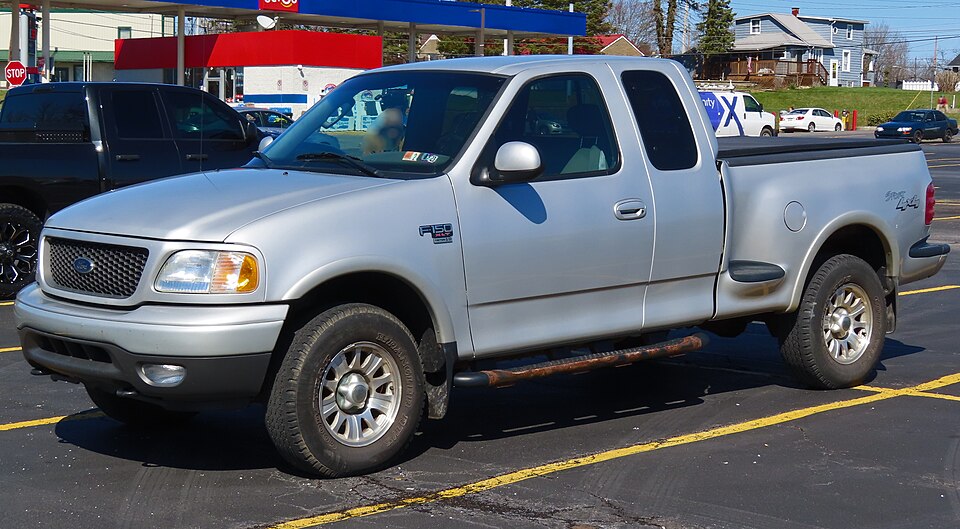
2003 Ford F-150 recalls and problems

The 2003 Ford F-150 has 4 recalls and 423 owner complaints on file with NHTSA; the most reported problem area is engine.

2003 Ford F-150
Photo: 2003 Ford F-150 by MercurySable99, CC BY-SA 4.0, via Wikimedia Commons
How the 2003 compares
Fewest complaintsMost complaints

Low complaint count among 27 F-150 model years — 21st most.

4recalls
423complaints
43crashes
37fires
36injuries
64,000median miles

Owner complaints filed with NHTSA, not verified and not adjusted for sales. Ranking compares this model's own years only.

Does your car have an open recall?
Recalls apply to specific vehicles. Only a VIN lookup on NHTSA's official site shows whether yours is affected and still unrepaired.
Check your VIN →

4 recalls

Fuel System

Jul 29, 2011 · NHTSA campaign 11V385000 · 1,100,000 vehicles

Problem: Ford is recalling certain 1997 through 2003 model year Ford f-150, 2004 model year Ford f-150 heritage, 1997 through 1999 model year f-250 less than 8,500 LBS. Gross vehicle weight rating (GVWR), and 2002 and 2003 Lincoln blackwood vehicles manufactured from June 20, 1995, through August 4, 2004, originally sold, or currently registered in, Connecticut, Delaware, Illinois, Indiana, Iowa, Kentucky, Maine, Maryland, Massachusetts, Michigan, Minnesota, Missouri, New Hampshire, New Jersey, New York, Ohio, Pennsylvania, Rhode Island, Vermont, West Virginia, Wisconsin, and the District of Columbia. Prolonged exposure to road deicing chemicals May cause severe corrosion of the fuel tank straps which secure the tank to the vehicle.

Original NHTSA wording

FORD IS RECALLING CERTAIN 1997 THROUGH 2003 MODEL YEAR FORD F-150, 2004 MODEL YEAR FORD F-150 HERITAGE, 1997 THROUGH 1999 MODEL YEAR F-250 LESS THAN 8,500 LBS. GROSS VEHICLE WEIGHT RATING (GVWR), AND 2002 AND 2003 LINCOLN BLACKWOOD VEHICLES MANUFACTURED FROM JUNE 20, 1995, THROUGH AUGUST 4, 2004, ORIGINALLY SOLD, OR CURRENTLY REGISTERED IN, CONNECTICUT, DELAWARE, ILLINOIS, INDIANA, IOWA, KENTUCKY, MAINE, MARYLAND, MASSACHUSETTS, MICHIGAN, MINNESOTA, MISSOURI, NEW HAMPSHIRE, NEW JERSEY, NEW YORK, OHIO, PENNSYLVANIA, RHODE ISLAND, VERMONT, WEST VIRGINIA, WISCONSIN, AND THE DISTRICT OF COLUMBIA. PROLONGED EXPOSURE TO ROAD DEICING CHEMICALS MAY CAUSE SEVERE CORROSION OF THE FUEL TANK STRAPS WHICH SECURE THE TANK TO THE VEHICLE.

Risk: As a result of the corrosion, one or both straps May fail allowing the fuel lines to separate from the tank, or in some cases, causing the tank to contact the ground. Either scenario May result in a fuel leak presenting a fire hazard.

Original NHTSA wording

AS A RESULT OF THE CORROSION, ONE OR BOTH STRAPS MAY FAIL ALLOWING THE FUEL LINES TO SEPARATE FROM THE TANK, OR IN SOME CASES, CAUSING THE TANK TO CONTACT THE GROUND. EITHER SCENARIO MAY RESULT IN A FUEL LEAK PRESENTING A FIRE HAZARD.

Remedy & notes

Ford will notify owners and instruct them to take their vehicles to a Ford or Lincoln dealer to have the fuel tank straps replaced with straps that have increased corrosion protection. Early in this campaign, if replacement straps are not available, dealers May install a cable support under the strap as an interim repair or a steel reinforcement over the existing strap as a permanent repair. Any repairs will be performed free of charge. The safety recall began on September 16, 2011. Owners May contact Ford motor company customer relationship center at 1-866-436-7332. Ford's recall campaign number is 11S21

Ford's recall campaign number is 11S21.owners May also contact the national highway traffic safety administration's vehicle safety hotline at 1-888-327-4236 (tty 1-800-424-9153), or go to <a href=http://www.safercar.gov>http://www.safercar.gov</a> .

Vehicle Speed Control

Aug 3, 2007 · NHTSA campaign 07V336000 · 3,600,000 vehicles

Problem: On certain pickup trucks, passenger vehicles, sport utility vehicles, and motor homes chassis, the speed control deactivation switch May, under certain conditions, leak internally and then overheat, smoke, or burn.

Original NHTSA wording

ON CERTAIN PICKUP TRUCKS, PASSENGER VEHICLES, SPORT UTILITY VEHICLES, AND MOTOR HOMES CHASSIS, THE SPEED CONTROL DEACTIVATION SWITCH MAY, UNDER CERTAIN CONDITIONS, LEAK INTERNALLY AND THEN OVERHEAT, SMOKE, OR BURN.

Risk: This could result in an underhood fire.

Original NHTSA wording

THIS COULD RESULT IN AN UNDERHOOD FIRE.

Remedy & notes

Dealers will install a fused wiring harness. Owners of the passenger cars included in this campaign will be instructed to return their vehicles to their dealers to have the speed control deactivation switch disconnected as an interim repair. As soon as repair parts are available (expected October 2007), owners will be instructed to return to the dealers for installation of a fused wiring harness. The recall began on August 13, 2007, and mailing completed by September 19, 2007. Owners May contact Ford at 1-888-222-2751.

Ford recall no. 05S28.customers May also contact the national highway traffic safety administration;s vehicle safety hotline at 1-888-327-4236 (tty 1-800-424-9153), or go to http://www.safercar.gov.

Vehicle Speed Control

Mar 6, 2007 · NHTSA campaign 07V078000 · 155,584 vehicles

Problem: On certain trucks equipped with speed control, gasoline or natural gas engines, the speed control deactivation switch May overheat.

Original NHTSA wording

ON CERTAIN TRUCKS EQUIPPED WITH SPEED CONTROL, GASOLINE OR NATURAL GAS ENGINES, THE SPEED CONTROL DEACTIVATION SWITCH MAY OVERHEAT.

Risk: Overheating could result in smoke, burn, or an underhood fire.

Original NHTSA wording

OVERHEATING COULD RESULT IN SMOKE, BURN, OR AN UNDERHOOD FIRE.

Remedy & notes

Dealers will install a fused wiring harness into the speed control system free of charge. The recall began on March 12, 2007. Owners May contact Ford at 1-800-392-3673. (note: Also see recalls 05V017, 05V388, and 06V286)

Ford recall no. 05S28. Customers May also contact the national highway traffic safety administration's vehicle safety hotline at 1-888-327-4236 (tty 1-800-424-9153), or go to http://www.safercar.gov.

Steering

Sep 22, 2003 · NHTSA campaign 03V349000 · 300 vehicles

Problem: On certain pickup trucks, the pitman arm to steering gear retaining nut was not fully tightened to the required specification.

Original NHTSA wording

ON CERTAIN PICKUP TRUCKS, THE PITMAN ARM TO STEERING GEAR RETAINING NUT WAS NOT FULLY TIGHTENED TO THE REQUIRED SPECIFICATION.

Risk: If the pitman arm to gearbox attachment nut loosens, a noise and a loose feel in the steering could occur. If the condition progressed and service was not sought, the nut could back off completely and the pitman arm could separate from the gear causing a loss of steering. If the warning is not heeded and steering is lost, a crash May result.

Original NHTSA wording

IF THE PITMAN ARM TO GEARBOX ATTACHMENT NUT LOOSENS, A NOISE AND A LOOSE FEEL IN THE STEERING COULD OCCUR. IF THE CONDITION PROGRESSED AND SERVICE WAS NOT SOUGHT, THE NUT COULD BACK OFF COMPLETELY AND THE PITMAN ARM COULD SEPARATE FROM THE GEAR CAUSING A LOSS OF STEERING. IF THE WARNING IS NOT HEEDED AND STEERING IS LOST, A CRASH MAY RESULT.

Remedy & notes

Dealers will tighten the pitman arm retaining nut to specifications. Owner notification began on October 1, 2003. Owners should contact Ford at 1-866-436-7332.

Ford recall no. 03S07.customers can also contact the national highway traffic safety administration's auto safety hotline at 1-888-DASH-2-DOT (1-888-327-4236).

Recall text as published by NHTSA and the manufacturer.

What owners complain about

Owner complaints filed with NHTSA; one complaint can name several areas. Not verified by NHTSA.

Complaints by year filed

2002: 1 complaints20022003: 48 complaints2004: 49 complaints492005: 36 complaints20052006: 19 complaints2007: 25 complaints2008: 30 complaints20082009: 21 complaints2010: 26 complaints2011: 34 complaints20112012: 16 complaints2013: 12 complaints2014: 19 complaints20142015: 14 complaints2016: 21 complaints2017: 8 complaints20172018: 5 complaints2019: 14 complaints2020: 7 complaints20202021: 2 complaints2022: 2 complaints2023: 5 complaints20232024: 2 complaints2025: 3 complaints2026: 4 complaints20264

NHTSA investigations

Fuel Tank Strap Failure Due to Corrosion

EA11006 · opened May 4, 2011 · closed Aug 19, 2011 · led to recall 11V385000
Summary

One or both of the steel straps holding up the fuel tank and attaching it to the truck frame can corrode and fail (break or separate).If one strap fails, the tank may tilt and drop and possibly contact the road surface.If both straps break, the entire tank may drop to the road.If either failure occurs while the vehicle is being driven, contact with the road can abrade the tank and create a hole from which gasoline can spill.When the tank drops, it remains attached to the vehicle only by the fuel filler hose and/or supply lines, or in rare instances, by the skid plate, if present.In some cases the weight of the tank sufficiently strained the hoses and fittings and caused separation and subsequent fuel leaks from those connections.The fire hazard created by leaking gasoline is increased by the possible presence of sparks created by the metal tank being dragged along the road.Corrosion of the straps appears to be caused by prolonged exposure to road deicers, frequently road salt, used to treat snow or ice covered roads.States in which large quantities of deicers are applied to roads during the winter season (salt belt states) account for the predominant portion of strap failures.Vehicles in these salt belt states are prone to experience corrosion related failures more frequently and earlier in a vehicle?s life cycle.Ford reports approximately 97 percent of reports it received relating to strap failure involve vehicles that were operated in these high corrosion areas, and 95 perc…

CNG REGULATOR LEAK

PE08063 · opened Oct 31, 2008 · closed Feb 27, 2009
Summary

THE AGENCY HAS CLOSED THIS INVESTIGATION BASED ON ITS REVIEW OF COMPLAINT REPORTS, DISCUSSIONS WITH COMPLAINANTS AND FIELD AND TECHNICAL DATA PROVIDED BY FORD.THE SUBJECT VEHICLES ARE 1/2 TON PICKUP TRUCKS AND ARE NATURAL GAS VEHICLES (NGV) THAT ARE FUELED BY GASOLINE OR COMPRESSED NATURAL GAS.THE AGENCY HAS RECEIVED REPORTS ALLEGING IMPROPER OPERATION OF THE NATURAL GAS FUEL PRESSURE REGULATOR ALLOWING RELEASE OF EXCESS AMOUNTS OF NATURAL GAS INTO THE ENGINE COMPARTMENT.FORD REPORTS THAT THE REGULATOR CONTAINS AN OVER PRESSURE RELIEF VALVE THAT WILL VENT NATURAL GAS SHOULD THE PRESSURE EXCEED A SET THRESHOLD.THE COMPLAINT REPORTS AND DATA REVIEWED BY THE AGENCY INDICATE THAT AN IMPROPERLY OPERATING PRESSURE REGULATOR CAN RESULT IN AN OVERPRESSURE CONDITION AND ACTIVATE THE REGULATOR PRESSURE RELIEF VALVE.THE RELEASED NATURAL GAS IS DIRECTED THROUGH A VENT HOSE THAT DISCHARGES THE NATURAL GAS IN THE VICINITY OF THE RIGHT FRONT WHEEL HOUSE AND AWAY FROM THE ENGINE COMPARTMENT'S EXTREMELY HOT AREAS/SURFACES.OWNERS ARE NORMALLY AWARE OF THIS PROBLEM BY THE PRESENCE OF AN ILLUMINATED WARNING LIGHT INSIDE THE VEHICLE, ODOR OF NATURAL GAS OR THE SOUND OF VENTING GAS.WHEN THE OPERATOR TURNS THE ENGINE OFF, THE NATURAL GAS SUPPLY TANK SOLENOID WILL CLOSE AND THE REGULATOR WILL NOT RELEASE NATURAL GAS.AT VEHICLE RESTART, THE SOLENOID VALVE WILL REMAIN CLOSED TO PREVENT LEAKAGE AND THE VEHICLE WILL ONLY OPERATE IN THE GASOLINE MODE.A SAFETY-RELATED DEFECT HAS NOT BEEN IDENTIFIED AT THI…

SPARK PLUG EJECTION FROM CYLINDER HEAD

DP05005 · opened Sep 22, 2005 · closed Jan 4, 2006
Summary

ON SEPTEMBER 6, 2005, ODI RECEIVED A PETITION REQUESTING THAT THE AGENCY INVESTIGATE ALLEGATIONS OF ENGINE SPARK PLUG EJECTION IN CERTAIN MODEL YEAR 1997 THROUGH 2004 FORD VEHICLES WITH TRITON V-8 AND V-10 ENGINES.ODI RECEIVED A TOTAL OF 474 NON-DUPLICATIVE COMPLAINTS ON THE SUBJECT VEHICLES WHERE THE COMPLAINANT, OR THE DEALER REPAIRING THE VEHICLE, REPORTED THAT A SPARK PLUG DETACHED FROM THE CYLINDER AND/OR EJECTED FROM THE ENGINE.AS OF DECEMBER 8, 2005, ODI IS NOT AWARE OF ANY ALLEGATIONS WHERE THE ALLEGED DEFECT RESULTED IN A LOSS OF VEHICLE CONTROL, A CRASH, AN INJURY, OR A FATALITY IN ANY OF THE 10,319,810 SUBJECT VEHICLES.IN ADDITION, ODI IS AWARE OF ONLY TWO INCIDENTS WHERE THE VEHICLE STALLED WITHOUT RESTART.INFORMATION CONTAINED IN THE ODI CONSUMER COMPLAINTS AND OBTAINED FROM 72 TELEPHONE INTERVIEWS WITH COMPLAINANTS SHOWED THE FOLLOWING:(1) 99% OF THE COMPLAINTS WERE ON MY 1997 TO 2002 SUBJECT VEHICLES.(2) MOST THE COMPLAINANTS REPORTED HEARING A LOUD POP WHILE DRIVING OR UPON STARTING UP THE VEHICLE FOLLOWED BY A LOUD, REPETITIVE CLICKING OR POPPING SOUND.(3) MANY OF THE COMPLAINANTS REPORTED THAT THE POPPING SOUND WAS ACCOMPANIED BY SOME LOSS OF VEHICLE POWER; HOWEVER, IN 99% OF THE INCIDENTS REPORTED, THE VEHICLE DID NOT STALL.IN THE VERY FEW INCIDENTS WHERE THE VEHICLE DID STALL, MOST VEHICLES COULD BE RESTARTED.(4) ONLY A SMALL PERCENTAGE OF THE COMPLAINANTS CITED THAT THEY SMELLED GAS OR A SLIGHT BURNING SMELL WHEN THE INCIDENT OCCURRED.(5) IN ALL BUT A VER…

2003 vs. other Ford F-150 years

Owner complaints by model year; the darker bar is the 2003. Click a bar to switch year.

Questions

Does the 2003 Ford F-150 have recalls?

Yes — NHTSA lists 4 recall campaigns covering the 2003 Ford F-150, the latest from Jul 29, 2011 (fuel system). A recall applies to specific vehicles: enter your VIN at nhtsa.gov/recalls to see whether yours is affected and still open.

What are the most common problems with the 2003 Ford F-150?

Owner complaints filed with NHTSA most often mention engine (97), power train (62), electrical system (47). Complaints are consumer reports and are not verified by NHTSA.