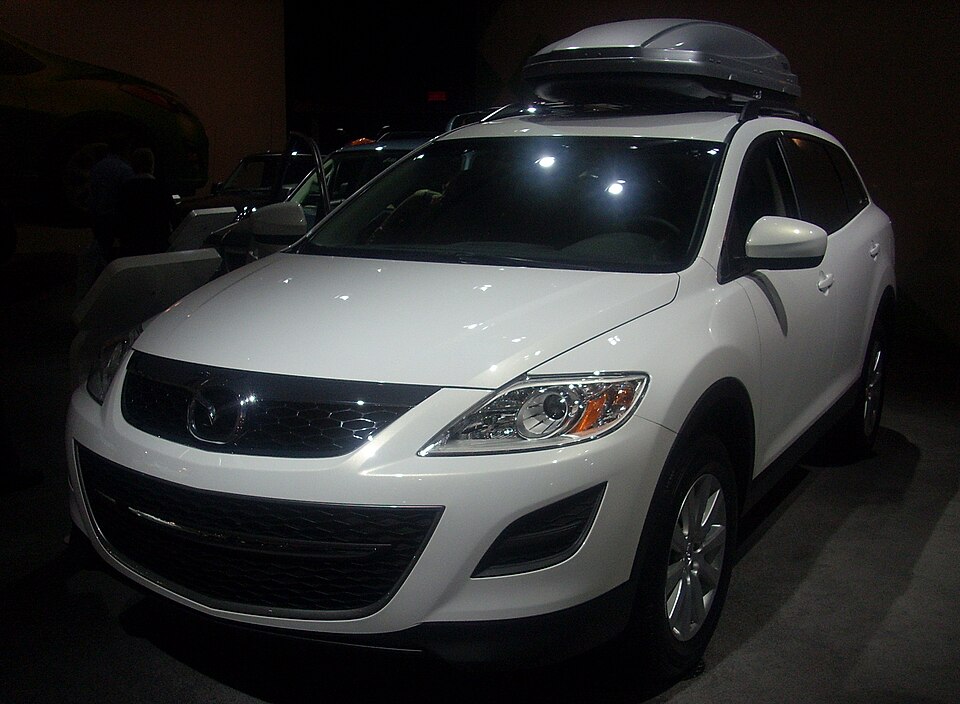
2010 Mazda CX-9 recalls and problems

The 2010 Mazda CX-9 has 6 recalls and 195 owner complaints on file with NHTSA; the most reported problem area is service brakes.

Do not drive warning. NHTSA and the manufacturer advise owners not to drive affected vehicles until the recall repair is done. Affected campaigns: 19V782000, 18V717000, 18V018000, 17V429000.
2010 Mazda Cx-9
Photo: 2010 Mazda Cx-9 by Bull-Doser, Public domain, via Wikimedia Commons
How the 2010 compares
Fewest complaintsMost complaints

Highest complaint count among 17 CX-9 model years — 2nd most.

6recalls
195complaints
7crashes
5fires
6injuries
71,000median miles

Owner complaints filed with NHTSA, not verified and not adjusted for sales. Ranking compares this model's own years only.

Does your car have an open recall?
Recalls apply to specific vehicles. Only a VIN lookup on NHTSA's official site shows whether yours is affected and still unrepaired.
Check your VIN →

6 recalls

Air Bags

Oct 31, 2019 · NHTSA campaign 19V782000 · 69,879 vehicles
Do not drive

Problem: Mazda North American Operations (Mazda) is recalling certain 2007-2012 CX-7, CX-9, and 2009-2012 Maza6 vehicles. These vehicles had their passenger frontal air bag inflators previously replaced under a prior recall using inflators of the same design. The inflators may explode due to propellant degradation occurring after long-term exposure to high absolute humidity, temperature and temperature cycling.

Risk: An inflator explosion may result in sharp metal fragments striking the driver or other occupants resulting in serious injury or death.

Remedy & notes

Owners are advised not to drive their vehicles until the repair has been performed. Mazda will notify owners, and dealers will replace the front passenger air bag inflator with an alternate one, free of charge. The recall began December 3, 2019. Owners may contact Mazda customer service at 1-800-222-5500, option 4. Mazda's number for this recall is 1317F. Note: This recall supersedes recalls 16V356 and 17V012.

Owners may also contact the National Highway Traffic Safety Administration Vehicle Safety Hotline at 1-888-327-4236 (TTY 1-800-424-9153), or go to www.safercar.gov.

Air Bags

Oct 12, 2018 · NHTSA campaign 18V717000 · 155,436 vehicles
Do not drive

Problem: Mazda North American Operations (Mazda) is recalling certain 2014-2015 Mazda CX-9 vehicles sold, or ever registered in the states of Alabama, California, Florida, Georgia, Hawaii, Louisiana, Mississippi, South Carolina, Texas, Puerto Rico, American Samoa, Guam, the Northern Mariana Islands (Saipan), and the U.S. Virgin Islands or "Zone A." Additionally, unless covered in "Zone A," Mazda is recalling certain 2011-2013 Mazda6, 2011-2012 CX-7, and 2011-2015 CX-9 sold, or ever registered in the states of Arizona, Arkansas, Delaware, Illinois, Indiana, Kansas, Kentucky, Maryland, Missouri, Nebraska, Nevada, New Jersey, New Mexico, North Carolina, Ohio, Oklahoma, Pennsylvania, Tennessee, Virginia, West Virginia and the District of Columbia, or "Zone B." Additionally, unless covered in Zone A or Zone B, Mazda is recalling certain 2010-2013 Mazda6, 2010-2012 CX-7, and 2010-2015 CX-9 vehicles ever registered in the states of Alaska, Colorado, Connecticut, Idaho, Iowa, Maine, Massachusetts, Michigan, Minnesota, Montana, New Hampshire, New York, North Dakota, Oregon, Rhode Island, South Dakota, Utah, Vermont, Washington, Wisconsin, and Wyoming or "Zone C." These vehicles are equipped with certain air bag inflators assembled as part of the passenger frontal air bag modules used as original equipment or replacement equipment. In the event of a crash necessitating deployment of the passenger frontal air bag, these inflators may explode due to propellant degradation occurring after long-term exposure to absolute humidity and temperature cycling.

Risk: An inflator explosion may result in sharp metal fragments striking the driver or other occupants resulting in serious injury or death.

Remedy & notes

Mazda will notify owners, and dealers will replace the front passenger air bag inflator with an alternate inflator, free of charge. The recall began November 9, 2018. Owners may contact Mazda customer service at 1-800-222-5500, Option 4. Mazda's number for this recall is 1317F.

Owners may also contact the National Highway Traffic Safety Administration Vehicle Safety Hotline at 1-888-327-4236 (TTY 1-800-424-9153), or go to www.safercar.gov.

Air Bags

Jan 9, 2018 · NHTSA campaign 18V018000 · 70,227 vehicles
Do not drive

Problem: Mazda North American Operations (Mazda) is recalling certain 2013 Mazda6 and CX-9 vehicles sold, or ever registered in the states of Alabama, California, Florida, Georgia, Hawaii, Louisiana, Mississippi, South Carolina, Texas, Puerto Rico, American Samoa, Guam, the Northern Mariana Islands (Saipan), and the U.S. Virgin Islands or "Zone A." Additionally, unless covered in "Zone A," Mazda is recalling certain 2010 Mazda6, CX-7 and CX-9 vehicles sold, or ever registered in the states of Arizona, Arkansas, Delaware, District of Columbia, Illinois, Indiana, Kansas, Kentucky, Maryland, Missouri, Nebraska, Nevada, New Jersey, New Mexico, North Carolina, Ohio, Oklahoma, Pennsylvania, Tennessee, Virginia, and West Virginia or "Zone B." Additionally, unless covered in Zone A or Zone B, Mazda is recalling certain 2009 Mazda6, CX-7, and CX-9 vehicles ever registered in the states of Alaska, Colorado, Connecticut, Idaho, Iowa, Maine, Massachusetts, Michigan, Minnesota, Montana, New Hampshire, New York, North Dakota, Oregon, Rhode Island, South Dakota, Utah, Vermont, Washington, Wisconsin, and Wyoming or "Zone C." These vehicles are equipped with certain air bag inflators assembled as part of the passenger frontal air bag modules used as original equipment or replacement equipment. In the event of a crash necessitating deployment of the passenger frontal air bag, these inflators may explode due to propellant degradation occurring after long-term exposure to absolute humidity and temperature cycling.

Risk: An inflator explosion may result in sharp metal fragments striking the driver or other occupants resulting in serious injury or death.

Remedy & notes

Mazda will notify owners, and dealers will replace the front passenger air bag inflator with an alternate inflator, free of charge. The recall began March 2, 2018. Owners may contact Mazda customer service at 1-800-222-5500. Mazda's number for this recall is 1317F.

Owners may also contact the National Highway Traffic Safety Administration Vehicle Safety Hotline at 1-888-327-4236 (TTY 1-800-424-9153), or go to www.safercar.gov.

Air Bags

Jun 29, 2017 · NHTSA campaign 17V429000 · 205,377 vehicles
Do not drive

Problem: Mazda North America Operations (Mazda) is recalling certain 2009-2011 Mazda6, and 2007-2011 CX-7 and CX-9 vehicles. These vehicles are equipped with certain air bag inflators assembled as part of the passenger frontal air bag modules, and used as original equipment or replacement equipment. In the event of a crash necessitating deployment of the front air bags, these inflators may rupture due to propellant degradation occurring after long-term exposure to absolute humidity and temperature cycling.

Risk: An inflator rupture may result in metal fragments striking the vehicle occupants resulting in serious injury or death.

Remedy & notes

Owners are advised not to drive their vehicles until the remedy is performed. Mazda will notify owners, and dealers will replace the passenger frontal air bag inflator with an alternate inflator, free of charge. The recall began on August 30, 2017. Owners may contact Mazda customer service at 1-800-222-5500. Mazda's number for this recall is 1317F. Note: This recall supersedes recall 16V356 and all vehicles that were not remedied under that campaign are now covered by this one.

Owners may also contact the National Highway Traffic Safety Administration Vehicle Safety Hotline at 1-888-327-4236 (TTY 1-800-424-9153), or go to www.safercar.gov.

Suspension

Jul 20, 2015 · NHTSA campaign 15V451000 · 193,484 vehicles

Problem: Mazda North American Operations (Mazda) is recalling certain model year 2007-2014 CX-9 vehicles manufactured October 24, 2006, to December 28, 2013. The affected vehicles have front suspension ball joints that may corrode from water leaking into the fitting.

Risk: Over time, the ball joint corrosion may result in the front lower control arm separating from the ball joint, causing a loss of steering control and increasing the risk of a crash.

Remedy & notes

Mazda will notify owners, and dealers will replace both the left and right lower control arms, free of charge. The recall began on September 14, 2015. The recall will begin with model year 2007-2009 vehicles registered in Connecticut, Delaware, Illinois, Indiana, Iowa, Kentucky, Maine, Maryland, Massachusetts, Michigan, Minnesota, Missouri, New Hampshire, New Jersey, New York, Ohio, Pennsylvania, Rhode Island, Vermont, Virginia, Washington D.C., West Virginia, and Wisconsin. The second phase will be for model year 2010-2014 vehicles in the same states. Finally, all remaining vehicles will be remedied. Owners may contact Mazda customer service at 1-800-222-5500. Mazda's number for this recall is 8515G.

Owners may also contact the National Highway Traffic Safety Administration Vehicle Safety Hotline at 1-888-327-4236 (TTY 1-800-424-9153), or go to www.safercar.gov.

Seats

Feb 19, 2010 · NHTSA campaign 10V051000 · 12,300 vehicles

Problem: Mazda is recalling certain model year 2010 cx-9 vehicles equipped with electrically heated front seats. There is a possibility under extremely cold conditions for the seat heater control circuit to overheat and fail due to insufficient electrical grounding.

Original NHTSA wording

MAZDA IS RECALLING CERTAIN MODEL YEAR 2010 CX-9 VEHICLES EQUIPPED WITH ELECTRICALLY HEATED FRONT SEATS. THERE IS A POSSIBILITY UNDER EXTREMELY COLD CONDITIONS FOR THE SEAT HEATER CONTROL CIRCUIT TO OVERHEAT AND FAIL DUE TO INSUFFICIENT ELECTRICAL GROUNDING.

Risk: This May cause burn damage of the seat cushion surface, or a risk of smoke/fire.

Original NHTSA wording

THIS MAY CAUSE BURN DAMAGE OF THE SEAT CUSHION SURFACE, OR A RISK OF SMOKE/FIRE.

Remedy & notes

Dealers will install an additional ground harness on the seat heater control system. The seat heater control circuit will be replaced if necessary and/or the seat will be repaired free of charge. The safety recall began on March 9, 2010. Owners May contact Mazda at 1-800-222-5500.

Mazda recall no. 5810B.owners May also contact the national highway traffic safety administration's vehicle safety hotline at 1-888-327-4236 (tty 1-800-424-9153), or go to <a href=http://www.safercar.gov>http://www.safercar.gov</a> .

Recall text as published by NHTSA and the manufacturer.

What owners complain about

Owner complaints filed with NHTSA; one complaint can name several areas. Not verified by NHTSA.

Complaints by year filed

2010: 4 complaints20102011: 4 complaints2012: 9 complaints20122013: 21 complaints2014: 22 complaints20142015: 12 complaints2016: 27 complaints2016272017: 22 complaints2018: 19 complaints20182019: 21 complaints2020: 9 complaints20202021: 8 complaints2022: 8 complaints20222023: 3 complaints2024: 3 complaints20242026: 3 complaints20263

NHTSA investigations

Inadvertent Curtain Air Bag Deployment

PE19006 · opened May 2, 2019 · closed Jan 15, 2021
Summary

The Office of Defects Investigation (ODI) opened this Preliminary Evaluation (PE19-006) on May 2, 2019 to investigate two Vehicle Owner Questionnaires (VOQs) and Early Warning Reporting data related to allegations of inadvertent deployment (IAD) of side curtain airbags in Model Year (MY) 2010 through 2013 Mazda CX-9 vehicles. ODI sent an Information Request (IR) to Mazda North America Operations, LLC. to gather information about the alleged defect in the subject vehicles. In the 20 months since opening the PE, ODI has received three additional VOQs. To date, there have been a total of 11 IAD incidents within the identified population of 104,360 vehicles. Of the 11 incidents, no serious injuries were reported. The last known incident occurred in December 2020.Mazda's response to ODI's IR letter identified the root cause as a manufacturing issue of the Bosch SMG076 Roll Rate Sensor within the Restraint Control Module (RCM). During the manufacturing calibration process, small particles may be generated that could affect roll sensor capacitance, which could lead to a loss of curtain airbag protection or an erroneous deployment command. On November 19, 2012, a revised Roll Rate Sensor calibration process was launched, establishing a clean point for the issue. In its responses to ODI, Mazda has assessed the condition as a low risk to motor vehicle safety, with low incident frequency not warranting action. Any RCM data indicating a malfunctioning Roll Rate Sensor will result in the …

Lower ball joint separation

PE15022 · opened Jun 9, 2015 · closed Aug 20, 2015 · led to recall 15V451000
Summary

In an July 7,2015 letter to NHTSA, Mazda identified a safety defect that could result in lower ball joint separation in approximately 193,484 model year (MY) 2007 through 2014 Mazda CX-9 vehicles (NHTSA Recall No. 15V-451,Mazda 8515G).Mazda indicated that damage to the ball joint boot may allow water to enter the front suspension ball joint fitting during use which may result in premature ball joint wear and a progressively looser joint.In January 2014, Mazda implemented redesigned lower control arms in production vehicles to improve the durability of the lower ball joints.The redesign involved changing the shape of the top surface of the ball joint boot cover and adding a suspension plate to the undersurface of the knuckle.Mazda's recall will replace the defect lower control arms with the redesigned parts.ODI's analysis of information collected during PE15-022 identified a total of 62 ball joint separation incidents, including 34 identified in ODI complaints and 31 identified in Mazda complaints and field reports (3 of the Mazda records involve vehicles/incidents that were also reported to ODI).When Mazda's design change was implemented, most of the field experience related to lower ball joints involved complaints of noise and premature wear-out.Only 1 of the ODI and 6 of the additional Mazda separation complaints identified in ODI's analysis were reported prior to January 2014.Significant increases in the number and trend in separation complaints were observed in 2015, when…

Brake Booster Failure

PE14005 · opened Feb 10, 2014 · closed Jun 26, 2014
Summary

In March 2014, Mazda Motor Corporation (Mazda) initiated Special Service Program SSP93 to extend the warranty coverage for a specific brake booster fault condition on model year (MY) 2007-2013 Mazda CX-9 vehicles.According to Mazda's dealer communication for SSP93, the subject vehicles may exhibit a condition were the brake pedal is harder than usual to depress. Complainants report hearing air leakage (hissing) from the driver-side foot area during braking.The Mazda program extends the warranty coverage for repairing this condition to unlimited time and mileage for repairs performed between March 31, 2014 and March 31, 2015 and to 7 years or 90,000 miles for repairs performed after March 31, 2015.In its response to the Office of Defects Investigation's (ODI) information request letter for PE14-005, Mazda identified a problem with booster diaphragms developing tears near the outer seal/circumference that can result in noise and degraded booster performance as the tears grow in length (Figures 1-3).The tears allow leakage from the ambient to the vacuum sides of the diaphragm that reduces the differential pressure across the diaphragm and produces a hissing noise after the tears have reached 10-12 mm in length.The problem was caused by wear of the mold used for the diaphragm forming process, which resulted in increased thickness and stress in the bending area of the diaphragm.Continuous operation in environments with high ambient temperatures accelerates the hardening of the dia…

2010 vs. other Mazda CX-9 years

Owner complaints by model year; the darker bar is the 2010. Click a bar to switch year.

Questions

Does the 2010 Mazda CX-9 have recalls?

Yes — NHTSA lists 6 recall campaigns covering the 2010 Mazda CX-9, the latest from Oct 31, 2019 (air bags). A recall applies to specific vehicles: enter your VIN at nhtsa.gov/recalls to see whether yours is affected and still open.

What are the most common problems with the 2010 Mazda CX-9?

Owner complaints filed with NHTSA most often mention service brakes (91), engine (27), power train (23). Complaints are consumer reports and are not verified by NHTSA.

Is it safe to drive the 2010 Mazda CX-9?

4 recalls for this model year carry a "Do Not Drive" advisory. Only vehicles with the recall open are affected — check your VIN at nhtsa.gov/recalls.