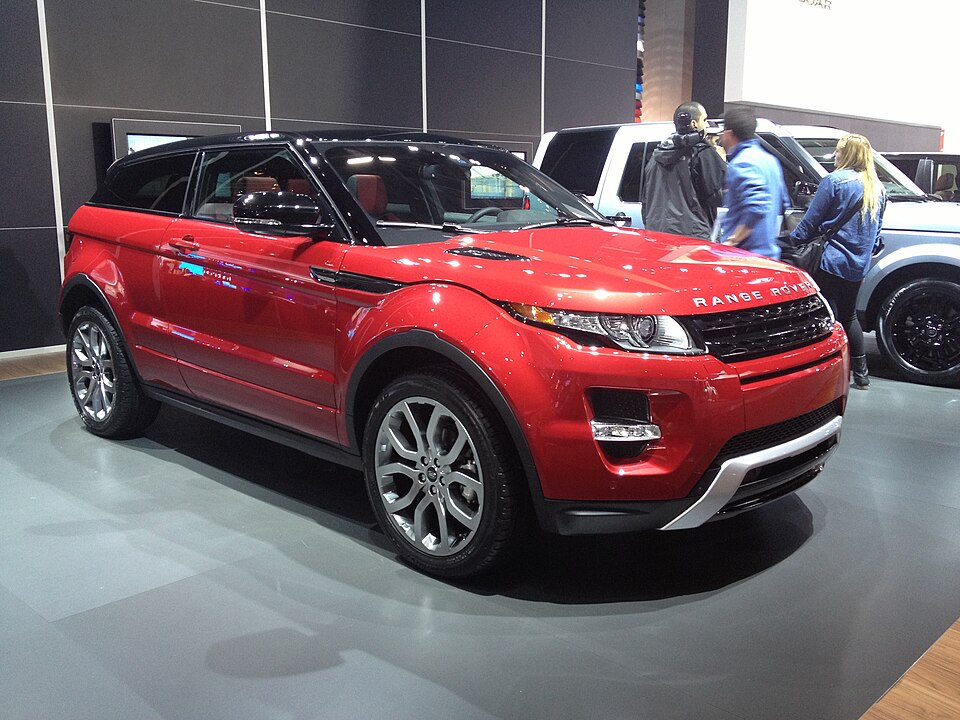
2013 Land Rover Range Rover Evoque recalls and problems

The 2013 Land Rover Range Rover Evoque has 1 recall and 46 owner complaints on file with NHTSA; the most reported problem area is engine.

2013 Land Rover Range Rover Evoque
Photo: 2013 Land Rover Range Rover Evoque by Sarah Larson from Ann Arbor, MI, USA, CC BY 2.0, via Wikimedia Commons
How the 2013 compares
Fewest complaintsMost complaints

High complaint count among 14 Range Rover Evoque model years — 5th most.

1recalls
46complaints
2crashes
0fires
0injuries
56,000median miles

Owner complaints filed with NHTSA, not verified and not adjusted for sales. Ranking compares this model's own years only.

Does your car have an open recall?
Recalls apply to specific vehicles. Only a VIN lookup on NHTSA's official site shows whether yours is affected and still unrepaired.
Check your VIN →

1 recall

Air Bags

Jul 1, 2014 · NHTSA campaign 14V395000 · 40,551 vehicles

Problem: Jaguar Land Rover North America, LLC (Land Rover) is recalling certain model year 2010-2015 LR2 and 2012-2013 Range Rover Evoque vehicles. A component within the Occupant Classification System (OCS) Electronic Control Unit (ECU) may fail, resulting in the front seat passenger air bag being totally or partially disabled.

Risk: In the event of a crash necessitating air bag deployment, if the air bag is disabled, the air bag may not deploy or may not deploy properly, increasing the risk of injury to the front seat passenger.

Remedy & notes

Land Rover will notify owners, and dealers will update the Restraint Control Module software, free of charge. The recall began on August 30, 2014. Owners may contact Land Rover customer service at 1-800-637-6837. Land Rover's number for this recall is P046.

Owners may also contact the National Highway Traffic Safety Administration Vehicle Safety Hotline at 1-888-327-4236 (TTY 1-800-424-9153), or go to www.safercar.gov.

Recall text as published by NHTSA and the manufacturer.

What owners complain about

Owner complaints filed with NHTSA; one complaint can name several areas. Not verified by NHTSA.

Complaints by year filed

2014: 3 complaints20142015: 2 complaints2016: 6 complaints20162017: 3 complaints2018: 3 complaints20182019: 5 complaints2020: 4 complaints20202021: 7 complaints72022: 7 complaints20222023: 2 complaints2024: 1 complaints20242025: 1 complaints2026: 2 complaints20262

NHTSA investigations

Desiccated Air Bag Inflator Rupture

EA21002 · opened Sep 17, 2021 · open
Summary

From 2000 through 2017, Takata produced millions of air bag inflators using two types of phase-stabilized ammonium nitrate ("PSAN") propellant -- propellant 2004 and propellant 2004L. After prolonged exposure to high temperature cycles and humidity, inflators using propellant 2004 can degrade, causing the propellant to burn too quickly when ignited. The rapid burning can cause the inflator to rupture during deployment, potentially causing serious or even fatal injury to vehicle occupants. See 2016 Blomquist Report at www.nhtsa.gov/sites/nhtsa.gov/files/documents/expert_report-hrblomquist.pdf.Consequently, all frontal inflators using propellant 2004 that do not contain a "desiccant" (a substance that traps and holds moisture) in US vehicles are under recall. These "non-desiccated" inflators either have been or are required to be replaced.In some cases, the remedy part for these recalled inflators was, or will be, an inflator using either propellant 2004 or 2004L that does contain a desiccant. None of these "desiccated" remedy parts (which were installed in older model year vehicles) are currently under recall for a degradation concern. Certain subsets of desiccated PSAN inflators using propellant 2004 for use as original equipment, however, have been recalled for a degradation concern. All Takata inflators produced with propellant 2004L contain desiccant, and none of these desiccated inflators using propellant 2004L are under recall for a degradation concern. There have been n…

Loss of Brake Power Assist

EA20001 · opened Aug 31, 2020 · closed Feb 27, 2023
Summary

On August 31, 2020, ODI upgraded PE18-014 to Engineering Analysis (EA)20-001 to continue its investigation of brake vacuum pump failures in model year (MY) 2012-2013 Range Rover Evoque vehicles and peer Jaguar Land Rover (JLR) products equipped with 2.0L GTDI engines fitted with Magna vacuum pumps. This investigative activity has focused on the cause, scope, and effect of inadequate vacuum supply at the vehicles brake booster with its attendant increases of brake pedal effort and diminished braking performance. Following a detailed analysis of data collected, the alleged defect is progressive and reasonably detectable with adequate power braking assist available prior to complete pump failure; occurs at marginal failure rates, particularly where the vehicle age is considered; and the complaint trend dissipated to one occurrence per year over the last three calendar years.Based on the analysis conducted, this investigation has been closed. The closing of this investigation does not foreclose the Agency from taking further action, if warranted, or the potential for a future finding that a safety-related defect exists, based upon additional information the Agency may receive. For a detailed summary of the investigation see attached closing resume document.The ODI reports cited above can be reviewed at: http://www-odi.nhtsa.dot.gov/owners/SearchNHTSAID using the following complaint identification numbers: 10986358, 11025409, 11083348, 11131896, 11149724, 11231234, 11343256, 11425…

Loss of Brake Power Assist

PE18014 · opened Dec 1, 2018 · closed Sep 10, 2020
Summary

On December 1, 2018, the Office of Defects Investigation (ODI) opened Preliminary Evaluation PE18-014 to investigate allegations of brake vacuum pump failure in model year (MY) 2012 through 2014 Range Rover Evoque vehicles. During PE18-014, ODI identified 33 complaints and field reports related to the alleged defect in the subject vehicles. Seven of the complaints were received by ODI and 26 were reported as consumer complaints or field reports in the Jaguar Land Rover (JLR) response to ODI's Information Request letter for PE18-014. All the complaints and field reports identified by ODI involved MY 2012-2013 Range Rover Evoque vehicles. ODI's analysis of warranty data supplied by JLR identified 198 claims related to the alleged defect in MY 2012-2013 vehicles, resulting in a claim rate of 0.84 percent. ODI identified just 6 claims in the MY 2014 Range Rover Evoque vehicles, resulting in a claim rate of0.09 percent.The subject vehicles are equipped with 2.0 liter Gasoline Turbocharged Direct Injection (GTDI) engines that utilize a mechanically driven single vane rotary vacuum pump supplied by Magna International (Magna). The 2.0L GTDI engines and subject Magna vacuum pumps were used by JLR in the following applications: MY 2012-2017 Land Rover Range Rover Evoque (L538), MY 2013-2015 Land Rover LR2 (L359), MY 2015-2017 Land Rover Discovery Sport (L550), MY 2013-2015 Jaguar XF (X250), and MY 2017 Jaguar XE (X760). Field return analyses of failed vacuum pumps from these products …

Powered vehicle rollaway

PE16015 · opened Dec 16, 2016 · closed Aug 11, 2020
Summary

On December 16, 2016, ODI opened PE16-015 to investigate seven complaints alleging incidents of powered rollaway in model year (MY) 2012 through 2014 Land Rover/Range Rover Evoque and Jaguar XF vehicles. The complaints all alleged that the rollaway incidents occurred after the operators shifted to Park and exited the vehicle with the engine left running. All of the incidents alleged that crashes resulted from the unexpected vehicle movement and three alleged injuries. Two of the complaints counted in the opening resume (ID's 10760326 and 10884136) involved the same vehicle and incident. ODI has not received any new complaints since PE16-015 was opened, resulting in current ODI report totals of 6 incidents, 6 crashes and 3 injuries. Field data provided by Jaguar Land Rover (JLR) in response to ODI's information request letter for PE16-015 included 10 allegations of powered rollaway incidents in the subject vehicles, including 9 alleging crashes. Updates provided by JLR through October 25, 2019, have identified one additional powered rollaway allegation in the subject vehicles. The new incident included a crash allegation, bringing the JLR field incident totals to 11 incidents and 10 crashes. None of the JLR reports allege injuries. Two of the JLR reports are duplicates of incidents reported to ODI, resulting in a total of 15 incidents, 14 crashes and 3 injury allegations in the subject vehicles. ODI's analysis of system design and field incident investigative data has not iden…

2013 vs. other Land Rover Range Rover Evoque years

Owner complaints by model year; the darker bar is the 2013. Click a bar to switch year.

Questions

Does the 2013 Land Rover Range Rover Evoque have recalls?

Yes — NHTSA lists 1 recall campaign covering the 2013 Land Rover Range Rover Evoque, the latest from Jul 1, 2014 (air bags). A recall applies to specific vehicles: enter your VIN at nhtsa.gov/recalls to see whether yours is affected and still open.

What are the most common problems with the 2013 Land Rover Range Rover Evoque?

Owner complaints filed with NHTSA most often mention engine (9), fuel system (8), air bags (7). Complaints are consumer reports and are not verified by NHTSA.