2015 Kia Optima Hybrid recalls and problems

The 2015 Kia Optima Hybrid has 0 recalls and 12 owner complaints on file with NHTSA; the most reported problem area is electrical system.

2014 Kia Optima Hybrid
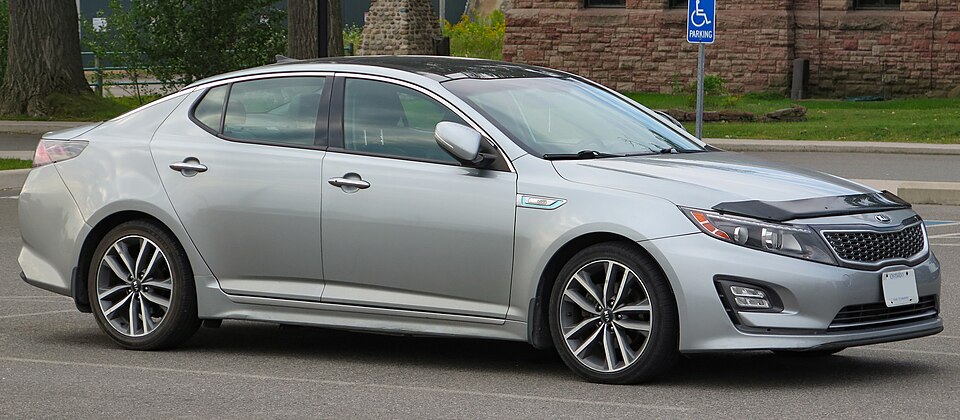
Pictured: a 2014 model; the 2015 may differ in details. Photo: 2014 Kia Optima Hybrid by Elise240SX, CC BY-SA 4.0, via Wikimedia Commons
How the 2015 compares
Fewest complaintsMost complaints

Low complaint count among 9 Optima Hybrid model years — 6th most.

0recalls
12complaints
0crashes
2fires
0injuries
60,400median miles

Owner complaints filed with NHTSA, not verified and not adjusted for sales. Ranking compares this model's own years only.

Does your car have an open recall?
Recalls apply to specific vehicles. Only a VIN lookup on NHTSA's official site shows whether yours is affected and still unrepaired.
Check your VIN →

0 recalls

No recall campaigns on file.

Recall text as published by NHTSA and the manufacturer.

What owners complain about

Owner complaints filed with NHTSA; one complaint can name several areas. Not verified by NHTSA.

Complaints by year filed

2018: 8 complaints201882019: 3 complaints20192021: 1 complaints20211

NHTSA investigations

Pedestrian alert sounds

DP22005 · opened Jan 27, 2023 · closed Aug 7, 2023 · led to recall 22V063000
Summary

NHTSA received a petition on or about July 18, 2022, requesting that Federal Motor Vehicle Safety Standard (FMVSS) 141 be applied to all electric and hybrid vehicles operating in the United States. The petition can be reviewed at NHTSA.gov under ODI Number 11486072. FMVSS 141 establishes performance requirements for pedestrian alert sounds for motor vehicles. The standard applies to hybrid and electric vehicles that have a gross vehicle weight rating of 4,536 KG or less or are defined as low-speed vehicles. The standard became fully applicable to all such vehicles manufactured on or after March 1, 2021.On January 27, 2023, NHTSA opened Defect Petition (DP) 22-005 to evaluate the subject matter described in the petition. On June 24, 2023 and as supplemented on June 25, 2023, the petitioner notified NHTSA he was withdrawing his petition. The petitioner indicated that, based on his review of data, there is no justification for asserting potential benefits that could be derived from actions sought by my petition. Based on the petitioner's withdrawal, DP22-005 is closed. Closure of this DP does not represent a determination by NHTSA regarding the subject matter of the petition.

Loss of Motive Power

DP22003 · opened Sep 12, 2022 · closed Dec 12, 2023
Summary

The National Highway Traffic Safety Administration (NHTSA) received a letter dated July 13, 2022, petitioning the Agency to initiate a safety defect investigation into loss of motive power allegations attributed to oil drain pan assembly failures on certain Hyundai Motor America, Inc. and Kia America, Inc. vehicles spanning Model Years (MY) 2005-2021. The Petitioners cited examples of complaints indicating that the subject vehicles were experiencing rapid loss of engine oil due to oil drain plug back outs, resulting in loss of motive power and/or catastrophic engine damage. Additional complaints were provided which alleged that the oil drain pans lack sufficient structural integrity and are susceptible to cracking. The petition itself can be reviewed at NHTSA.gov under ODI number 11481745. On September 12, 2022, the Office of Defects Investigation (ODI) opened Defect Petition (DP22-003) to evaluate the Petitioners’ request. The Petitioners have provided additional complaints within four supplemental letters dated January 31, 2023, March 21, 2023, May 23, 2023, and August 4, 2023. ODI’s evaluation included the review and analysis of the complaints and supporting information submitted by the Petitioners, as well as additional complaints submitted directly to NHTSA which referenced either the oil drain plug or a crack in the oil pan. After reviewing the available data, ODI has not identified evidence that would support opening a defect investigation into the oil drain pan as…

Electrical overstress

EA19001 · opened Apr 19, 2019 · closed Sep 19, 2024 · led to recall 20V024
Summary

The Office of Defects Investigation (ODI) opened this investigation to determine if the failure of airbags to deploy during severe crashes, in certain vehicles, was the result of a safety related defect.  During the investigation a complex failure was studied that can result in non-deployment of subject vehicle air bags and other restraint system devices in severe crash events. The subject vehicles may be equipped with an airbag control unit (ACU) for the supplemental restraint system (SRS) Electronic Control Unit (ECU) manufactured by ZF-TRW.  The ECU receives signals from crash sensors mounted in the vehicle and deploys the vehicle air bags and seat belt pretensioners in accordance with manufacturer design specifications.  The ECU in the subject vehicles contains a model DS84 application-specific integrated circuit (ASIC) which controls the communication of the crash sensor signal, firing commands (i.e., when to deploy the airbag(s) and/or pretensioners), and fault information (e.g., diagnostic trouble codes). In September 2016, FCA announced recall 16V-668 for certain model year (MY) 2010 to 2014 Chrysler, Dodge and Jeep products manufactured with the subject ZF-TRW ACU.  In this recall, FCA discussed an EOS condition that resulted in a failure of the subject DS84 ASIC, which caused air bag non-deployment.  FCA noted that the defect condition had only been observed in vehicles equipped with sensor harnessing routed across the front of the vehicle.  Other FCA vehicles…

2015 vs. other Kia Optima Hybrid years

Owner complaints by model year; the darker bar is the 2015. Click a bar to switch year.

Questions

Does the 2015 Kia Optima Hybrid have recalls?

NHTSA lists no recall campaigns for the 2015 Kia Optima Hybrid. Check your VIN at nhtsa.gov/recalls to be sure.

What are the most common problems with the 2015 Kia Optima Hybrid?

Owner complaints filed with NHTSA most often mention electrical system (5), engine (5), steering (2). Complaints are consumer reports and are not verified by NHTSA.