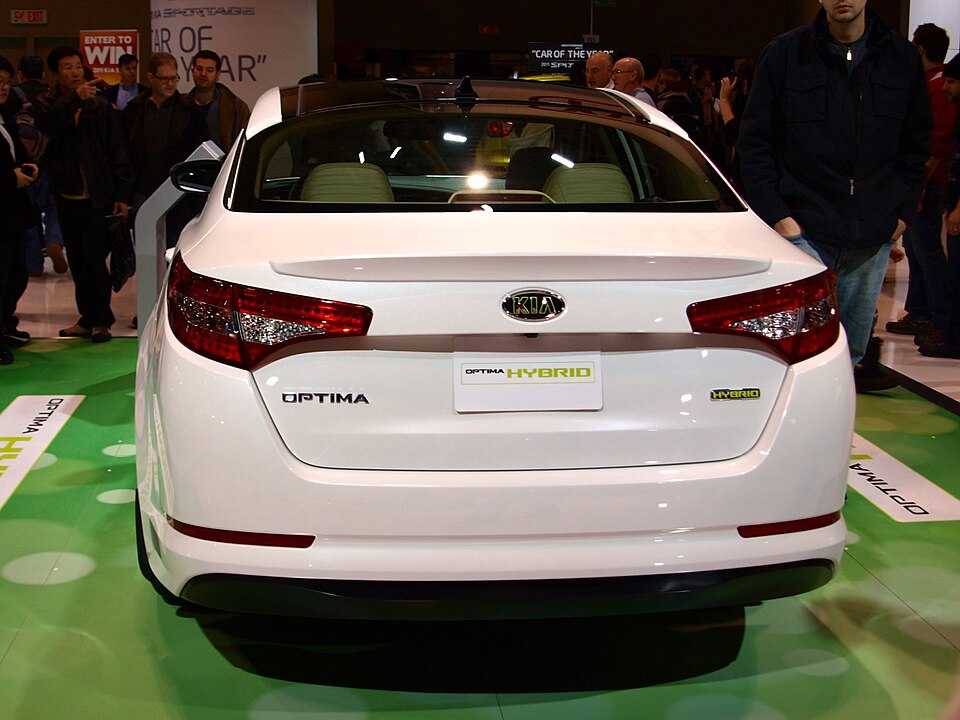
The 2012 Kia Optima Hybrid has 3 recalls and 109 owner complaints on file with NHTSA; the most reported problem area is engine.
Park outside warning. Owners are advised to park outside and away from buildings until the repair is done, because of a fire risk. Campaign: 23V652000.
Highest complaint count among 9 Optima Hybrid model years — the most of any year.
3recalls
109complaints
5crashes
5fires
2injuries
87,200median miles
Owner complaints filed with NHTSA, not verified and not adjusted for sales. Ranking compares this model's own years only.
Does your car have an open recall? Recalls apply to specific vehicles. Only a VIN lookup on NHTSA's official site shows whether yours is affected and still unrepaired.
Problem: Kia America, Inc. (Kia) is recalling certain 2010-2019 Borrego, 2014-2016 Cadenza, 2010-2013 Forte, Forte Koup, Sportage, 2015-2018 K900, 2011-2015 Optima, 2011-2013 Optima Hybrid, Soul, 2012-2017 Rio, 2011-2014 Sorento, and 2010-2011 Rondo vehicles. The Hydraulic Electronic Control Unit (HECU) may experience an electrical short, which can result in an engine compartment fire while parked or driving.
Risk: An engine compartment fire while parked or driving can increase the risk of injury.
Remedy & notes
Owners are advised to park outside and away from structures until the recall repair is complete. Dealers will replace the HECU fuse, free of charge. Interim notification letters, notifying owners of the safety risk, were mailed November 14, 2023. Owner notification letters were mailed March 29, 2024 through June 18, 2024. Owners may contact Kia customer service at 1-800-333-4542. Kia's number for this recall is SC284.
Owners may also contact the National Highway Traffic Safety Administration Vehicle Safety Hotline at 1-888-327-4236 (TTY 1-800-424-9153), or go to www.nhtsa.gov.
Engine
Dec 2, 2020 · NHTSA campaign 20V750000 · 294,756 vehicles
Problem: Kia Motors America (Kia) is recalling certain 2012-2013 Sorento, 2012-2015 Forte and Forte Koup, 2011-2013 Optima Hybrid, 2014-2015 Soul, and 2012 Sportage vehicles. An engine compartment fire can occur while driving.
Risk: An engine compartment fire increases the risk of injury.
Remedy & notes
Kia will notify owners, and dealers will inspect the engine compartment for fuel and/or engine oil leaks, perform an engine test and make any repairs, including engine replacement, as necessary, free of charge. In addition, Kia dealers will update the Knock Sensor Detection System (KSDS) software, free of charge. The recall began January 27, 2021. Owners may contact Kia customer service at 1-800-333-4542. Kia's number for this recall is SC200.
Owners may also contact the National Highway Traffic Safety Administration Vehicle Safety Hotline at 1-888-327-4236 (TTY 1-800-424-9153), or go to www.safercar.gov.
Air Bags
Jun 1, 2018 · NHTSA campaign 18V363000 · 507,587 vehicles
Problem: Kia Motors America (Kia) is recalling certain 2010-2013 Kia Forte, Forte Koup, 2011-2013 Kia Optima and 2011-2012 Kia Optima Hybrid and Sedona vehicles. In the event of a crash, the air bag control unit (ACU) may short circuit, preventing the frontal air bags and seat belt pretensioners from deploying.
Risk: If the frontal air bags and seat belt pretensioners are disabled, there is an increased risk of injury to the vehicle occupants in the event of a vehicle crash that necessitates deployment of these safety systems.
Remedy & notes
Kia will notify owners. For model year 2011 Sedona vehicles, Kia will instruct dealers to verify the ACU part number and, if necessary, install an extension wire harness kit between the ACU Connector and the Vehicle Harness Connector. For all other affected vehicles, Kia will instruct dealers to install the extension wire harness kit. The recall began September 28, 2018. Owners may contact Kia customer service at 1-800-333-4542. Kia's number for this recall is SC165.
Owners may also contact the National Highway Traffic Safety Administration Vehicle Safety Hotline at 1-888-327-4236 (TTY 1-800-424-9153), or go to www.safercar.gov.
Recall text as published by NHTSA and the manufacturer.
Owner complaints filed with NHTSA; one complaint can name several areas. Not verified by NHTSA.
Complaints by year filed
NHTSA investigations
Hyundai and Kia ABS Module Fires
AQ23002 · opened Nov 17, 2023 · open
Summary
The Office of Defects Investigation (ODI) has received eight Hyundai Motor America (Hyundai) and eight Kia America, Inc. (Kia) Part 573 Recall Reports between 2016 and 2023. The combined 16 safety recalls all involve the antilock braking system (ABS) modules or Hydraulic Electronic Control Units (HECU) manufactured by the equipment supplier Mando. The Part 573 Recall Reports contain varying defect descriptions and differing remedy descriptions for the same or similar equipment supplied by Mando. Safety recalls included in this Audit Query (AQ) review include: Hyundai recalls 20V-520, 20V-543, 21V-161, 21V-160, 21V-303, 22V-056, 22V-810, and 23V-651. Kia recalls 16V-815, 20V-518, 20V-519, 21V-137, 21V-331, 22V-051, 22V-800, and 23V-652 The purpose of this AQ is to evaluate the timeliness and scoping of Hyundai and Kiaâs defect decision making and adherence with reporting requirements; and understand the varying defect descriptions and remedies between these recalls.
Pedestrian alert sounds
DP22005 · opened Jan 27, 2023 · closed Aug 7, 2023 · led to recall 22V063000
Summary
NHTSA received a petition on or about July 18, 2022, requesting that Federal Motor Vehicle Safety Standard (FMVSS) 141 be applied to all electric and hybrid vehicles operating in the United States. The petition can be reviewed at NHTSA.gov under ODI Number 11486072. FMVSS 141 establishes performance requirements for pedestrian alert sounds for motor vehicles. The standard applies to hybrid and electric vehicles that have a gross vehicle weight rating of 4,536 KG or less or are defined as low-speed vehicles. The standard became fully applicable to all such vehicles manufactured on or after March 1, 2021.On January 27, 2023, NHTSA opened Defect Petition (DP) 22-005 to evaluate the subject matter described in the petition. On June 24, 2023 and as supplemented on June 25, 2023, the petitioner notified NHTSA he was withdrawing his petition. The petitioner indicated that, based on his review of data, there is no justification for asserting potential benefits that could be derived from actions sought by my petition. Based on the petitioner's withdrawal, DP22-005 is closed. Closure of this DP does not represent a determination by NHTSA regarding the subject matter of the petition.
Loss of Motive Power
DP22003 · opened Sep 12, 2022 · closed Dec 12, 2023
Summary
The National Highway Traffic Safety Administration (NHTSA) received a letter dated July 13, 2022, petitioning the Agency to initiate a safety defect investigation into loss of motive power allegations attributed to oil drain pan assembly failures on certain Hyundai Motor America, Inc. and Kia America, Inc. vehicles spanning Model Years (MY) 2005-2021. The Petitioners cited examples of complaints indicating that the subject vehicles were experiencing rapid loss of engine oil due to oil drain plug back outs, resulting in loss of motive power and/or catastrophic engine damage. Additional complaints were provided which alleged that the oil drain pans lack sufficient structural integrity and are susceptible to cracking. The petition itself can be reviewed at NHTSA.gov under ODI number 11481745. On September 12, 2022, the Office of Defects Investigation (ODI) opened Defect Petition (DP22-003) to evaluate the Petitionersâ request. The Petitioners have provided additional complaints within four supplemental letters dated January 31, 2023, March 21, 2023, May 23, 2023, and August 4, 2023. ODIâs evaluation included the review and analysis of the complaints and supporting information submitted by the Petitioners, as well as additional complaints submitted directly to NHTSA which referenced either the oil drain plug or a crack in the oil pan. After reviewing the available data, ODI has not identified evidence that would support opening a defect investigation into the oil drain pan as…
Engine Fires
EA21003 · opened Dec 22, 2021 · closed Feb 5, 2024 · led to recall 23V877
Summary
On March 29, 2019, the Office of Defects Investigation (ODI) opened two Preliminary Evaluations (PE19-003 on Hyundai and PE19-004 on Kia) to broadly investigate incidents of non-crash fires (regardless of origin or operational status of the vehicle) on various model year Hyundai and Kia vehicles. During the PE investigations, Hyundai and Kia issued several recalls to address vehicle fires, including those due to engine failures involving various engine types. The remedies for the engine failure recalls typically involve engine inspection (to detect existing damage), and if necessary, engine replacement. Additionally, both manufacturers have been installing an engine control software modification known as Knock Sensor Detection Software (KSDS) which is intended to detect impending engine failure, alert the driver, and limit engine power (to lessen likelihood of engine failure).KSDS is being installed under recalls and non-safety field actions, and both companies have extended limited engine warranties (see recall files). On December 22, 2021, ODI upgraded PE19-003 and PE19-004 to this Engineering Analysis (EA21-003, covering both Hyundai and Kia) to evaluate the scope of the prior recalls related to engine failures/fires and the efficacy of the recall remedies for the recalls, as well as the long-term viability of related programs and non-safety field actions being conducted by Hyundai and Kia. The former issue involved approximately 550,000 MY 2013 Hyundai Elantra, MY…
Electrical overstress
EA19001 · opened Apr 19, 2019 · closed Sep 19, 2024 · led to recall 20V024
Summary
The Office of Defects Investigation (ODI) opened this investigation to determine if the failure of airbags to deploy during severe crashes, in certain vehicles, was the result of a safety related defect. During the investigation a complex failure was studied that can result in non-deployment of subject vehicle air bags and other restraint system devices in severe crash events. The subject vehicles may be equipped with an airbag control unit (ACU) for the supplemental restraint system (SRS) Electronic Control Unit (ECU) manufactured by ZF-TRW.  The ECU receives signals from crash sensors mounted in the vehicle and deploys the vehicle air bags and seat belt pretensioners in accordance with manufacturer design specifications.  The ECU in the subject vehicles contains a model DS84 application-specific integrated circuit (ASIC) which controls the communication of the crash sensor signal, firing commands (i.e., when to deploy the airbag(s) and/or pretensioners), and fault information (e.g., diagnostic trouble codes). In September 2016, FCA announced recall 16V-668 for certain model year (MY) 2010 to 2014 Chrysler, Dodge and Jeep products manufactured with the subject ZF-TRW ACU.  In this recall, FCA discussed an EOS condition that resulted in a failure of the subject DS84 ASIC, which caused air bag non-deployment. FCA noted that the defect condition had only been observed in vehicles equipped with sensor harnessing routed across the front of the vehicle.  Other FCA vehicles…
Non-crash Vehicle Fires
PE19004 · opened Mar 29, 2019 · closed Dec 22, 2021 · led to recall 20V088000
Summary
During this Preliminary Evaluation (PE), the Office of Defects Investigation (ODI) assessed the scope, frequency and potential safety-related consequences of non-crash vehicle fires caused by both engine failures and failures of other vehicle systems/components in model year (MY) 2011-2014 Kia Optima, MY 2011-2014 Kia Sorento and MY 2010-2015 Kia Soul vehicles equipped with Theta II, Gamma, Nu and Lambda II engines (approximately 1.7 million vehicles). ODI also reviewed field and other data on other Kia vehicles (approximately 3.6 million additional vehicles) equipped with the same engines used in the above-mentioned vehicles.As a result of this PE, Kia has issued NHTSA Recalls 20V-750 and 21V-844 to address potential engine failures and fires in certain Kia vehicles equipped with various engine types.Additional information on these and other related recall actions is available in the downloadable version of this resume available at NHTSA.gov.In addition, ODI has upgraded this PE to an Engineering Analysis (EA) 21-003 which will focus on potential recall scope concerns and recall remedy concerns related to the engine failure-related recalls mentioned above and conducted previously.See the EA21-003 Opening Resume available at NHTSA.gov for more information.Also available in the downloadable version of this resume is a list of the reference numbers for the 444 ODI reports, or Vehicle Owner Questionnaires (VOQs), cited above which ODI received through mid-November 2021.Note that…
Non-crash Vehicle Fires
DP18003 · opened Aug 21, 2018 · closed May 10, 2019 · led to recall 18V907000
Summary
In a letter dated June 11, 2018, the Center for Auto Safety (CAS) petitioned the National Highway Traffic Safety Administration (NHTSA) to initiate a safety defect investigation into non-collision related fires on model year (MY) 2011-2014 Kia Optima and Sorento, and Hyundai Sonata and Santa Fe vehicles. In a letter dated July 24, 2018, CAS requested that MY 2010-2015 Kia Soul vehicles be added to the petition. CAS stated that there is a higher number of complaints to NHTSA regarding non-crash fires on these vehicles compared to other similar vehicles. The Office of Defects Investigation (ODI) had already opened Recall Queries (RQ17-003 and RQ17-004) on all Kia and Hyundai vehicles equipped with Theta II engines for engine failures that may cause stalling and fires.The queries cover most of the petition subject Optima, Sorento, Sonata, and Santa Fe vehicles but not any of the subject Soul vehicles.On August 21, 2018, ODI opened a Defect Petition (DP18-003) to evaluate whether to grant or deny the CAS petition. ODI sent Information Request letters to Kia and Hyundai (September and October 2018) requesting information on all engine and non-engine related fires in the petition vehicles.ODI performed extensive analysis on the information obtained from Kia and Hyundai. During the DP18-003 analysis, Kia and Hyundai each initiated three additional safety recalls related to engine compartment fires on certain petitioned and non-petitioned vehicles (nearly 740,000 total vehicles: Reca…
2012 vs. other Kia Optima Hybrid years
Owner complaints by model year; the darker bar is the 2012. Click a bar to switch year.
Questions
Does the 2012 Kia Optima Hybrid have recalls?
Yes — NHTSA lists 3 recall campaigns covering the 2012 Kia Optima Hybrid, the latest from Sep 25, 2023 (service brakes). A recall applies to specific vehicles: enter your VIN at nhtsa.gov/recalls to see whether yours is affected and still open.
What are the most common problems with the 2012 Kia Optima Hybrid?
Owner complaints filed with NHTSA most often mention engine (73), electrical system (20), service brakes (12). Complaints are consumer reports and are not verified by NHTSA.
Is it safe to drive the 2012 Kia Optima Hybrid?
1 recall advises parking outside because of a fire risk. Only vehicles with the recall open are affected — check your VIN at nhtsa.gov/recalls.
 Recalls by Model