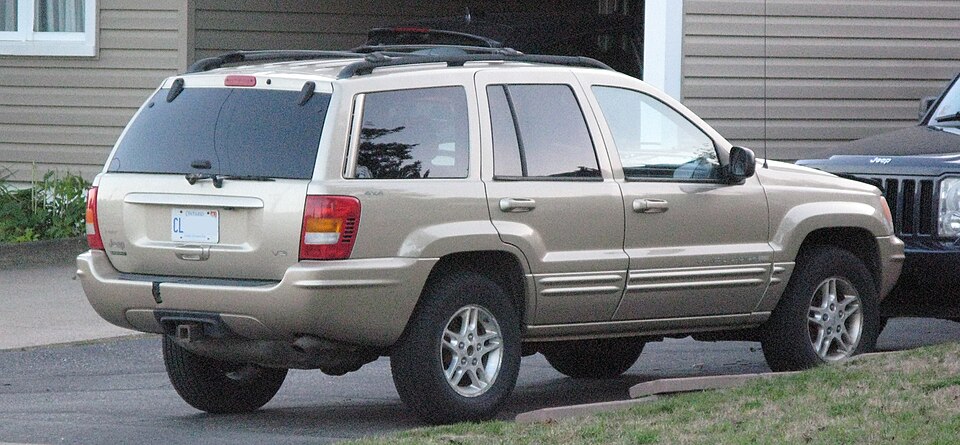
2000 Jeep Grand Cherokee recalls and problems

The 2000 Jeep Grand Cherokee has 6 recalls and 1,447 owner complaints on file with NHTSA; the most reported problem area is service brakes.

2000 Jeep Grand Cherokee
Photo: 2000 Jeep Grand Cherokee by SsmIntrigue, CC BY-SA 4.0, via Wikimedia Commons
How the 2000 compares
Fewest complaintsMost complaints

High complaint count among 27 Grand Cherokee model years — 6th most.

6recalls
1,447complaints
108crashes
18fires
93injuries
88,450median miles

Owner complaints filed with NHTSA, not verified and not adjusted for sales. Ranking compares this model's own years only.

Does your car have an open recall?
Recalls apply to specific vehicles. Only a VIN lookup on NHTSA's official site shows whether yours is affected and still unrepaired.
Check your VIN →

6 recalls

Engine

Jun 8, 2006 · NHTSA campaign 06V199000 · 189,479 vehicles

Problem: On certain sport utility vehicles, the plastic blades of the electric motor driven cooling fan May separate and penetrate the shroud.

Original NHTSA wording

ON CERTAIN SPORT UTILITY VEHICLES, THE PLASTIC BLADES OF THE ELECTRIC MOTOR DRIVEN COOLING FAN MAY SEPARATE AND PENETRATE THE SHROUD.

Risk: If this occurs while the hood is open, a person in the vicinity of the engine could be struck by the blade and injured.

Original NHTSA wording

IF THIS OCCURS WHILE THE HOOD IS OPEN, A PERSON IN THE VICINITY OF THE ENGINE COULD BE STRUCK BY THE BLADE AND INJURED.

Remedy & notes

Dealers will replace the electric cooling fan modules free of charge. The recall began on September 4, 2006. Owners May contact daimlerchrysler at 1-800-853-1403.

Daimlerchrysler recall no. F25.customers May also contact the national highway traffic safety administration's vehicle safety hotline at 1-888-327-4236 (tty 1-800-424-9153), or go to http://www.safercar.gov.

Fuel System

Apr 8, 2002 · NHTSA campaign 02V104000 · 1,115,322 vehicles

Problem: On certain sport utility vehicles equipped with a 4.0L engine only, the design of the intake and exhaust manifolds could allow debris to accumulate at the #3 cylinder location.

Original NHTSA wording

ON CERTAIN SPORT UTILITY VEHICLES EQUIPPED WITH A 4.0L ENGINE ONLY, THE DESIGN OF THE INTAKE AND EXHAUST MANIFOLDS COULD ALLOW DEBRIS TO ACCUMULATE AT THE #3 CYLINDER LOCATION.

Risk: This could result in a vehicle fire.

Original NHTSA wording

THIS COULD RESULT IN A VEHICLE FIRE.

Remedy & notes

Dealers will install a manifold shield to modify the air flow characteristics and to prevent the accumulation of debris in the area of the #3 cylinder. Owner notification began May 13, 2002. Owners who take their vehicles to an authorized dealer on an agreed upon service date and do not receive the free remedy within a reasonable time should contact daimlerchrysler at 1-800-853-1403.

Daimlerchrysler recall no.B06.also, customers can contact the national highway traffic safety administration's auto safety hotline at 1-888-DASH-2-DOT (1-888-327-4236).

Fuel System

Jul 17, 2000 · NHTSA campaign 00V195000 · 1,500 vehicles

Problem: Vehicle description: Sport utility vehicles. Some of these vehicles May have been built with fuel tanks with suspect vent tube welds.

Original NHTSA wording

VEHICLE DESCRIPTION: SPORT UTILITY VEHICLES. SOME OF THESE VEHICLES MAY HAVE BEEN BUILT WITH FUEL TANKS WITH SUSPECT VENT TUBE WELDS.

Risk: Separation of the vent tube weld could result in a fuel leak. Fuel leakage in the presence of an ignition source could result in a fire.

Original NHTSA wording

SEPARATION OF THE VENT TUBE WELD COULD RESULT IN A FUEL LEAK. FUEL LEAKAGE IN THE PRESENCE OF AN IGNITION SOURCE COULD RESULT IN A FIRE.

Remedy & notes

Dealers will replace any fuel tanks built in the suspect time period. The vehicle will be inspected and if the bar code on the fuel tank indicates that the tank was built during the suspect period, it will be replaced.

Owner notification began August 28, 2000. Owners who take their vehicles to an authorized dealer on an agreed upon service date and do not receive the free remedy within a reasonable time should contactdaimlerchrysler at 1-800-992-1997. Also contact the national highway traffic safety administration's auto safety hotline at 1-888-DASH-2-DOT (1-888-327-4236).

Seat Belts

Feb 4, 2000 · NHTSA campaign 00V034000 · 204,000 vehicles

Problem: Vehicle description: Passenger vehicles. The seat belt shoulder height adjustable turning loop (atl) top mounting bolt was inadequately manufactured.

Original NHTSA wording

VEHICLE DESCRIPTION: PASSENGER VEHICLES. THE SEAT BELT SHOULDER HEIGHT ADJUSTABLE TURNING LOOP (ATL) TOP MOUNTING BOLT WAS INADEQUATELY MANUFACTURED.

Risk: The affected mounting bolts May not withstand sufficient force to function properly in certain impact situations, increasing the risk of injury to a belted occupant.

Original NHTSA wording

THE AFFECTED MOUNTING BOLTS MAY NOT WITHSTAND SUFFICIENT FORCE TO FUNCTION PROPERLY IN CERTAIN IMPACT SITUATIONS, INCREASING THE RISK OF INJURY TO A BELTED OCCUPANT.

Remedy & notes

Dealers will replace the shoulder belt height adjuster mounting bolts.

Owner notification began March 13, 2000. Owners who take their vehicles to an authorized dealer on an agreed upon service date and do not receive the free remedy within a reasonable time should contact daimlerchrysler at 1-800-992-1997.also contact the national highway traffic safety administration's auto safety hotline at 1-888-DASH-2-DOT (1-888-327-4236).

Air Bags

Dec 2, 1999 · NHTSA campaign 99V343000 · 350 vehicles

Problem: Vehicle description: Passenger and sport utility vehicles. The passenger air bag inflator assembly contains an incorrect inflator charge amount.

Original NHTSA wording

VEHICLE DESCRIPTION: PASSENGER AND SPORT UTILITY VEHICLES. THE PASSENGER AIR BAG INFLATOR ASSEMBLY CONTAINS AN INCORRECT INFLATOR CHARGE AMOUNT.

Risk: This condition could increase the risk of a passenger occupant injury under certain accident conditions.

Original NHTSA wording

THIS CONDITION COULD INCREASE THE RISK OF A PASSENGER OCCUPANT INJURY UNDER CERTAIN ACCIDENT CONDITIONS.

Remedy & notes

Dealers will replace the air bag module with a correct module.

Owner notification began January 24, 2000.owners who take their vehicles to an authorized dealer on an agreed upon service date and do not receive the free remedy within a reasonable time should contact daimlerchrysler at 1-800-992-1997.also contact the national highway traffic safety administration's auto safety hotline at 1-888-DASH-2-DOT (1-888-327-4236).

Steering

Nov 4, 1999 · NHTSA campaign 99V312000 · 1,259 vehicles

Problem: Vehicle description: Sport utility vehicles. Some steering gear units were assembled with internal end-of-travel-stops that missed the heat treat process, resulting in soft internal travel stops.

Original NHTSA wording

VEHICLE DESCRIPTION: SPORT UTILITY VEHICLES. SOME STEERING GEAR UNITS WERE ASSEMBLED WITH INTERNAL END-OF-TRAVEL-STOPS THAT MISSED THE HEAT TREAT PROCESS, RESULTING IN SOFT INTERNAL TRAVEL STOPS.

Risk: This could result in sticking, binding, or seizing of the steering gear.

Original NHTSA wording

THIS COULD RESULT IN STICKING, BINDING, OR SEIZING OF THE STEERING GEAR.

Remedy & notes

Dealers will replace the steering gear on involved vehicles.

Daimlerchrysler recall no. 854. Owner notification began December 20, 1999.owners who take their vehicles to an authorized dealer on an agreed upon service date and do not receive the free remedy within a reasonable time should contact daimlerchrysler at 1-800-992-1997. Also contact the national highway traffic safety administration's auto safety hotline at 1-888-DASH-2-DOT (1-888-327-4236).

Recall text as published by NHTSA and the manufacturer.

What owners complain about

Owner complaints filed with NHTSA; one complaint can name several areas. Not verified by NHTSA.

Complaints by year filed

2000: 58 complaints20002001: 196 complaints2002: 197 complaints20021972003: 123 complaints2004: 124 complaints20042005: 52 complaints2006: 99 complaints20062007: 105 complaints2008: 105 complaints20082009: 78 complaints2010: 99 complaints20102011: 45 complaints2012: 26 complaints20122013: 19 complaints2014: 23 complaints20142015: 39 complaints2016: 19 complaints20162017: 13 complaints2018: 8 complaints20182019: 7 complaints2020: 4 complaints20202021: 3 complaints2022: 3 complaints20222025: 2 complaints20252

NHTSA investigations

Crash Related Fuel Tank Fires

EA12005 · opened Jun 12, 2012 · closed Nov 14, 2014 · led to recall 13V252000
Summary

ODI has completed an extensive analysis of rear crash fuel tank system integrity data for the subject Jeep Cherokee, Grand Cherokee and Liberty vehicles (SVs).As of June 2013, ODI knew of 56 post-collision fatal fires, 28 non-fatal fires, and 6 fuel leak incidents (totaling 90 incidents, 75 fatalities and 58 injuries) involving the SVs.Based on this analysis, ODI issued a Recall Request Letter (RRL) on June 3, 2013 requesting that Chrysler recall the Grand Cherokee and Liberty vehicles due to the rate of fatal, non-fatal fire, and fuel leak incidents when compared to peer vehicles (compact and medium SUVs) built during the same time period.In the RRL, ODI described how the location of the aft-mounted fuel tank made the SVs vulnerable to rear impact crash fuel tank failures.During the analysis, besides the high speed/high severity crashes present in both the SV and peer vehicles, ODI observed a significant number of low and moderate speed rear impact crash related fires and leaks, particularly in the Liberty.The data also demonstrated that SVs originally equipped with towing hitch receivers (trailer hitches) appeared to be under-represented in rear-impact related fuel tank failures.In the RRL, ODI requested that Chrysler provide its response by June 18, 2013, otherwise NHTSA might proceed to an Initial Decision that the SVs contain a safety-related defect.Chrysler responded to the RRL on June 4, 2013 and vigorously disputed the tentative findings of the RRL.Among other things,…

Crash Related Fuel Tank Fires

PE10031 · opened Aug 23, 2010 · closed Jun 14, 2012
Summary

NHTSA has conducted extensive analysis of the data regarding fuel tank integrity for the model year (MY) 1993-2004 Jeep Grand Cherokee (JGC). As a result of that work, the agency has decided to upgrade its safety defect investigation to an Engineering Analysis and to expand the scope of vehicles included in the investigation. NHTSA's assessment of the data collected during this investigation indicates that rear-impact-related tank failures and vehicle fires are more prevalent in the JGC than in the non-Jeep peer vehicles. In addition, the agency's analysis of its FARS data for the peer vehicles and three Jeep models shows a higher incidence of rear-impact, fatal fire crashes for the Jeep products.PE10-031 had focused on the fuel tank system integrity of the JGC vehicles during rear-end collisions and impacts.The fuel tank is located at the rear of the vehicle, between the bumper and axle, and is manufactured from a plastic material (HDPE).Three peer vehicles (across the same MY range as the JGC) were identified for comparative assessment: the Chevrolet Blazer, Ford Explorer, and Toyota 4Runner.ODI has collected and assessed a significant volume of data for the JGC and three peer vehicles under the Defect Petition (DP) 09-005 and PE10-031, much of which was either provided by the petitioner or by the subject and peer manufacturers in response to ODI's information request letters.NHTSA has also utilized its FARS database.Fatal crash data was collected for the JGC and its three …

Fuel Storage System Crash Related Fires

DP09005 · opened Nov 6, 2009 · closed Aug 23, 2010
Summary

In a letter dated October 2, 2009, the Center for Auto Safety (CAS) petitioned NHTSA to open a defect investigation and recall model year 1993-2004 Jeep Grand Cherokees.CAS alleged that the subject vehicles have defective fuel tank storage systems that present a fire hazard in crashes. CAS alleged that the plastic fuel tank's placement behind the rear axle and below the rear bumper, and the lack of adequate shielding, make it more vulnerable to rupture or leakage from a rear-impact by another vehicle (including damage from other components located on the Grand Cherokee), or in the case of rollover crashes, from other external objects.CAS also alleged that the fuel filler neck tears off in crashes.In its petition, CAS cites data from NHTSA's Fatality Analysis Reporting System (FARS) showing 172 fatal fire crashes with 254 fatalities involving the subject vehicles from calendar years 1992 through 2008.CAS stated that there have been at least 44 crashes with 64 total fatalities (subject and non-subject vehicles) where fire was entered as the Most Harmful Event (MHE) in the FARS database.In response to the CAS petition, ODI made a preliminary examination of available data.FARS data showed 2,988 occupants of the subject vehicles have died in crashes since 1992.Of those, 55 died in 44 crashes where fire was listed as the Most Harmful Event.Identifying crashes most likely associated with the alleged defect as described by CAS (defined as the subject vehicle being struck at the 5, 6 …

FAN BLADE FAILURE (ENGINE COOLING FAN)

EA05020 · opened Nov 14, 2005 · closed Sep 12, 2006 · led to recall 06V199000
Summary

DAIMLERCHRYSLER CORPORATION (DCC) HAS NOTIFIED THE AGENCY THAT IT WILL CONDUCT A SAFETY RECALL (06V199) OF CERTAIN JEEP GRAND CHEROKEE VEHICLES TO REPLACE THE ENGINE'S ELECTRIC MOTOR DRIVEN COOLING FAN. THE 182,875 VEHICLES INCLUDED IN THE RECALL ARE MODEL YEAR (MY) 2002 EQUIPPED WITH 4.0 LITER (SIX CYLINDER) ENGINES MANUFACTURED FROM FEBRUARY 4, 2002 THROUGH JUNE 17, 2002; AND MY 2000 EQUIPPED WITH EITHER THE 4.0 LITER (SIX CYLINDER) OR THE 4.7 LITER (EIGHT CYLINDER) ENGINE MANUFACTURED FROM JANUARY 31, 2000 THROUGH JUNE 12, 2000.DCC NOTED THAT THEIR ANALYSIS OF FAILED PARTS SHOWED EVIDENCE OF BRITTLE FRACTURE OF THE FAN BLADE.DCC FURTHER STATED, POOR BONDING BETWEEN THE RESIN MATERIAL AND THE GLASS FIBERS WAS OBSERVED, WHICH MAY BE ATTRIBUTED TO THE INJECTION MOLDING PROCESS. SINCE THE ROOT CAUSE OF FAN FAILURE COULD NOT BE CONCLUSIVELY IDENTIFIED DCC DECIDED THE RECALL SCOPE WOULD BE DETERMINED BY THE BUILD DATE RANGE OF THE COMPLAINT VEHICLES.THERE WERE 48 REPORTS FOR MY 2000, AND 196 FOR MY 2002.ODI WILL CONTINUE TO MONITOR THIS ISSUE FOR REPORTS ON VEHICLES OUTSIDE OF THE RECALL SCOPE.

ROLL-AWAY IN REVERSE WHEN PARKED

EA01017 · opened Nov 1, 2001 · closed Dec 18, 2002 · led to recall 02V053000
Summary

DAIMLERCHRYSLER HAS RECALLED THE ZJ MODELS TO INCORPORATE A SECONDARY DETENT SPRING INTO THE SHIFTER.EVEN THOUGH THE WJ 6 CYL. VEHICLES USE THE SAME MANUAL DETENT LEVER THAT AS THE VEHICLES IN THE RECALL POPULATION, ODI BELIEVES THAT THE WJ REDESIGNED SHIFTER, WHICH IMPROVES FLOOR SHIFTER FUNCTIONALITY AND ERGONOMICS, HELPS TO PROVIDE FEEDBACK TO THE DRIVER TO INDICATE WHETHER ?PARK? HAS OR HAS NOT BEEN ACHIEVED.ALTHOUGH THE INVESTIGATOR WAS ABLE TO INDUCE A ?FALSE PARK? IN THE WJ PLATFORM FOR 6 CYL. VEHICLES, THE LEVEL OF DIFFICULTY WAS GREATER THAN THAT REQUIRED FOR ALL ZJ MODELS, AND THE COMPLAINT RATE WAS SIGNIFICANTLY LOWER THAN THE RECALLED ZJ POPULATION.FURTHER, THE ODI INVESTIGATOR WAS ALSO ABLE TO CREATE A ?FALSE PARK? IN PEER VEHICLES WITH THE SAME LEVEL OF DIFFICULTY AND FREQUENCY AS THE SUBJECT VEHICLE WJ PLATFORM.THE WJ COMPLAINT RATE WAS INFLATED DUE TO NATIONAL EXPOSURE THROUGH THE PRESS. THE COMPLAINT RATE PRIER TO THE JULY 5, 2001 MEDIA COVERAGE FOR THE WJ VEHICLES IS SIMILAR TO THE PEER VEHICLE INCIDENT RATE.BASED ON THE ABOVE, A SAFETY-RELATED DEFECT TREND HAS NOT BEEN IDENTIFIED AT THIS TIME IN THE WJ POPULATION.ACCORDINGLY, THIS INVESTIGATION IS CLOSED WITH A SAFETY RECAL FOR THE ZJ PLATFORM ONLY.

2000 vs. other Jeep Grand Cherokee years

Owner complaints by model year; the darker bar is the 2000. Click a bar to switch year.

Questions

Does the 2000 Jeep Grand Cherokee have recalls?

Yes — NHTSA lists 6 recall campaigns covering the 2000 Jeep Grand Cherokee, the latest from Jun 8, 2006 (engine). A recall applies to specific vehicles: enter your VIN at nhtsa.gov/recalls to see whether yours is affected and still open.

What are the most common problems with the 2000 Jeep Grand Cherokee?

Owner complaints filed with NHTSA most often mention service brakes (435), engine (211), seats (180). Complaints are consumer reports and are not verified by NHTSA.