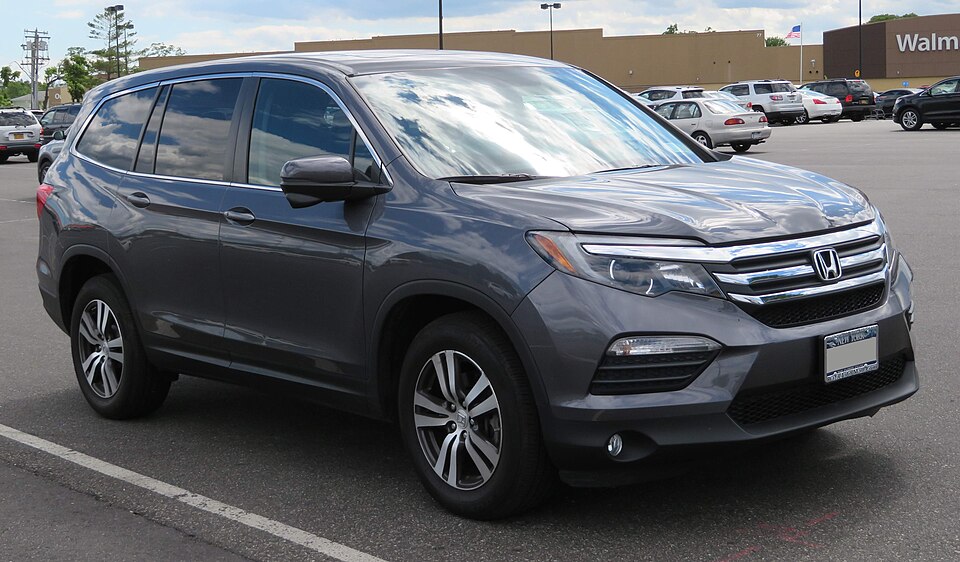
2017 Honda Pilot recalls and problems

The 2017 Honda Pilot has 4 recalls and 943 owner complaints on file with NHTSA; the most reported problem area is engine.

2017 Honda Pilot
Photo: 2017 Honda Pilot by Kevauto, CC BY-SA 4.0, via Wikimedia Commons
How the 2017 compares
Fewest complaintsMost complaints

Highest complaint count among 24 Pilot model years — 2nd most.

4recalls
943complaints
10crashes
5fires
7injuries
38,000median miles

Owner complaints filed with NHTSA, not verified and not adjusted for sales. Ranking compares this model's own years only.

Does your car have an open recall?
Recalls apply to specific vehicles. Only a VIN lookup on NHTSA's official site shows whether yours is affected and still unrepaired.
Check your VIN →

4 recalls

Structure

Jun 4, 2026 · NHTSA campaign 26V365000 · 965,561 vehicles

Problem: American Honda Motor Company (Honda) is recalling certain 2016-2022 Honda Pilot, 2017-2023 Ridgeline, 2019-2023 Passport, and 2014-2020 Acura MDX vehicles that were sold in Connecticut, Delaware, District of Columbia, Illinois, Indiana, Iowa, Kentucky, Maine, Maryland, Massachusetts, Michigan, Minnesota, Missouri, New Hampshire, New Jersey, New York, Ohio, Pennsylvania, Rhode Island, Vermont, Virginia, West Virginia, or Wisconsin. The rear subframe may corrode at the suspension mounting points, which can result in rear suspension component failure.

Risk: Failure of rear suspension components, such as the rear control arm, can cause a loss of vehicle handling and control, increasing the risk of a crash or injury.

Remedy

Dealers will inspect the rear subframe and install a rear subframe reinforcement kit and, as necessary, repair or replace the rear subframe components, free of charge. Interim letters notifying owners of the safety risk were mailed July 27, 2026. Additional letters will be sent once the final remedy is available, anticipated in the fall of 2026. Owners may contact Honda's customer service at 1-888-234-2138. Honda's numbers for this recall are AOU and AOT. Vehicle Identification Numbers (VINs) involved in this recall will become searchable on NHTSA.gov beginning June 10, 2026.

Air Bags

May 21, 2026 · NHTSA campaign 26V332000 · 98,892 vehicles

Problem: Honda (American Honda Motor Co.) is recalling certain 2018-2021, 2023 Acura TLX, 2019-2024 RDX, 2017-2020, 2022-2026 MDX, 2017-2021, 2023, 2025 Honda Ridgeline, 2017-2022 Pilot, 2019-2021 Passport, 2018-2026 Odyssey, 2019-2022 Insight, 2019-2021 HR-V, 2018-2020 Fit, 2020-2022 CR-V Hybrid, 2017-2022 CR-V, 2017-2018, 2021 Civic Type R, 2017-2021 Civic hatchback, 2016-2020 Civic coupe, 2016-2022 Civic, 2017-2022 Accord Hybrid, and 2016-2022 Accord vehicles. The front passenger seat weight sensor may crack and short circuit, which can cause the air bags to deploy unintentionally during a crash.

Risk: Air bags that deploy unintentionally during a crash increase the risk of injury.

Remedy

Dealers will replace the seat weight sensors, free of charge. Owner notification letters were mailed July 7, 2026. Owners may contact Honda's customer service at 1-888-234-2138. Honda's numbers for this recall are BOL, WO9, OOA, WOM, XOH, NOC, POD, BOE, UOF, POB, EOG, AOI, QO8, TOJ, DO7, and SOK. This recall expands previous NHTSA recall number 24V064. Vehicle Identification Numbers (VINs) involved in this recall will be searchable on NHTSA.gov beginning May 29, 2026.

Fuel System

Dec 18, 2023 · NHTSA campaign 23V858000 · 2,490,460 vehicles

Problem: Honda (American Honda Motor Co.) is recalling certain 2013-2023 Honda Accord, Civic Coupe, Civic Sedan, Civic Hatchback, Civic Type R, CR-V, HR-V, Ridgeline, Odyssey, Acura ILX, MDX, MDX Hybrid, RDX, RLX, TLX, 2019-2022 Honda Insight, Passport, 2020 Honda CR-V Hybrid, 2018-2019 Honda Clarity PHEV, Fit, and 2015-2020 Honda Accord Hybrid, Pilot, Acura NSX vehicles. The fuel pump inside the fuel tank may fail.

Risk: Fuel pump failure can cause an engine stall while driving, increasing the risk of a crash.

Remedy & notes

Dealers will replace the fuel pump module, free of charge. Owner letters were mailed September 6, 2024. Owners may contact Honda customer service at 1-888-234-2138. Honda's numbers for this recall are KGC and KGD. This recall is an expansion of NHTSA recall numbers 21V-215 and 20V-314.

Owners may also contact the National Highway Traffic Safety Administration Vehicle Safety Hotline at 1-888-327-4236 (TTY 1-800-424-9153), or go to www.nhtsa.gov.

Latches/locks/linkages

Nov 29, 2021 · NHTSA campaign 21V932000 · 724,826 vehicles

Problem: Honda (American Honda Motor Co.) is recalling certain 2019 Passport, 2016-2019 Pilot, and 2017-2020 Ridgeline vehicles. The hood latch striker may become damaged and separate from the hood, which can result in the hood opening while driving.

Risk: A hood that opens while driving can obstruct the driver's view and increase the risk of a crash.

Remedy & notes

Dealers will either repair the hood latch striker, or replace the hood if necessary, free of charge. Owner notification letters were mailed January 18, 2022. Owners may contact Honda customer service at 1-888-234-2138. Honda's number for this recall is PBV.

Owners may also contact the National Highway Traffic Safety Administration Vehicle Safety Hotline at 1-888-327-4236 (TTY 1-800-424-9153), or go to www.nhtsa.gov.

Recall text as published by NHTSA and the manufacturer.

What owners complain about

Owner complaints filed with NHTSA; one complaint can name several areas. Not verified by NHTSA.

Complaints by year filed

2017: 23 complaints20172018: 43 complaints20182019: 38 complaints20192020: 73 complaints20202021: 82 complaints20212022: 233 complaints20222332023: 94 complaints20232024: 112 complaints20242025: 119 complaints20252026: 126 complaints2026126

NHTSA investigations

Engine failure

PE25008 · opened Aug 20, 2025 · open
Summary

The Office of Defects Investigation (ODI) has received 414 reports of connecting rod bearing failures in the 3.5L V6 engine used in the following vehicles: Model Years (MY) 2018-2020 Acura TLX, MY2016-2020 Acura MDX, MY2016-2020 Honda Pilot, MY2018-2020 Honda Odyssey, and MY2017-2019 Honda Ridgeline.  The subject engine failures were analyzed as part of a Recall Query (RQ24013).  It was determined that these engine failures are outside the scope of Honda Recall 23V-751. Further, evidence gathered in conjunction with RQ24013 does not suggest this failure is caused by the same crankshaft manufacturing defect that is addressed by Honda in Recall 23V-751.  Based on analysis of data from RQ24013, NHTSA has closed that investigation. The significant number of reports of engine failure in vehicles outside the scope of RQ24013 presents a potential safety risk that warrants further investigation.  ODI is opening this Preliminary Evaluation (PE) to further evaluate the scope and severity of the potential problem and to fully assess the potential safety-related issues.  To review the ODI reports cited in the Opening Resume ODI Report Identification Number document, go to NHTSA.gov.

No Restart After Auto Start/Stop Engages

EA25004 · opened Mar 26, 2025 · open
Summary

On June 3, 2022, the Office of Defects Investigation (ODI) opened Preliminary Evaluation PE22005 after the agency received VOQs and several field reports concerning the Auto Idle Stop (AIS) feature on 2016-2019MY Honda Pilot vehicles. The complaints allege that the engine fails to restart on its own from a complete stop at a traffic light or road intersection with the AIS function engaged. The subject vehicles are equipped with a 3.5L engine with a 9-speed automatic transmission. On January 6, 2023, Honda released service bulletins 23-008 and 23-009. These service bulletins address the failure to restart issue in the 2016-2019MY Honda Pilot vehicles, as well as the 2015-2020 Acura TLX, 2016-2020 Acura MDX, 2019-2022 Honda Passport, and 2020-2023 Honda Ridgeline vehicles. The repair outlined in the service bulletins is a two-stage countermeasure to remedy the issue. The first stage is a Programmed Fuel Injection (“PGM-FI”) software update. The second stage is only deployed if the software update fails to remedy the issue. The second stage, depending on the model and model year, consists of replacement of the starter assembly, starter relays, and a valve adjustment. Additionally, Honda extended the warranty coverage to 10 years with unlimited mileage for vehicles requiring the second stage component replacement. ODI continues to receive complaints of the AIS failure to restart, with many complainants alleging the campaign countermeasures had been completed.NHTSA has review…

Engine failure

RQ24013 · opened Nov 8, 2024 · closed Aug 20, 2025
Summary

On November 8, 2024, the Office of Defects Investigation (ODI) opened Recall Query RQ24013 to assess the scope of Honda recall 23V-751 after receiving complaints that alleged connecting rod bearing failures in vehicles that were not within the scope of recall 23V-751. In November 2023, Honda recalled 248,999 various Model Year (MY)2016–2020 Honda and Acura vehicles equipped with the 3.5L V6 engine. Honda recalled these vehicles due to a crankshaft manufacturing defect that caused premature connecting rod bearing wear and engine seizure. While the out-of-scope failures involved in these complaints appear to have a very similar failure mechanism as the recalled engines, a thorough analysis of all available data from Honda has not indicated that the same manufacturing defect exists in the out-of-scope engines as the engines recalled by 23V-751. Based on this analysis ODI has determined that Honda has properly defined the scope of recall 23V-751. Consequently, ODI will close this RQ investigation.  NHTSA will continue to investigate these complaints of engine failure as part of a new Preliminary Evaluation Investigation (PE25008). The Agency reserves the right to take additional action if warranted by new circumstances.

No Restart After Auto Start/Stop Engages

PE22005 · opened Jun 3, 2022 · closed Mar 26, 2025
Summary

On June 3, 2022, the Office of Defects Investigation (ODI) opened Preliminary Evaluation PE22005 after the agency received VOQs and several field reports concerning the Auto Idle Stop (AIS) feature on 2016-2019MY Honda Pilot vehicles. The complaints allege that the engine fails to restart on its own from a complete stop at a traffic light or road intersection with the AIS function engaged. The subject vehicles are equipped with a 3.5L engine with a 9-speed automatic transmission. On January 6, 2023, Honda released service bulletins 23-008 and 23-009. These service bulletins address the failure to restart issue in the 2016-2019MY Honda Pilot vehicles, as well as the 2015-2020 Acura TLX, 2016-2020 Acura MDX, 2019-2022 Honda Passport, and 2020-2023 Honda Ridgeline vehicles. The repair outlined in the service bulletins is a two-stage countermeasure to remedy the issue. The first stage is a Programmed Fuel Injection (“PGM-FI”) software update. The second stage is only deployed if the software update fails to remedy the issue. The second stage, depending on the model and model year, consists of replacement of the starter assembly, starter relays, and a valve adjustment. Additionally, Honda extended the warranty coverage to 10 years with unlimited mileage for vehicles requiring the second stage component replacement. ODI continues to receive complaints of the AIS failure to restart, with many complainants alleging the campaign countermeasures had been completed.NHTSA has review…

2017 vs. other Honda Pilot years

Owner complaints by model year; the darker bar is the 2017. Click a bar to switch year.

Questions

Does the 2017 Honda Pilot have recalls?

Yes — NHTSA lists 4 recall campaigns covering the 2017 Honda Pilot, the latest from Jun 4, 2026 (structure). A recall applies to specific vehicles: enter your VIN at nhtsa.gov/recalls to see whether yours is affected and still open.

What are the most common problems with the 2017 Honda Pilot?

Owner complaints filed with NHTSA most often mention engine (491), electrical system (266), fuel system (142). Complaints are consumer reports and are not verified by NHTSA.