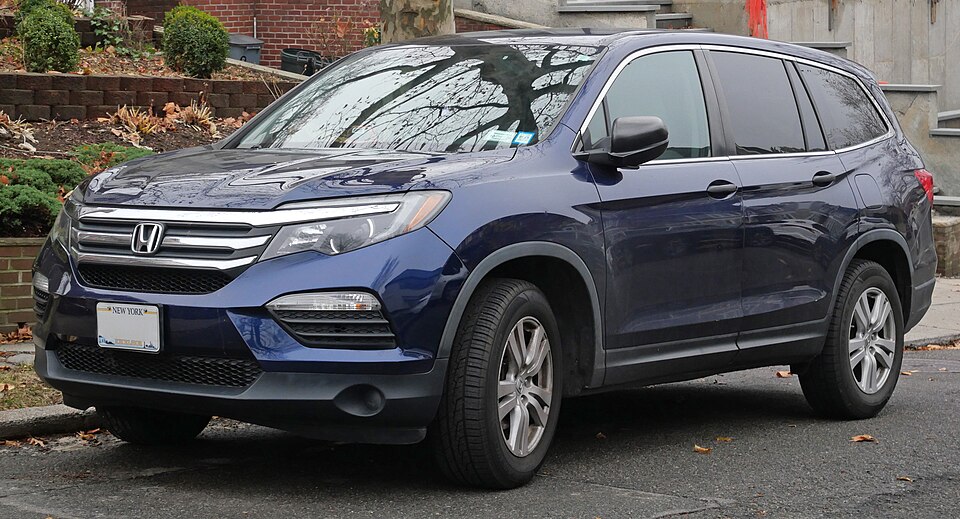
2016 Honda Pilot recalls and problems

The 2016 Honda Pilot has 8 recalls and 1,730 owner complaints on file with NHTSA; the most reported problem area is engine.

2016 Honda Pilot
Photo: 2016 Honda Pilot by Kevauto, CC BY-SA 4.0, via Wikimedia Commons
How the 2016 compares
Fewest complaintsMost complaints

Highest complaint count among 24 Pilot model years — the most of any year.

8recalls
1,730complaints
23crashes
10fires
20injuries
50,000median miles

Owner complaints filed with NHTSA, not verified and not adjusted for sales. Ranking compares this model's own years only.

Does your car have an open recall?
Recalls apply to specific vehicles. Only a VIN lookup on NHTSA's official site shows whether yours is affected and still unrepaired.
Check your VIN →

8 recalls

Structure

Jun 4, 2026 · NHTSA campaign 26V365000 · 965,561 vehicles

Problem: American Honda Motor Company (Honda) is recalling certain 2016-2022 Honda Pilot, 2017-2023 Ridgeline, 2019-2023 Passport, and 2014-2020 Acura MDX vehicles that were sold in Connecticut, Delaware, District of Columbia, Illinois, Indiana, Iowa, Kentucky, Maine, Maryland, Massachusetts, Michigan, Minnesota, Missouri, New Hampshire, New Jersey, New York, Ohio, Pennsylvania, Rhode Island, Vermont, Virginia, West Virginia, or Wisconsin. The rear subframe may corrode at the suspension mounting points, which can result in rear suspension component failure.

Risk: Failure of rear suspension components, such as the rear control arm, can cause a loss of vehicle handling and control, increasing the risk of a crash or injury.

Remedy

Dealers will inspect the rear subframe and install a rear subframe reinforcement kit and, as necessary, repair or replace the rear subframe components, free of charge. Interim letters notifying owners of the safety risk were mailed July 27, 2026. Additional letters will be sent once the final remedy is available, anticipated in the fall of 2026. Owners may contact Honda's customer service at 1-888-234-2138. Honda's numbers for this recall are AOU and AOT. Vehicle Identification Numbers (VINs) involved in this recall will become searchable on NHTSA.gov beginning June 10, 2026.

Fuel System

Dec 18, 2023 · NHTSA campaign 23V858000 · 2,490,460 vehicles

Problem: Honda (American Honda Motor Co.) is recalling certain 2013-2023 Honda Accord, Civic Coupe, Civic Sedan, Civic Hatchback, Civic Type R, CR-V, HR-V, Ridgeline, Odyssey, Acura ILX, MDX, MDX Hybrid, RDX, RLX, TLX, 2019-2022 Honda Insight, Passport, 2020 Honda CR-V Hybrid, 2018-2019 Honda Clarity PHEV, Fit, and 2015-2020 Honda Accord Hybrid, Pilot, Acura NSX vehicles. The fuel pump inside the fuel tank may fail.

Risk: Fuel pump failure can cause an engine stall while driving, increasing the risk of a crash.

Remedy & notes

Dealers will replace the fuel pump module, free of charge. Owner letters were mailed September 6, 2024. Owners may contact Honda customer service at 1-888-234-2138. Honda's numbers for this recall are KGC and KGD. This recall is an expansion of NHTSA recall numbers 21V-215 and 20V-314.

Owners may also contact the National Highway Traffic Safety Administration Vehicle Safety Hotline at 1-888-327-4236 (TTY 1-800-424-9153), or go to www.nhtsa.gov.

Engine

Nov 13, 2023 · NHTSA campaign 23V751000 · 248,999 vehicles

Problem: Honda (American Honda Motor Co.) is recalling certain 2015-2020 Acura TLX, 2016-2020 Acura MDX, 2016 and 2018-2019 Pilot, 2017 and 2019 Ridgeline, and 2018-2019 Odyssey vehicles. Due to a manufacturing error, the connecting rod bearing in the engine may wear and seize, damaging the engine.

Risk: A damaged engine may run improperly or stall while driving, increasing the risk of a fire, crash, or injury.

Remedy & notes

Dealers will inspect and repair, or replace the engine as necessary, free of charge. Owner letters were mailed March 28, 2024. 2016-2017 Acura MDX owner letters were mailed November 1, 2024. 2016-2020 Acura MDX owner letters are expected to be mailed in mid-December 2024. Honda began mailing owner notification letters as of March 18, 2024. 2015-2016 Acura owner letters are expected to be mailed mid-December 2024, 2018 Acura TLX owner letters are expected to be mailed the end of March/early April 2024, 2019 Acura TLX owner letters are expected to be mailed mid-May 2024, 2020 Acura TLX owner letters are expected to be mailed mid-June 2024, and 2016-2020 Acura MDX owner letters are expected to be mailed January 27, 2025. Owners may contact Honda customer service at 1-888-234-2138. Honda's numbers for these recalls are XG1 and GG0.

Owners may also contact the National Highway Traffic Safety Administration Vehicle Safety Hotline at 1-888-327-4236 (TTY 1-800-424-9153), or go to www.nhtsa.gov.

Latches/locks/linkages

Nov 29, 2021 · NHTSA campaign 21V932000 · 724,826 vehicles

Problem: Honda (American Honda Motor Co.) is recalling certain 2019 Passport, 2016-2019 Pilot, and 2017-2020 Ridgeline vehicles. The hood latch striker may become damaged and separate from the hood, which can result in the hood opening while driving.

Risk: A hood that opens while driving can obstruct the driver's view and increase the risk of a crash.

Remedy & notes

Dealers will either repair the hood latch striker, or replace the hood if necessary, free of charge. Owner notification letters were mailed January 18, 2022. Owners may contact Honda customer service at 1-888-234-2138. Honda's number for this recall is PBV.

Owners may also contact the National Highway Traffic Safety Administration Vehicle Safety Hotline at 1-888-327-4236 (TTY 1-800-424-9153), or go to www.nhtsa.gov.

Fuel System

Mar 30, 2017 · NHTSA campaign 17V219000 · 136 vehicles

Problem: Honda (American Honda Motor Co.) is recalling certain 2016 Honda Pilot 2WD and AWD vehicles. The affected vehicles have fuel tanks that may leak.

Risk: A fuel leak in the presence of an ignition source can increase the risk of a fire.

Remedy & notes

Honda will notify owners, and dealers will replace the fuel tank, free of charge. Owners may contact Honda customer service at 1-888-234-2138. Honda's number for this recall is KE8.

Owners may also contact the National Highway Traffic Safety Administration Vehicle Safety Hotline at 1-888-327-4236 (TTY 1-800-424-9153), or go to www.safercar.gov.

Fuel System

Jun 9, 2016 · NHTSA campaign 16V417000 · 39 vehicles

Problem: Honda (American Honda Motor Co.) is recalling certain model year 2015 Acura MDX 2WD and MDX 4WD vehicles, 2016 Acura MDX 4WD vehicles, 2015-2016 Honda Odyssey vehicles, and 2016 Honda Pilot 2WD and 4WD vehicles. The affected vehicles have fuel tanks that were manufactured with insufficient welds which may separate and allow fuel to leak out.

Risk: A fuel leak in the presence of an ignition source may result in a fire.

Remedy & notes

Honda will notify owners, and dealers will replace the fuel tanks, free of charge. Owners may contact Honda/Acura customer service at 1-888-234-2138. The recall began on July 29, 2016. Honda's numbers for this recall are KA9 (Honda vehicles) and KB0 (Acura vehicles).

Owners may also contact the National Highway Traffic Safety Administration Vehicle Safety Hotline at 1-888-327-4236 (TTY 1-800-424-9153), or go to www.safercar.gov.

Electrical System

Oct 16, 2015 · NHTSA campaign 15V668000 · 35,406 vehicles

Problem: Honda (American Honda Motor Co.) is recalling certain model year 2016 Honda Pilot 2WD vehicles manufactured May 4, 2015, to September 8, 2015 and 2016 Pilot 4WD vehicles manufactured May 7, 2015 to September 4, 2015. In the affected vehicles, when one of the safety systems such as tire pressure monitoring, anti-lock braking or electronic stability control malfunctions, there is potential that the instrument panel will not illuminate the corresponding warning light, however the warning lamps will illuminate when the ignition is turned off and then turned back on. As such, these vehicles fail to comply with the requirements of Federal Motor Vehicle Safety Standard (FMVSS) number 126, "Electronic stability control systems", number 135, "Light vehicle brake systems" and number 138, "Tire pressure monitoring systems".

Risk: If a safety system cannot immediately warn the driver when needed, the driver may be at increased risk of a crash.

Remedy & notes

Honda will notify owners, and dealers will update the instrument cluster software, free of charge. The recall began on December 11, 2015. Owners may contact Honda customer service at 1-888-234-2138. Honda's number for this recall is JV7.

Owners may also contact the National Highway Traffic Safety Administration Vehicle Safety Hotline at 1-888-327-4236 (TTY 1-800-424-9153), or go to www.safercar.gov.

Seat Belts

Jul 6, 2015 · NHTSA campaign 15V424000 · 1,358 vehicles

Problem: Honda (American Honda Motor Co.) is recalling certain model year 2016 Honda Pilot vehicles manufactured May 4, 2015, to June 5, 2015. Due to an assembly issue, the third row seatbelt may be trapped between the rear seat and the rear sideliner.

Risk: If the third row seatbelt is trapped, the occupants may not be restrained properly, increasing the risk of injury.

Remedy & notes

Honda will notify owners, and dealers will inspect and repair the rear third row seat belt, free of charge. The recall began on August 6, 2015. Owners may contact Honda customer service at 1-310-783-2000. Honda's number for this recall is JS7.

Owners may also contact the National Highway Traffic Safety Administration Vehicle Safety Hotline at 1-888-327-4236 (TTY 1-800-424-9153), or go to www.safercar.gov.

Recall text as published by NHTSA and the manufacturer.

What owners complain about

Owner complaints filed with NHTSA; one complaint can name several areas. Not verified by NHTSA.

Complaints by year filed

2015: 9 complaints20152016: 61 complaints20162017: 45 complaints20172018: 71 complaints20182019: 242 complaints20192020: 200 complaints20202021: 138 complaints20212022: 247 complaints20222472023: 124 complaints20232024: 197 complaints20242025: 234 complaints20252026: 162 complaints2026162

NHTSA investigations

Engine failure

PE25008 · opened Aug 20, 2025 · open
Summary

The Office of Defects Investigation (ODI) has received 414 reports of connecting rod bearing failures in the 3.5L V6 engine used in the following vehicles: Model Years (MY) 2018-2020 Acura TLX, MY2016-2020 Acura MDX, MY2016-2020 Honda Pilot, MY2018-2020 Honda Odyssey, and MY2017-2019 Honda Ridgeline.  The subject engine failures were analyzed as part of a Recall Query (RQ24013).  It was determined that these engine failures are outside the scope of Honda Recall 23V-751. Further, evidence gathered in conjunction with RQ24013 does not suggest this failure is caused by the same crankshaft manufacturing defect that is addressed by Honda in Recall 23V-751.  Based on analysis of data from RQ24013, NHTSA has closed that investigation. The significant number of reports of engine failure in vehicles outside the scope of RQ24013 presents a potential safety risk that warrants further investigation.  ODI is opening this Preliminary Evaluation (PE) to further evaluate the scope and severity of the potential problem and to fully assess the potential safety-related issues.  To review the ODI reports cited in the Opening Resume ODI Report Identification Number document, go to NHTSA.gov.

No Restart After Auto Start/Stop Engages

EA25004 · opened Mar 26, 2025 · open
Summary

On June 3, 2022, the Office of Defects Investigation (ODI) opened Preliminary Evaluation PE22005 after the agency received VOQs and several field reports concerning the Auto Idle Stop (AIS) feature on 2016-2019MY Honda Pilot vehicles. The complaints allege that the engine fails to restart on its own from a complete stop at a traffic light or road intersection with the AIS function engaged. The subject vehicles are equipped with a 3.5L engine with a 9-speed automatic transmission. On January 6, 2023, Honda released service bulletins 23-008 and 23-009. These service bulletins address the failure to restart issue in the 2016-2019MY Honda Pilot vehicles, as well as the 2015-2020 Acura TLX, 2016-2020 Acura MDX, 2019-2022 Honda Passport, and 2020-2023 Honda Ridgeline vehicles. The repair outlined in the service bulletins is a two-stage countermeasure to remedy the issue. The first stage is a Programmed Fuel Injection (“PGM-FI”) software update. The second stage is only deployed if the software update fails to remedy the issue. The second stage, depending on the model and model year, consists of replacement of the starter assembly, starter relays, and a valve adjustment. Additionally, Honda extended the warranty coverage to 10 years with unlimited mileage for vehicles requiring the second stage component replacement. ODI continues to receive complaints of the AIS failure to restart, with many complainants alleging the campaign countermeasures had been completed.NHTSA has review…

Engine failure

RQ24013 · opened Nov 8, 2024 · closed Aug 20, 2025
Summary

On November 8, 2024, the Office of Defects Investigation (ODI) opened Recall Query RQ24013 to assess the scope of Honda recall 23V-751 after receiving complaints that alleged connecting rod bearing failures in vehicles that were not within the scope of recall 23V-751. In November 2023, Honda recalled 248,999 various Model Year (MY)2016–2020 Honda and Acura vehicles equipped with the 3.5L V6 engine. Honda recalled these vehicles due to a crankshaft manufacturing defect that caused premature connecting rod bearing wear and engine seizure. While the out-of-scope failures involved in these complaints appear to have a very similar failure mechanism as the recalled engines, a thorough analysis of all available data from Honda has not indicated that the same manufacturing defect exists in the out-of-scope engines as the engines recalled by 23V-751. Based on this analysis ODI has determined that Honda has properly defined the scope of recall 23V-751. Consequently, ODI will close this RQ investigation.  NHTSA will continue to investigate these complaints of engine failure as part of a new Preliminary Evaluation Investigation (PE25008). The Agency reserves the right to take additional action if warranted by new circumstances.

No Restart After Auto Start/Stop Engages

PE22005 · opened Jun 3, 2022 · closed Mar 26, 2025
Summary

On June 3, 2022, the Office of Defects Investigation (ODI) opened Preliminary Evaluation PE22005 after the agency received VOQs and several field reports concerning the Auto Idle Stop (AIS) feature on 2016-2019MY Honda Pilot vehicles. The complaints allege that the engine fails to restart on its own from a complete stop at a traffic light or road intersection with the AIS function engaged. The subject vehicles are equipped with a 3.5L engine with a 9-speed automatic transmission. On January 6, 2023, Honda released service bulletins 23-008 and 23-009. These service bulletins address the failure to restart issue in the 2016-2019MY Honda Pilot vehicles, as well as the 2015-2020 Acura TLX, 2016-2020 Acura MDX, 2019-2022 Honda Passport, and 2020-2023 Honda Ridgeline vehicles. The repair outlined in the service bulletins is a two-stage countermeasure to remedy the issue. The first stage is a Programmed Fuel Injection (“PGM-FI”) software update. The second stage is only deployed if the software update fails to remedy the issue. The second stage, depending on the model and model year, consists of replacement of the starter assembly, starter relays, and a valve adjustment. Additionally, Honda extended the warranty coverage to 10 years with unlimited mileage for vehicles requiring the second stage component replacement. ODI continues to receive complaints of the AIS failure to restart, with many complainants alleging the campaign countermeasures had been completed.NHTSA has review…

2016 vs. other Honda Pilot years

Owner complaints by model year; the darker bar is the 2016. Click a bar to switch year.

Questions

Does the 2016 Honda Pilot have recalls?

Yes — NHTSA lists 8 recall campaigns covering the 2016 Honda Pilot, the latest from Jun 4, 2026 (structure). A recall applies to specific vehicles: enter your VIN at nhtsa.gov/recalls to see whether yours is affected and still open.

What are the most common problems with the 2016 Honda Pilot?

Owner complaints filed with NHTSA most often mention engine (828), electrical system (583), unknown or other (292). Complaints are consumer reports and are not verified by NHTSA.