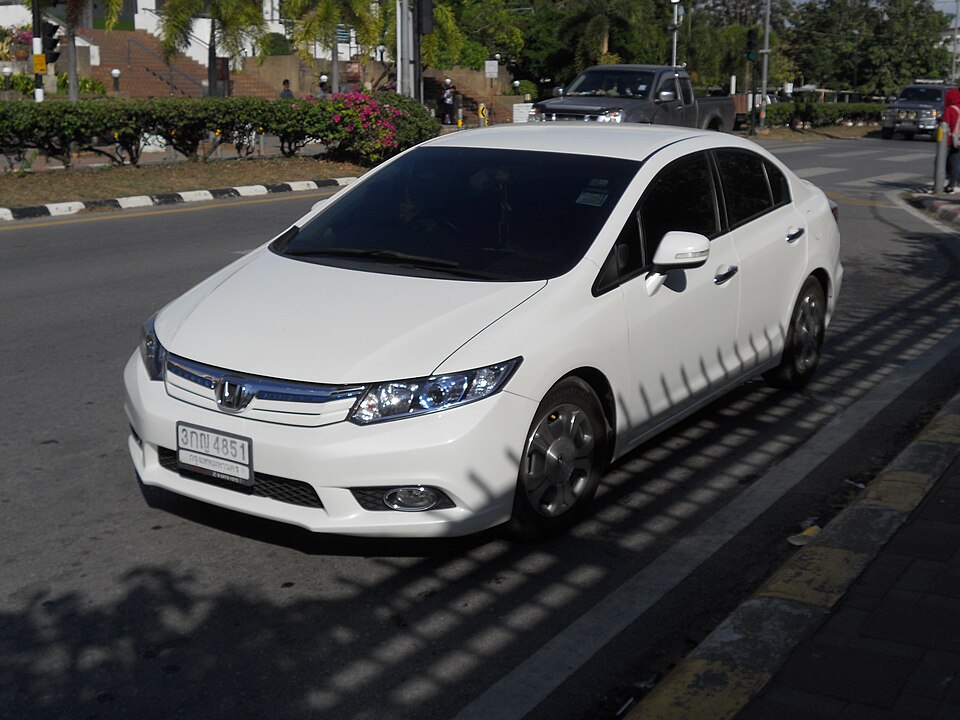
2013 Honda Civic Hybrid recalls and problems

The 2013 Honda Civic Hybrid has 0 recalls and 9 owner complaints on file with NHTSA; the most reported problem area is electrical system.

2013 Honda Civic Hybrid
Photo: 2013 Honda Civic Hybrid by Chanokchon, CC BY-SA 4.0, via Wikimedia Commons
How the 2013 compares
Fewest complaintsMost complaints

Low complaint count among 14 Civic Hybrid model years — 10th most.

0recalls
9complaints
0crashes
0fires
0injuries
45,000median miles

Owner complaints filed with NHTSA, not verified and not adjusted for sales. Ranking compares this model's own years only.

Does your car have an open recall?
Recalls apply to specific vehicles. Only a VIN lookup on NHTSA's official site shows whether yours is affected and still unrepaired.
Check your VIN →

0 recalls

No recall campaigns on file.

Recall text as published by NHTSA and the manufacturer.

What owners complain about

Owner complaints filed with NHTSA; one complaint can name several areas. Not verified by NHTSA.

Complaints by year filed

2014: 1 complaints20142015: 3 complaints201532017: 3 complaints20172023: 1 complaints20232026: 1 complaints20261

NHTSA investigations

Pedestrian alert sounds

DP22005 · opened Jan 27, 2023 · closed Aug 7, 2023 · led to recall 22V063000
Summary

NHTSA received a petition on or about July 18, 2022, requesting that Federal Motor Vehicle Safety Standard (FMVSS) 141 be applied to all electric and hybrid vehicles operating in the United States. The petition can be reviewed at NHTSA.gov under ODI Number 11486072. FMVSS 141 establishes performance requirements for pedestrian alert sounds for motor vehicles. The standard applies to hybrid and electric vehicles that have a gross vehicle weight rating of 4,536 KG or less or are defined as low-speed vehicles. The standard became fully applicable to all such vehicles manufactured on or after March 1, 2021.On January 27, 2023, NHTSA opened Defect Petition (DP) 22-005 to evaluate the subject matter described in the petition. On June 24, 2023 and as supplemented on June 25, 2023, the petitioner notified NHTSA he was withdrawing his petition. The petitioner indicated that, based on his review of data, there is no justification for asserting potential benefits that could be derived from actions sought by my petition. Based on the petitioner's withdrawal, DP22-005 is closed. Closure of this DP does not represent a determination by NHTSA regarding the subject matter of the petition.

Desiccated Air Bag Inflator Rupture

EA21002 · opened Sep 17, 2021 · open
Summary

From 2000 through 2017, Takata produced millions of air bag inflators using two types of phase-stabilized ammonium nitrate ("PSAN") propellant -- propellant 2004 and propellant 2004L. After prolonged exposure to high temperature cycles and humidity, inflators using propellant 2004 can degrade, causing the propellant to burn too quickly when ignited. The rapid burning can cause the inflator to rupture during deployment, potentially causing serious or even fatal injury to vehicle occupants. See 2016 Blomquist Report at www.nhtsa.gov/sites/nhtsa.gov/files/documents/expert_report-hrblomquist.pdf.Consequently, all frontal inflators using propellant 2004 that do not contain a "desiccant" (a substance that traps and holds moisture) in US vehicles are under recall. These "non-desiccated" inflators either have been or are required to be replaced.In some cases, the remedy part for these recalled inflators was, or will be, an inflator using either propellant 2004 or 2004L that does contain a desiccant. None of these "desiccated" remedy parts (which were installed in older model year vehicles) are currently under recall for a degradation concern. Certain subsets of desiccated PSAN inflators using propellant 2004 for use as original equipment, however, have been recalled for a degradation concern. All Takata inflators produced with propellant 2004L contain desiccant, and none of these desiccated inflators using propellant 2004L are under recall for a degradation concern. There have been n…

Electrical overstress

EA19001 · opened Apr 19, 2019 · closed Sep 19, 2024 · led to recall 20V024
Summary

The Office of Defects Investigation (ODI) opened this investigation to determine if the failure of airbags to deploy during severe crashes, in certain vehicles, was the result of a safety related defect.  During the investigation a complex failure was studied that can result in non-deployment of subject vehicle air bags and other restraint system devices in severe crash events. The subject vehicles may be equipped with an airbag control unit (ACU) for the supplemental restraint system (SRS) Electronic Control Unit (ECU) manufactured by ZF-TRW.  The ECU receives signals from crash sensors mounted in the vehicle and deploys the vehicle air bags and seat belt pretensioners in accordance with manufacturer design specifications.  The ECU in the subject vehicles contains a model DS84 application-specific integrated circuit (ASIC) which controls the communication of the crash sensor signal, firing commands (i.e., when to deploy the airbag(s) and/or pretensioners), and fault information (e.g., diagnostic trouble codes). In September 2016, FCA announced recall 16V-668 for certain model year (MY) 2010 to 2014 Chrysler, Dodge and Jeep products manufactured with the subject ZF-TRW ACU.  In this recall, FCA discussed an EOS condition that resulted in a failure of the subject DS84 ASIC, which caused air bag non-deployment.  FCA noted that the defect condition had only been observed in vehicles equipped with sensor harnessing routed across the front of the vehicle.  Other FCA vehicles…

2013 vs. other Honda Civic Hybrid years

Owner complaints by model year; the darker bar is the 2013. Click a bar to switch year.

Questions

Does the 2013 Honda Civic Hybrid have recalls?

NHTSA lists no recall campaigns for the 2013 Honda Civic Hybrid. Check your VIN at nhtsa.gov/recalls to be sure.

What are the most common problems with the 2013 Honda Civic Hybrid?

Owner complaints filed with NHTSA most often mention electrical system (2), engine (2), air bags (1). Complaints are consumer reports and are not verified by NHTSA.