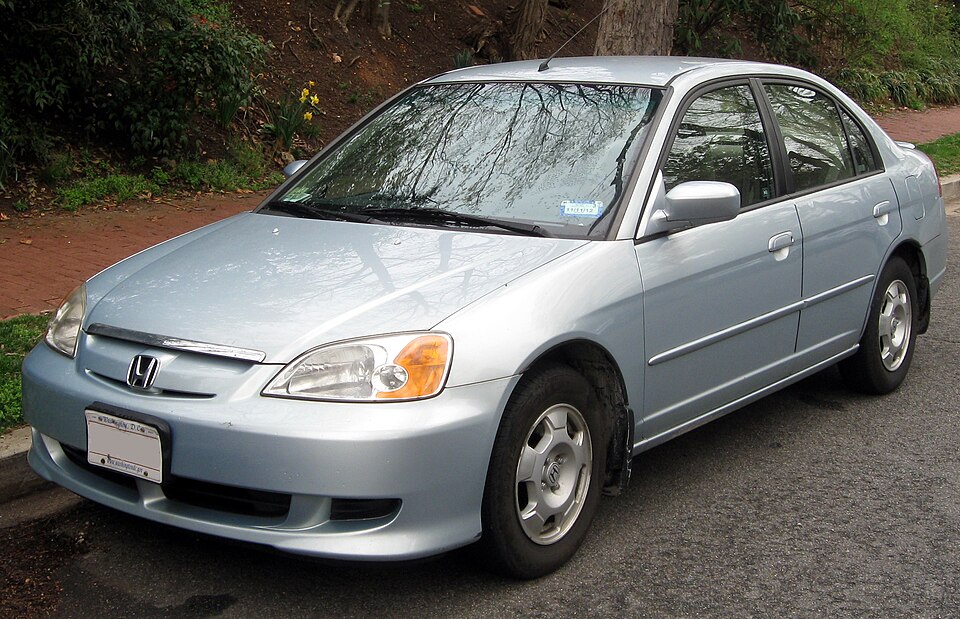
2003 Honda Civic Hybrid recalls and problems

The 2003 Honda Civic Hybrid has 6 recalls and 51 owner complaints on file with NHTSA; the most reported problem area is power train.

2003 Honda Civic Hybrid
Photo: 2003 Honda Civic Hybrid by IFCAR, Public domain, via Wikimedia Commons
How the 2003 compares
Fewest complaintsMost complaints

High complaint count among 14 Civic Hybrid model years — 4th most.

6recalls
51complaints
5crashes
0fires
2injuries
126,205median miles

Owner complaints filed with NHTSA, not verified and not adjusted for sales. Ranking compares this model's own years only.

Does your car have an open recall?
Recalls apply to specific vehicles. Only a VIN lookup on NHTSA's official site shows whether yours is affected and still unrepaired.
Check your VIN →

6 recalls

Air Bags

Jun 27, 2019 · NHTSA campaign 19V501000 · 1,657,752 vehicles

Problem: Honda (American Honda Motor Co.) is recalling certain 2003-2006 Acura MDX, 2005-2012 RL, 2003-2007 Honda Accord, 2001-2005 Civic, 2003-2005 Civic Hybrid, 2001-2005 Civic GX NGV, 2002-2006 CR-V, 2003-2011 Element, 2007-2008 Fit, 2002-2004 Odyssey, 2003-2008 Pilot, and 2006-2014 Ridgeline vehicles. The vehicles are equipped with passenger frontal air bag inflators assembled as a recall remedy part or replacement service part, that may explode due to propellant degradation occurring after long-term exposure to high absolute humidity, temperature and temperature cycling.

Risk: An inflator explosion may result in sharp metal fragments striking the driver or other occupants resulting in serious injury or death.

Remedy & notes

Honda will notify owners, and dealers will replace the passenger frontal airbag inflator, free of charge. The recall began August 12, 2019. Owners may contact Honda customer service at 1-888-234-2138. Honda's numbers for this recall are E5D and X5C.

Owners may also contact the National Highway Traffic Safety Administration Vehicle Safety Hotline at 1-888-327-4236 (TTY 1-800-424-9153), or go to www.safercar.gov.

Air Bags

Jun 27, 2019 · NHTSA campaign 19V499000 · 3,947 vehicles

Problem: Honda (American Honda Motor Co.) is recalling certain 2003 Acura 3.2CL, 2002-2003 3.2TL, 2003-2006 MDX, 2001-2007 Honda Accord, 2001-2005 Civic, 2003-2005 Civic Hybrid, 2001-2005 Civic GX NGV, 2002-2006 CR-V, 2003-2011 Element, 2002-2004 Odyssey, 2003-2008 Pilot and 2006 Ridgeline vehicles. These vehicles are equipped with driver frontal air bag inflators assembled as a recall remedy part or replacement service part, that may explode due to propellant degradation occurring after long-term exposure to high absolute humidity, temperature and temperature cycling.

Risk: An inflator explosion may result in sharp metal fragments striking the driver or other occupants resulting in serious injury or death.

Remedy & notes

Honda will notify owners, and dealers will replace the driver frontal air bag inflator, free of charge. The recall began August 12, 2019. Owners may contact Honda customer service at 1-888-234-2138. Honda's numbers for this recall are Q5A and Y58.

Owners may also contact the National Highway Traffic Safety Administration Vehicle Safety Hotline at 1-888-327-4236 (TTY 1-800-424-9153), or go to www.safercar.gov.

Air Bags

Mar 6, 2019 · NHTSA campaign 19V182000 · 1,101,534 vehicles

Problem: Honda (American Honda Motor Co.) is recalling specific 2003 Acura 3.2CL, 2013-2016 ILX, 2013-2014 ILX Hybrid, 2003-2006 MDX, 2007-2016 RDX, 2002-2003 3.2TL, 2004-2006, and 2009-2014 TL, 2010-2013 ZDX and 2001-2007 and 2009 Honda Accord, 2001-2005 Civic, 2003-2005 Civic Hybrid, 2001-2005 Civic GX NGV, 2002-2007 and 2010-2011 CR-V, 2003-2011 Element, 2007 Fit, 2002-2004 Odyssey, 2003-2008 Pilot, and 2006-2014 Ridgeline vehicles. The affected vehicles received a replacement driver air bag inflator as part of a previous Takata inflator recall remedy or a replacement driver air bag module containing the same inflator type as a service part. Due to a manufacturing error, in the event of a crash necessitating deployment of the driver frontal air bag, these inflators may explode.

Risk: An explosion of an inflator within the driver frontal air bag module may result in sharp metal fragments striking the driver, front seat passenger or other occupants resulting in serious injury or death.

Remedy & notes

Honda will notify owners, and dealers will replace the driver's air bag inflator with an alternate inflator, free of charge. The recall began April 10, 2019. Honda owners may contact customer service at 1-888-234-2138. Honda's number for this recall is O41. Acura owners may contact customer service at 1-888-234-2138. Acura's number for this recall is U40.

Owners may also contact the National Highway Traffic Safety Administration Vehicle Safety Hotline at 1-888-327-4236 (TTY 1-800-424-9153), or go to www.safercar.gov.

Air Bags

Jun 15, 2015 · NHTSA campaign 15V370000 · 3,498,481 vehicles

Problem: Honda (American Honda Motor Co.) is recalling certain model year 2001-2005 Honda Civic vehicles manufactured March 21, 2000, to January 20, 2005, 2001-2004 Honda Civic GX vehicles manufactured June 14, 2000, to August 19, 2004, 2003-2005 Honda Civic Hybrid vehicles manufactured February 24, 2002, to January 18, 2005, 2003-2007 Honda Accord vehicles manufactured February 21, 2002, to August 28, 2007, 2002-2004 Honda CR-V vehicles, 2002-2003 Honda Odyssey vehicles manufactured June 19, 2001, to July 12, 2003, 2003 Acura MDX vehicles manufactured September 19, 2002, to June 19, 2003, 2003 Honda Element vehicles manufactured June 25, 2002, to July 31, 2003, and 2003 Honda Pilot vehicles manufactured November 26, 2001, to August 21, 2003. The affected vehicles have a passenger side frontal air bag that may be susceptible to moisture intrusion which, over time, could cause the inflator to rupture upon its deployment.

Risk: In the event of a crash necessitating deployment of the passenger's frontal air bag, the inflator could rupture with metal fragments striking the passenger seat occupant or other occupants possibly causing serious injury or death.

Remedy & notes

Honda will notify owners, and dealers will replace the passenger air bag inflator, free of charge. The recall began on July 1, 2015. Owners may contact Honda customer service at 1-888-234-2138. Honda's numbers for this recall are JU4, JU5, JU6, and JU7. Note: Vehicles that have already received a replacement passenger air bag inflator as part of the recall remedy for an earlier campaign such as 14V353 or 14V700 (Honda recall numbers S95, JH6, JH7, JH8, JH9, JJ0, JJ1, JJ2, JJ6, JM5 and JM6) are not included in this recall. However, this recall does supersede 13V132 and 14V349. Note: On December 18, 2015 Honda informed NHTSA of an expansion of this recall to include certain model year 2004 Honda CR-V vehicles in addition to additional model year 2003 CR-V vehicles.

Owners may also contact the National Highway Traffic Safety Administration Vehicle Safety Hotline at 1-888-327-4236 (TTY 1-800-424-9153), or go to www.safercar.gov.

Air Bags

May 28, 2015 · NHTSA campaign 15V320000 · 6,281,043 vehicles

Problem: Honda (American Honda Motor Co.) is recalling certain model year 2001-2007 Accord, 2001-2005 Civic, 2001-2004 Honda Civic GX, 2003-2005 Honda Civic Hybrid, 2002-2006 CR-V, 2003-2011 Element, 2002-2004 Odyssey, 2003-2008 Pilot, 2006 Ridgeline, 2003 Acura 3.2CL, 2003-2006 Acura MDX, and 2002-2003 Acura 3.2TL vehicles. The affected vehicles are equipped with a dual-stage driver frontal air bag that may be susceptible to moisture intrusion and other factors, including manufacturing variability that, over time, could cause the inflator to rupture.

Risk: In the event of a crash necessitating deployment of the driver's frontal air bag, the inflator could rupture with metal fragments striking the driver or other occupants resulting in serious injury or death.

Remedy & notes

Honda will notify owners, and dealers will replace the driver frontal air bag inflator, free of charge. The recall began on July 1, 2015. Owners may contact Honda customer service at 1-888-234-2138. Owners may contact Acura customer service at 1-800-382-2238, select option 4. Note: Vehicles that have had their driver frontal air bag replaced previously as part of a recall remedy prior to September 12, 2014 need to have their air bag replaced under this recall as well. Vehicles that, on or after September 12, 2014, received a remedy for a prior driver frontal air bag inflator recall already received an inflator of a different design, and therefore are not included in this recall and do not require additional servicing. Note: This recall fully supersedes recalls 08V-593, 09V-259, 10V-041, 11V-260, 14V-351 and 15V-153. Honda's numbers for this recall are JQ9, JR0, JR1, JR2, JR3, JR4, JR5, JR6, JR7, and JR8.

Owners may also contact the National Highway Traffic Safety Administration Vehicle Safety Hotline at 1-888-327-4236 (TTY 1-800-424-9153), or go to www.safercar.gov.

Air Bags

Nov 4, 2014 · NHTSA campaign 14V700000

Problem: American Honda Motor Co. (Honda) is recalling certain model year 2001-2005 Honda Civic, 2003-2004 Civic CNG and Element, 2002-2005 CR-V, 2002-2004 Odyssey, 2003-2005 Accord, Pilot, Civic Hybrid, and Acura MDX, 2005 Acura RL and 2006 Honda Ridgeline vehicles originally sold, or ever registered, in geographic locations associated with high absolute humidity. Specifically, vehicles sold, or ever registered, in Alabama, Florida, Georgia, Hawaii, Louisiana, Mississippi, South Carolina, Texas, Puerto Rico, U.S. Virgin Islands, Saipan, Guam, and American Samoa are addressed by this recall. Upon deployment of the passenger side frontal air bag, excessive internal pressure may cause the inflator to rupture.

Risk: In the event of a crash necessitating deployment of the passenger’s frontal air bag, the inflator could rupture with metal fragments striking the vehicle occupants potentially resulting in serious injury or death.

Remedy & notes

Honda will notify owners, and dealers will replace the passenger side air bag inflator, free of charge. The recall began January 26, 2015. Owners may contact Honda customer service at 1-800-999-1009.

Owners may also contact the National Highway Traffic Safety Administration Vehicle Safety Hotline at 1-888-327-4236 (TTY 1-800-424-9153), or go to www.safercar.gov.Note: This recall supersedes safety recall 14V-353, with the exception of vehicles originally sold, or ever registered, in California.Those vehicles will continue to be addressed, and a free remedy provided, under that safety recall campaign.This recall also includes vehicles in the specific geographic areas listed above that were included within safety recalls 13V-132 and 14V-349.

Recall text as published by NHTSA and the manufacturer.

What owners complain about

Owner complaints filed with NHTSA; one complaint can name several areas. Not verified by NHTSA.

Complaints by year filed

2011: 1 complaints20112012: 10 complaints20122013: 7 complaints20132014: 7 complaints20142015: 11 complaints2015112016: 5 complaints20162017: 4 complaints20172018: 3 complaints20182019: 3 complaints20193

NHTSA investigations

Pedestrian alert sounds

DP22005 · opened Jan 27, 2023 · closed Aug 7, 2023 · led to recall 22V063000
Summary

NHTSA received a petition on or about July 18, 2022, requesting that Federal Motor Vehicle Safety Standard (FMVSS) 141 be applied to all electric and hybrid vehicles operating in the United States. The petition can be reviewed at NHTSA.gov under ODI Number 11486072. FMVSS 141 establishes performance requirements for pedestrian alert sounds for motor vehicles. The standard applies to hybrid and electric vehicles that have a gross vehicle weight rating of 4,536 KG or less or are defined as low-speed vehicles. The standard became fully applicable to all such vehicles manufactured on or after March 1, 2021.On January 27, 2023, NHTSA opened Defect Petition (DP) 22-005 to evaluate the subject matter described in the petition. On June 24, 2023 and as supplemented on June 25, 2023, the petitioner notified NHTSA he was withdrawing his petition. The petitioner indicated that, based on his review of data, there is no justification for asserting potential benefits that could be derived from actions sought by my petition. Based on the petitioner's withdrawal, DP22-005 is closed. Closure of this DP does not represent a determination by NHTSA regarding the subject matter of the petition.

Desiccated Air Bag Inflator Rupture

EA21002 · opened Sep 17, 2021 · open
Summary

From 2000 through 2017, Takata produced millions of air bag inflators using two types of phase-stabilized ammonium nitrate ("PSAN") propellant -- propellant 2004 and propellant 2004L. After prolonged exposure to high temperature cycles and humidity, inflators using propellant 2004 can degrade, causing the propellant to burn too quickly when ignited. The rapid burning can cause the inflator to rupture during deployment, potentially causing serious or even fatal injury to vehicle occupants. See 2016 Blomquist Report at www.nhtsa.gov/sites/nhtsa.gov/files/documents/expert_report-hrblomquist.pdf.Consequently, all frontal inflators using propellant 2004 that do not contain a "desiccant" (a substance that traps and holds moisture) in US vehicles are under recall. These "non-desiccated" inflators either have been or are required to be replaced.In some cases, the remedy part for these recalled inflators was, or will be, an inflator using either propellant 2004 or 2004L that does contain a desiccant. None of these "desiccated" remedy parts (which were installed in older model year vehicles) are currently under recall for a degradation concern. Certain subsets of desiccated PSAN inflators using propellant 2004 for use as original equipment, however, have been recalled for a degradation concern. All Takata inflators produced with propellant 2004L contain desiccant, and none of these desiccated inflators using propellant 2004L are under recall for a degradation concern. There have been n…

Air Bag Inflator Rupture

EA15001 · opened Feb 24, 2015 · open · led to recall 14V668
Summary

The Office of Defects Investigation (ODI) opened PE14-016 in June 2014 based on six inflator rupture incidents involving consumer owned vehicles produced by five vehicle manufacturers.All six vehicles were operated in Florida or Puerto Rico at the time of the rupture and for the majority of their service life, and were equipped with inflators produced by Takata, a tier-one supplier of automotive air bag systems.During the course of PE14-016, ODI determined that five additional vehicle manufacturers used inflators of a similar design and vintage also supplied by Takata. No evidence of field failures was found in vehicles produced by these five additional manufacturers.Nonetheless, at ODI's insistence, all 10 vehicle manufacturers initiated a regional recall within approximately two weeks of the opening of the investigation.The regions recalled initially included Florida, Puerto Rico, Hawaii, and the U.S. Virgin Islands, areas with high absolute humidity and climatic conditions believed to be a significant factor in the inflator ruptures.As part of the recall actions, inflators removed from remedied vehicles are to be returned to Takata for testing.Takata's initial test results on passenger inflators from remedied vehicles indicated a much higher than anticipated rupture frequency for inflators returned from Florida.Accordingly ODI requested all 10 manufacturers expand the regional recalls for passenger inflators to include other geographic areas where high absolute humidity co…

Air Bag Inflator Rupture

PE14016 · opened Jun 11, 2014 · closed Mar 2, 2015 · led to recall 13V172000
Summary

The Office of Defects Investigation (ODI) opened PE14-016 in June 2014 based on six inflator rupture incidents involving consumer owned vehicles produced by five vehicle manufacturers.All six vehicles were operated in Florida or Puerto Rico at the time of the rupture and for the majority of their service life, and were equipped with inflators produced by Takata, a tier-one supplier of automotive air bag systems.During the course of PE14-016, ODI determined that five additional vehicle manufacturers used inflators of a similar design and vintage also supplied by Takata. No evidence of field failures was found in vehicles produced by these five additional manufacturers.Nonetheless, at ODI's insistence, all 10 vehicle manufacturers initiated a regional recall within approximately two weeks of the opening of the investigation.The regions recalled initially included Florida, Puerto Rico, Hawaii, and the U.S. Virgin Islands, areas with consistently high absolute humidity and climatic conditions believed to be a significant factor in the inflator ruptures.As part of the recall actions, inflators removed from remedied vehicles are to be returned to Takata for testing.Takata's initial test results on passenger inflators from remedied vehicles indicated a much higher than anticipated rupture frequency for inflators returned from Florida.Accordingly, ODI requested all 10 manufacturers expand the regional recalls for passenger inflators to include other geographic areas where high absolu…

2003 vs. other Honda Civic Hybrid years

Owner complaints by model year; the darker bar is the 2003. Click a bar to switch year.

Questions

Does the 2003 Honda Civic Hybrid have recalls?

Yes — NHTSA lists 6 recall campaigns covering the 2003 Honda Civic Hybrid, the latest from Jun 27, 2019 (air bags). A recall applies to specific vehicles: enter your VIN at nhtsa.gov/recalls to see whether yours is affected and still open.

What are the most common problems with the 2003 Honda Civic Hybrid?

Owner complaints filed with NHTSA most often mention power train (26), air bags (9), engine (9). Complaints are consumer reports and are not verified by NHTSA.