2012 Ford Fusion Hybrid recalls and problems

The 2012 Ford Fusion Hybrid has 0 recalls and 96 owner complaints on file with NHTSA; the most reported problem area is steering.

2013 Ford Fusion Hybrid
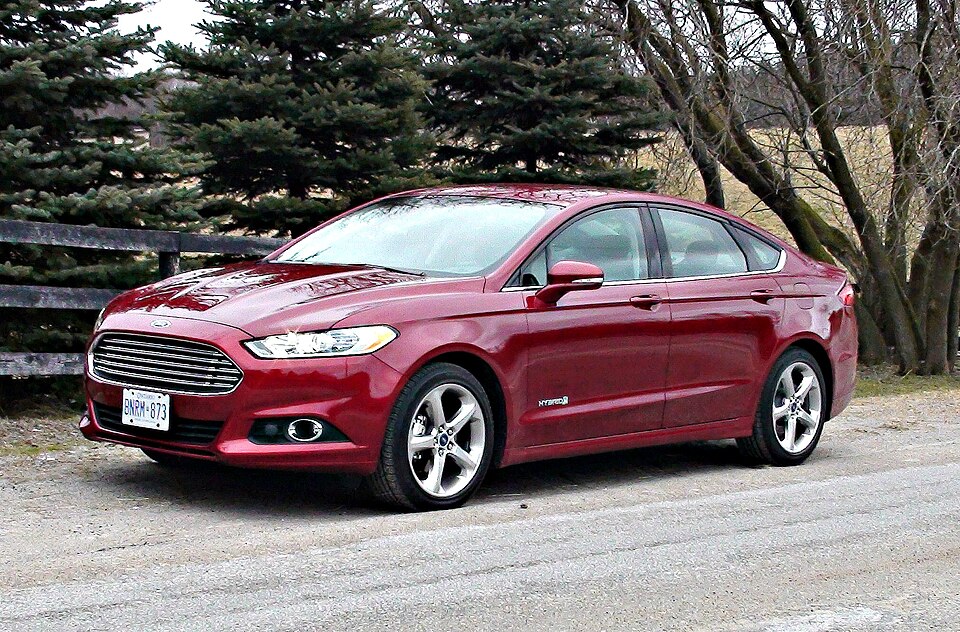
Pictured: a 2013 model; the 2012 may differ in details. Photo: 2013 Ford Fusion Hybrid by Stradablog (Tino Rossini), CC BY 2.0, via Wikimedia Commons
How the 2012 compares
Fewest complaintsMost complaints

High complaint count among 11 Fusion Hybrid model years — 4th most.

0recalls
96complaints
4crashes
0fires
2injuries
62,000median miles

Owner complaints filed with NHTSA, not verified and not adjusted for sales. Ranking compares this model's own years only.

Does your car have an open recall?
Recalls apply to specific vehicles. Only a VIN lookup on NHTSA's official site shows whether yours is affected and still unrepaired.
Check your VIN →

0 recalls

No recall campaigns on file.

Recall text as published by NHTSA and the manufacturer.

What owners complain about

Owner complaints filed with NHTSA; one complaint can name several areas. Not verified by NHTSA.

Complaints by year filed

2013: 9 complaints20132014: 6 complaints2015: 15 complaints20152016: 8 complaints2017: 9 complaints20172018: 30 complaints302019: 12 complaints20192021: 1 complaints2022: 1 complaints20222023: 1 complaints2024: 1 complaints20242025: 2 complaints2026: 1 complaints20261

NHTSA investigations

Pedestrian alert sounds

DP22005 · opened Jan 27, 2023 · closed Aug 7, 2023 · led to recall 22V063000
Summary

NHTSA received a petition on or about July 18, 2022, requesting that Federal Motor Vehicle Safety Standard (FMVSS) 141 be applied to all electric and hybrid vehicles operating in the United States. The petition can be reviewed at NHTSA.gov under ODI Number 11486072. FMVSS 141 establishes performance requirements for pedestrian alert sounds for motor vehicles. The standard applies to hybrid and electric vehicles that have a gross vehicle weight rating of 4,536 KG or less or are defined as low-speed vehicles. The standard became fully applicable to all such vehicles manufactured on or after March 1, 2021.On January 27, 2023, NHTSA opened Defect Petition (DP) 22-005 to evaluate the subject matter described in the petition. On June 24, 2023 and as supplemented on June 25, 2023, the petitioner notified NHTSA he was withdrawing his petition. The petitioner indicated that, based on his review of data, there is no justification for asserting potential benefits that could be derived from actions sought by my petition. Based on the petitioner's withdrawal, DP22-005 is closed. Closure of this DP does not represent a determination by NHTSA regarding the subject matter of the petition.

Desiccated Air Bag Inflator Rupture

EA21002 · opened Sep 17, 2021 · open
Summary

From 2000 through 2017, Takata produced millions of air bag inflators using two types of phase-stabilized ammonium nitrate ("PSAN") propellant -- propellant 2004 and propellant 2004L. After prolonged exposure to high temperature cycles and humidity, inflators using propellant 2004 can degrade, causing the propellant to burn too quickly when ignited. The rapid burning can cause the inflator to rupture during deployment, potentially causing serious or even fatal injury to vehicle occupants. See 2016 Blomquist Report at www.nhtsa.gov/sites/nhtsa.gov/files/documents/expert_report-hrblomquist.pdf.Consequently, all frontal inflators using propellant 2004 that do not contain a "desiccant" (a substance that traps and holds moisture) in US vehicles are under recall. These "non-desiccated" inflators either have been or are required to be replaced.In some cases, the remedy part for these recalled inflators was, or will be, an inflator using either propellant 2004 or 2004L that does contain a desiccant. None of these "desiccated" remedy parts (which were installed in older model year vehicles) are currently under recall for a degradation concern. Certain subsets of desiccated PSAN inflators using propellant 2004 for use as original equipment, however, have been recalled for a degradation concern. All Takata inflators produced with propellant 2004L contain desiccant, and none of these desiccated inflators using propellant 2004L are under recall for a degradation concern. There have been n…

Power Steering Failure

EA17004 · opened Nov 20, 2017 · closed Feb 9, 2024
Summary

On September 28, 2016, the Office of Defects Investigation (ODI) opened a Preliminary Evaluation (PE16-011) to investigate claims of power steering assist loss on model year (MY) 2010 Ford Fusion vehicles.  During the PE, ODI received 718 unique claims related to the alleged problem with 598 reports indicating the power steering assist failed while driving at various speeds with no warning.  Ford Motor Company (Ford) provided 1,851 unique reports and 1,720 warranty claims related to the alleged problem.  It should be noted that as the result of investigation PE14-030, Ford conducted a safety recall (15V-340) ofMY 2011-2012 Ford Fusion and other vehicles using the same electric power assist steering unit to rectify incidents of loss of power steering assist. On November 20, 2017, PE16-011 was upgraded to this Engineering Analysis (EA17-004) to further assess the scope, frequency, and consequence of this failure.  This was based on an analysis of the subject vehicle complaint data that had indicated an increased likelihood of failure as the vehicles age.  At the time, the rate of occurrence of this failure was comparable to previous investigations involving loss of power steering assist including the previously mentioned PE14-030. During the EA, ODI’s analysis of the alleged defect in the subject vehicles identified the following:  testing showed minor steering effort changes between “assist” and “no assist”, no root cause identified, a declining failure trend, …

Electric power steering failure

PE14030 · opened Oct 2, 2014 · closed Sep 10, 2015 · led to recall 15V340000
Summary

The Office of Defects Investigation (ODI) opened a preliminary evaluation to investigate complaints of the loss of power steering while driving. The subject vehicles are equipped with a rack mounted Electric Power Assisted Steering (EPAS) unit.Some of the complaints alleged that the steering assist failed and resulted in increased steering efforts that contributed to a loss of control and in some cases a crash.The EPAS system was manufactured by TRW Automotive for Ford and was designated as Generation I.These units were first produced and put into vehicle production in July 2008 beginning with the model year (MY) 2010 Ford Fusion and Mercury Milan.The system is comprised of a mechanical steering rack-and-pinion gear with torque sensor, electric assist motor, motor position sensor and a power steering control module (PSCM). The PSCM is self-monitoring and designed to detect faults within the system and can store diagnostic trouble codes (DTCs) if a problem is detected.There are 29 potential DTCs the system can detect.Many of these allow the system to go into reduced-assist steering mode by using the default vehicle speed signal should the live speed signal be lost, if voltage to EPAS system falls below 10.7 or goes above 17 volts, the temperature at the PSCM goes above 105C (221F), or if high friction is detected.Some DTCs will cause the system to go into manual steering mode (no assist). On July 1, 2015, Ford filed a Defect Information Report (DIR) identifying a safety relate…

2012 vs. other Ford Fusion Hybrid years

Owner complaints by model year; the darker bar is the 2012. Click a bar to switch year.

Questions

Does the 2012 Ford Fusion Hybrid have recalls?

NHTSA lists no recall campaigns for the 2012 Ford Fusion Hybrid. Check your VIN at nhtsa.gov/recalls to be sure.

What are the most common problems with the 2012 Ford Fusion Hybrid?

Owner complaints filed with NHTSA most often mention steering (36), air bags (32), service brakes (17). Complaints are consumer reports and are not verified by NHTSA.