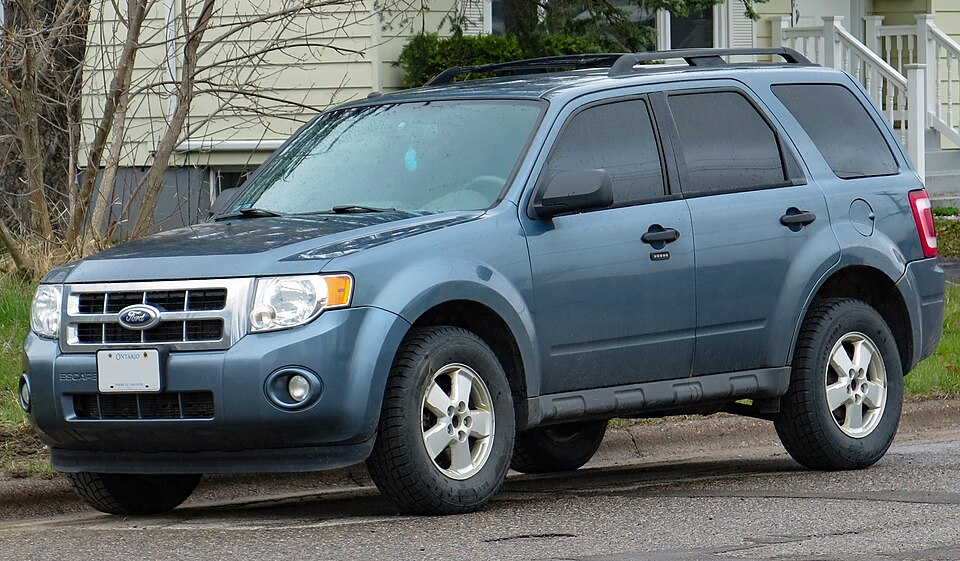
2012 Ford Escape recalls and problems

The 2012 Ford Escape has 1 recall and 604 owner complaints on file with NHTSA; the most reported problem area is fuel system.

2012 Ford Escape
Photo: 2012 Ford Escape by Elise240SX, CC BY-SA 4.0, via Wikimedia Commons
How the 2012 compares
Fewest complaintsMost complaints

Average complaint count among 27 Escape model years — 15th most.

1recalls
604complaints
38crashes
3fires
27injuries
57,000median miles

Owner complaints filed with NHTSA, not verified and not adjusted for sales. Ranking compares this model's own years only.

Does your car have an open recall?
Recalls apply to specific vehicles. Only a VIN lookup on NHTSA's official site shows whether yours is affected and still unrepaired.
Check your VIN →

1 recall

Fuel System

Oct 26, 2016 · NHTSA campaign 16V777000 · 329,265 vehicles

Problem: Ford Motor Company (Ford) is recalling certain model year 2010-2012 Ford Escape vehicles manufactured February 26, 2009, to April 29, 2012, and 2010-2011 Mercury Mariner vehicles manufactured February 25, 2009, to December 12, 2010. On vehicles with a 3.0L engine, the Fuel Delivery Module (FDM) may crack, causing a fuel leak.

Risk: A fuel leak in the presence of an ignition source increases the risk of a fire.

Remedy & notes

Ford will notify owners, and dealers will replace the FDM flange with one that has a redesigned fuel supply port, free of charge. Remedy parts are currently unavailable. Interim notices were mailed to owners on December 13, 2016. Owners will receive a second notice when remedy parts become available. Owners may contact Ford customer service at 1-866-436-7332. Ford's number for this recall is 16S41.

Owners may also contact the National Highway Traffic Safety Administration Vehicle Safety Hotline at 1-888-327-4236 (TTY 1-800-424-9153), or go to www.safercar.gov.

Recall text as published by NHTSA and the manufacturer.

What owners complain about

Owner complaints filed with NHTSA; one complaint can name several areas. Not verified by NHTSA.

Complaints by year filed

2011: 2 complaints20112012: 22 complaints2013: 51 complaints20132014: 45 complaints2015: 43 complaints20152016: 47 complaints2017: 71 complaints20172018: 119 complaints1192019: 51 complaints20192020: 19 complaints2021: 37 complaints20212022: 20 complaints2023: 26 complaints20232024: 19 complaints2025: 21 complaints20252026: 11 complaints202611

NHTSA investigations

Electronic Throttle Body Malfunction

PE13003 · opened Feb 21, 2013 · closed Feb 28, 2014
Summary

On February 21, 2013, the Office of Defects Investigations (ODI) opened Preliminary Evaluation PE13-003 to investigate allegations of electronic throttle body (ETB) failures resulting in sudden reduction of engine power in model year (MY) 2009-2013 Ford Escape, Fusion, Mariner and Milan vehicles. During this investigation, Ford identified a condition in subject vehicles equipped with 2.5L and 3.0L engines that may result in a sudden reduction of engine power.According to Ford, the ETB internal motor contacts may develop a high resistance material buildup condition on the commutator, resulting in intermittent electrical connectivity and reduced engine power. When this condition occurs, the Malfunction Indicator Lamp (MIL) or Wrench light will illuminate and the vehicle may enter a limited limp home mode.Ford?s trade name for the feature is Failure Mode Effects Management (FMEM) mode.In this mode, engine power and vehicle speed are reduced, while full function of the power steering, power braking, lighting, and climate control systems are maintained.ODI?s complaint analysis indicate that the predominant failure mode involved reduced motive power associated with the limited limp home mode with engine speeds limited to approximately 900 RPM. Analysis of warranty claims provided by Ford identified 59,807 claims related to ETB replacements and approximately 50 percent of claims are associated with diagnostic trouble codes (DTC) P2111, Throttle Body Stuck Open, and P2112, Throttle B…

Electronic Throttle Body Malfunction

DP12006 · opened Oct 2, 2012 · closed Feb 21, 2013
Summary

In a letter dated August 30, 2012, The North Carolina Consumers Council (NCCC) petitioned the National Highway Traffic Safety Administration (NHTSA) to initiate a defect investigation of alleged electronic throttle body failures resulting in engine stall or surge while driving in model year (MY) 2005 through 2012 Ford Escape vehicles. On October 2, 2012 the Office of Defects Investigation (ODI) opened a Defect Petition DP12-006 to evaluate whether to grant or deny the petition. The petition is hereby granted on certain model years. The NCCC letter cites two complaints of stall while driving in MY 2009 Ford Escape vehicles that were diagnosed as failed throttle bodies with diagnostic trouble codes (DTC) P2111, Throttle Body Stuck Open, and P2112, Throttle Body Stuck Closed. The petitioner indicates that the owners of both vehicles reported experiencing repeated incidents of stalling and engine surging. According to Ford, Escape non-hybrid vehicles are equipped with Electronic Throttle Body (ETB) assemblies beginning with MY 2009. Vehicles manufactured between June 22, 2009 and October 15, 2009 may contain contaminated printed circuit boards (PCB) with plating variations. Plating variations could lead to a lack of continuity in the throttle position sensor circuit where P2111 and/or other DTCs would be generated and stored. Ford and its electronic throttle body supplier, Delphi, modified the PCB manufacturing process and issued a technical service bulletin (TSB) 09-23-5. Vehicl…

2012 vs. other Ford Escape years

Owner complaints by model year; the darker bar is the 2012. Click a bar to switch year.

Questions

Does the 2012 Ford Escape have recalls?

Yes — NHTSA lists 1 recall campaign covering the 2012 Ford Escape, the latest from Oct 26, 2016 (fuel system). A recall applies to specific vehicles: enter your VIN at nhtsa.gov/recalls to see whether yours is affected and still open.

What are the most common problems with the 2012 Ford Escape?

Owner complaints filed with NHTSA most often mention fuel system (160), steering (140), engine (79). Complaints are consumer reports and are not verified by NHTSA.