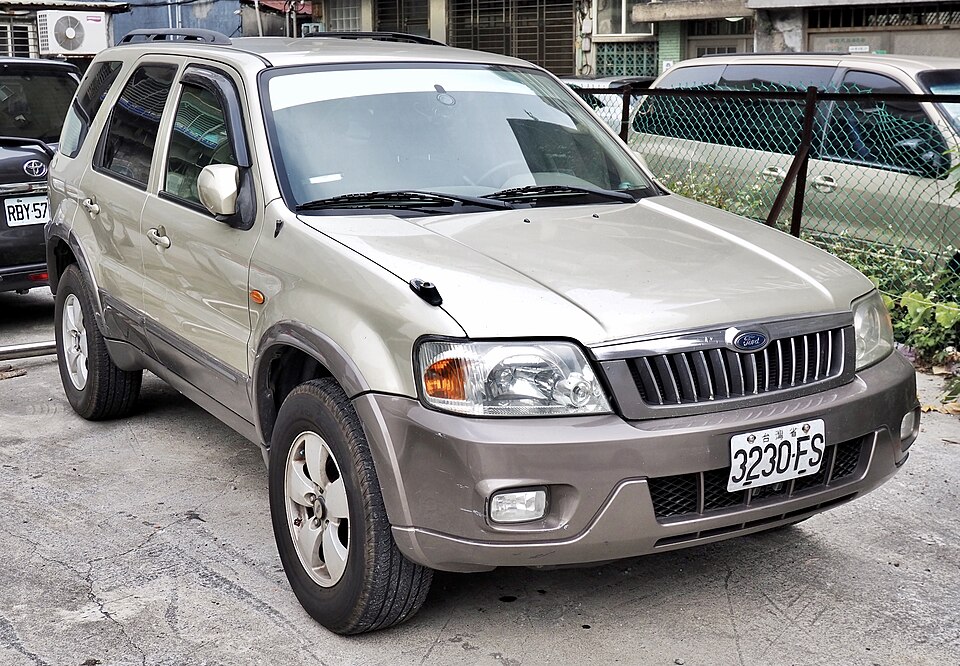
Low complaint count among 27 Escape model years — 19th most.
3recalls
464complaints
16crashes
9fires
26injuries
83,000median miles
Owner complaints filed with NHTSA, not verified and not adjusted for sales. Ranking compares this model's own years only.
Does your car have an open recall? Recalls apply to specific vehicles. Only a VIN lookup on NHTSA's official site shows whether yours is affected and still unrepaired.
Problem: Ford Motor Company (Ford) is recalling certain model year 2001-2008 Ford Escape and Mercury Mariner vehicles manufactured March 31, 2001, to September 1, 2009. The affected vehicles are equipped with either a 2.3L or 3.0L engine and have had their CD4E transmission replaced with remanufactured one that was rebuilt between June 11, 2015 through July 15, 2015. These service repair part transmissions have a shift lever bolt that may not be properly tightened. As a result, the shift control lever could disengage from the transmission without warning.
Risk: If the shift lever disengages from the transmission, a driver may be unable to shift gear positions and the indicated shift position may not represent the gear position the vehicle is in. Should a disengagement occur while the vehicle is being driven, when the driver goes to stop and park the vehicle, the gear selection indicator may show that the transmission is in the "PARK" position, but the vehicle transmission may not actually be in the "PARK" gear position. If the vehicle is not in the "PARK" position there is a risk the vehicle will roll away as the driver and other occupants exit the vehicle or anytime thereafter. A vehicle rollaway increases the risk of injury to exiting occupants and bystanders.
Remedy & notes
Ford will notify owners, and dealers will inspect the transmissions and either tighten the manual shift lever bolt or replace the manual shift lever assembly. These repairs will be performed free of charge. The recall began on October 23, 2015. Owners may contact Ford customer service at 1-866-436-7332. Ford's number for this recall is 15S28.
Owners may also contact the National Highway Traffic Safety Administration Vehicle Safety Hotline at 1-888-327-4236 (TTY 1-800-424-9153), or go to www.safercar.gov.
Problem: Ford Motor Company (Ford) is recalling certain model year 2005-2008 Ford Escape hybrid electric vehicles manufactured October 13, 2003, to June 20, 2008, and 2006-2008 Mercury Mariner hybrid electric vehicles manufactured June 10, 2005, to June 20, 2008. The coolant pump for the hybrid system may fail resulting in the hybrid electronics overheating.
Risk: If the hybrid electronics system overheats, it may shut down the powertrain, resulting in a stall-like condition, increasing the risk of a crash.
Remedy & notes
Ford will notify owners, and dealers will inspect and replace the original Motor Electronics Coolant (MEC) Pump with an improved brushless pump, free of charge. The recall is expected to begin on October 27, 2014. Owners may contact Ford customer service at 1-866-436-7332. Ford's number for this recall is 14S19.
Owners may also contact the National Highway Traffic Safety Administration Vehicle Safety Hotline at 1-888-327-4236 (TTY 1-800-424-9153), or go to www.safercar.gov.
Visibility
Nov 9, 2005 · NHTSA campaign 05V520000 · 199,942 vehicles
Problem: On certain trucks, passenger cars and sport utility vehicles, the windshield wiper motor May have been produced without grease being applied to the output shaft gear.
Original NHTSA wording
ON CERTAIN TRUCKS, PASSENGER CARS AND SPORT UTILITY VEHICLES, THE WINDSHIELD WIPER MOTOR MAY HAVE BEEN PRODUCED WITHOUT GREASE BEING APPLIED TO THE OUTPUT SHAFT GEAR.
Risk: After a period of continuous use on the high speed setting, lack of grease on the output shaft gear May cause the gear to distort or fracture during operation resulting in a loss of wiper function. Inoperative wipers under inclement weather conditions could cause a crash due to impaired visibility.
Original NHTSA wording
AFTER A PERIOD OF CONTINUOUS USE ON THE HIGH SPEED SETTING, LACK OF GREASE ON THE OUTPUT SHAFT GEAR MAY CAUSE THE GEAR TO DISTORT OR FRACTURE DURING OPERATION RESULTING IN A LOSS OF WIPER FUNCTION. INOPERATIVE WIPERS UNDER INCLEMENT WEATHER CONDITIONS COULD CAUSE A CRASH DUE TO IMPAIRED VISIBILITY.
Remedy & notes
Dealers will inspect the wiper motor for the presence of grease and grease the wiper motor gears if necessary. The recall began on November 22, 2005. Owners May contact Ford at 1-800-392-3673 or Lincoln/Mercury at 1-800-521-4140.
Ford recall no. 05S40. Customers May also contact the national highway traffic safety administration's vehicle safety hotline at 1-888-327-4236 (tty 1-800-424-9153), or go to http://www.safercar.gov.
Recall text as published by NHTSA and the manufacturer.
Owner complaints filed with NHTSA; one complaint can name several areas. Not verified by NHTSA.
Complaints by year filed
NHTSA investigations
Electronic Throttle Body Malfunction
DP12006 · opened Oct 2, 2012 · closed Feb 21, 2013
Summary
In a letter dated August 30, 2012, The North Carolina Consumers Council (NCCC) petitioned the National Highway Traffic Safety Administration (NHTSA) to initiate a defect investigation of alleged electronic throttle body failures resulting in engine stall or surge while driving in model year (MY) 2005 through 2012 Ford Escape vehicles. On October 2, 2012 the Office of Defects Investigation (ODI) opened a Defect Petition DP12-006 to evaluate whether to grant or deny the petition. The petition is hereby granted on certain model years. The NCCC letter cites two complaints of stall while driving in MY 2009 Ford Escape vehicles that were diagnosed as failed throttle bodies with diagnostic trouble codes (DTC) P2111, Throttle Body Stuck Open, and P2112, Throttle Body Stuck Closed. The petitioner indicates that the owners of both vehicles reported experiencing repeated incidents of stalling and engine surging. According to Ford, Escape non-hybrid vehicles are equipped with Electronic Throttle Body (ETB) assemblies beginning with MY 2009. Vehicles manufactured between June 22, 2009 and October 15, 2009 may contain contaminated printed circuit boards (PCB) with plating variations. Plating variations could lead to a lack of continuity in the throttle position sensor circuit where P2111 and/or other DTCs would be generated and stored. Ford and its electronic throttle body supplier, Delphi, modified the PCB manufacturing process and issued a technical service bulletin (TSB) 09-23-5. Vehicl…
2006 vs. other Ford Escape years
Owner complaints by model year; the darker bar is the 2006. Click a bar to switch year.
Questions
Does the 2006 Ford Escape have recalls?
Yes — NHTSA lists 3 recall campaigns covering the 2006 Ford Escape, the latest from Sep 29, 2015 (power train). A recall applies to specific vehicles: enter your VIN at nhtsa.gov/recalls to see whether yours is affected and still open.
What are the most common problems with the 2006 Ford Escape?
Owner complaints filed with NHTSA most often mention vehicle speed control (99), power train (80), engine (68). Complaints are consumer reports and are not verified by NHTSA.
 Recalls by Model