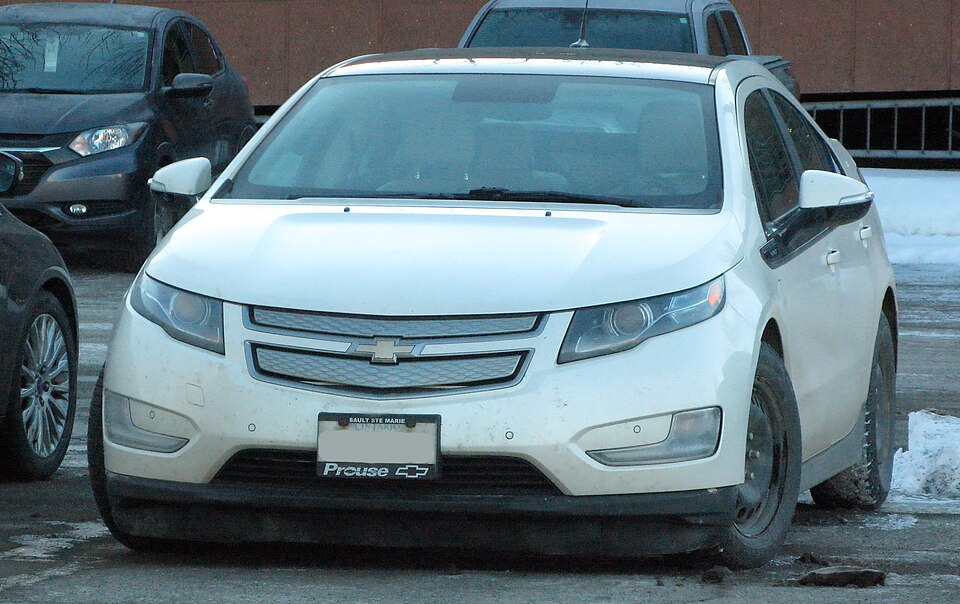
2012 Chevrolet Volt recalls and problems

The 2012 Chevrolet Volt has 2 recalls and 245 owner complaints on file with NHTSA; the most reported problem area is air bags.

2012 Chevrolet Volt
Photo: 2012 Chevrolet Volt by SsmIntrigue, CC BY-SA 4.0, via Wikimedia Commons
How the 2012 compares
Fewest complaintsMost complaints

High complaint count among 9 Volt model years — 3rd most.

2recalls
245complaints
6crashes
2fires
11injuries
80,000median miles

Owner complaints filed with NHTSA, not verified and not adjusted for sales. Ranking compares this model's own years only.

Does your car have an open recall?
Recalls apply to specific vehicles. Only a VIN lookup on NHTSA's official site shows whether yours is affected and still unrepaired.
Check your VIN →

2 recalls

Electrical System

Mar 13, 2015 · NHTSA campaign 15V145000 · 50,236 vehicles

Problem: General Motors LLC (GM) is recalling certain model year 2011-2013 Volt vehicles manufactured August 25, 2010, to June 26, 2013. If the driver exits the vehicle without turning off the electrical system, the battery may drain low enough that the gasoline engine will automatically start itself to recharge the electric battery.

Risk: If the engine runs for an extended period of time in an enclosed space, there may be a build up of carbon monoxide, increasing the risk of personal injury.

Remedy & notes

GM will notify owners, and dealers will update the engine management software to limit the time that the stationary vehicle can be left in the ON position, free of charge. The recall began April 15, 2015. Owners may contact Chevrolet customer service at 1-800-222-1020. GM's number for this recall is 14617.

Owners may also contact the National Highway Traffic Safety Administration Vehicle Safety Hotline at 1-888-327-4236 (TTY 1-800-424-9153), or go to www.safercar.gov.

Electronic Stability Control

Jun 27, 2013 · NHTSA campaign 13V271000 · 4 vehicles

Problem: General Motors (GM) is recalling certain model year 2012 Chevrolet Volt vehicles manufactured March 1, 2012, through April 17, 2012. Due to a brake pressure modulator valve problem, the vehicles do not relieve brake pressure from the front brakes during an anti-lock brake system (ABS), electronic stability control (ESC), or traction control event. One or both front brakes may lock up and not release. Thus, these vehicles fail to conform to Federal Motor Vehicle Safety Standards (FMVSS) No. 126, "Electronic Stability Control Systems"' and No. 135, "Light Vehicle Brake Systems."

Risk: If the brakes lock up it could cause a loss of steering control and/or a lengthened distance needed to stop the vehicle, increasing the risk of a crash.

Remedy & notes

General Motors will notify owners, and dealers will install a new brake pressure modulator valve free of charge. The recall is expected to begin July 12, 2013. Owners may contact Chevrolet at 1-866-694-6546. GM's recall number is 13184.

Owners may also contact the National Highway Traffic Safety Administration Vehicle Safety Hotline at 1-888-327-4236 (TTY 1-800-424-9153), or go to www.safercar.gov.

Recall text as published by NHTSA and the manufacturer.

What owners complain about

Owner complaints filed with NHTSA; one complaint can name several areas. Not verified by NHTSA.

Complaints by year filed

2011: 1 complaints20112012: 6 complaints2013: 8 complaints20132014: 15 complaints2015: 15 complaints20152016: 16 complaints2017: 21 complaints20172018: 31 complaints2019: 40 complaints2019402020: 33 complaints2021: 22 complaints20212022: 14 complaints2023: 9 complaints20232024: 8 complaints2025: 2 complaints20252026: 4 complaints20264

NHTSA investigations

Pedestrian alert sounds

DP22005 · opened Jan 27, 2023 · closed Aug 7, 2023 · led to recall 22V063000
Summary

NHTSA received a petition on or about July 18, 2022, requesting that Federal Motor Vehicle Safety Standard (FMVSS) 141 be applied to all electric and hybrid vehicles operating in the United States. The petition can be reviewed at NHTSA.gov under ODI Number 11486072. FMVSS 141 establishes performance requirements for pedestrian alert sounds for motor vehicles. The standard applies to hybrid and electric vehicles that have a gross vehicle weight rating of 4,536 KG or less or are defined as low-speed vehicles. The standard became fully applicable to all such vehicles manufactured on or after March 1, 2021.On January 27, 2023, NHTSA opened Defect Petition (DP) 22-005 to evaluate the subject matter described in the petition. On June 24, 2023 and as supplemented on June 25, 2023, the petitioner notified NHTSA he was withdrawing his petition. The petitioner indicated that, based on his review of data, there is no justification for asserting potential benefits that could be derived from actions sought by my petition. Based on the petitioner's withdrawal, DP22-005 is closed. Closure of this DP does not represent a determination by NHTSA regarding the subject matter of the petition.

Passenger Sensing System

PE19013 · opened Sep 17, 2019 · closed Jul 2, 2021
Summary

In September 2019, the Office of Defects Investigation (ODI) opened PE19-013 to assess the potential safety related effects of a malfunction of the Passenger Sensing System (PSS) in 2012-2013 Model Year (MY) Chevrolet Volt vehicles. Consumers reported that due to a malfunction of the PSS, the air bag system malfunction indicator light (MIL) was activated. Many of the complaints noted the malfunction occurred after the warranty period expired and mentioned high repair costs as a major deterrent to the repair of the vehicle.The PSS sensor mat is embedded in the front passenger seat cushion and is intended to detect child seats and small statured occupants who could be harmed by deployment of the frontal passenger air bag. The PSS may develop a malfunction due to bunching of the sensor mat in the seat trench. The bunching of the sensor mat could cause the mat to repeatedly fold in the same location. Over time, the repeated folding can cause an increased resistance in the sensor mat. An increased resistance in the PSS sensor mat is detected as a fault in the air bag system diagnostic. If this fault is detected, a diagnostic trouble code will be stored in the air bag control unit and the air bag MIL will illuminate.Further, if the fault is detected, the passenger frontal and knee air bags will be suppressed in a crash of sufficient severity to warrant a commanded deployment regardless of the nature of size of the occupant of the front passenger seat.The report counts shown above i…

Post-Crash EV Fire Hazard

PE11037 · opened Nov 25, 2011 · closed Jan 20, 2012
Summary

The subject vehicles, which employ emerging technology, are range-extended electric vehicles that utilize a high voltage (HV) battery to provide energy for propulsion. The HV battery is lithium-ion based technology that has a nominal full charge of 390 VDC, a 16 kWh capacity, and a control system that incorporates liquid (antifreeze) cooling and various electronic devices (control modules, sensors, wiring, etc) to monitor and manage the HV battery. The HV battery, portions of the cooling system, and the control system are contained within a common enclosure.During an NCAP oblique side pole impact test conducted by NHTSA in May 2011, the pole struck and deformed the sill plate under the driver's door at a location where there is a structural member. The lateral member displaced inward, pierced the HV battery enclosure and battery, and caused a battery coolant leak. Thereafter, the Agency conducted a rollover test (the rollover test consists of four 90-degree rotate-and-hold movements about the vehicle's longitudinal axis). In that test, the HV battery and electronics were exposed to coolant that leaked as a result of the crash. The vehicle fire that occurred three weeks later and the additional testing NHTSA conducted are discussed in a report titled 2011 Chevrolet Volt Battery Fire Incident Report a copy of which is available in the public file. The report indicates that intrusion induced coolant leakage, and subsequent rollover that saturates electronic components, were the …

2012 vs. other Chevrolet Volt years

Owner complaints by model year; the darker bar is the 2012. Click a bar to switch year.

Questions

Does the 2012 Chevrolet Volt have recalls?

Yes — NHTSA lists 2 recall campaigns covering the 2012 Chevrolet Volt, the latest from Mar 13, 2015 (electrical system). A recall applies to specific vehicles: enter your VIN at nhtsa.gov/recalls to see whether yours is affected and still open.

What are the most common problems with the 2012 Chevrolet Volt?

Owner complaints filed with NHTSA most often mention air bags (86), electrical system (86), fuel system (37). Complaints are consumer reports and are not verified by NHTSA.