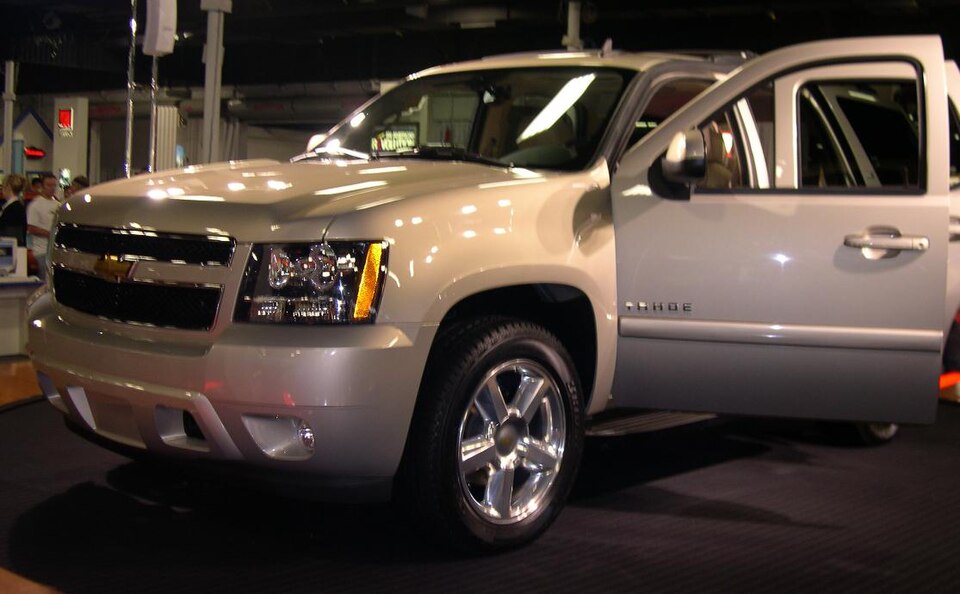
The 2006 Chevrolet Tahoe has 3 recalls and 114 owner complaints on file with NHTSA; the most reported problem area is structure.
Photo: 2006 Chevrolet Tahoe by No machine-readable author provided. Sfoskett~commonswiki assumed (based on copyright claims)., CC BY-SA 3.0, via Wikimedia Commons
How the 2006 compares
Low
Fewest complaintsMost complaints
Low complaint count among 27 Tahoe model years — 20th most.
3recalls
114complaints
4crashes
4fires
2injuries
75,245median miles
Owner complaints filed with NHTSA, not verified and not adjusted for sales. Ranking compares this model's own years only.
Does your car have an open recall? Recalls apply to specific vehicles. Only a VIN lookup on NHTSA's official site shows whether yours is affected and still unrepaired.
Feb 11, 2014 · NHTSA campaign 14V070000 · 22 vehicles
Problem: Monroe Truck Equipment (Monroe) is recalling certain model year 2006, 2008 and 2009 Chevrolet C7500 vehicles, 2005-2006 Chevrolet Tahoe vehicles, and 2009 Ford F-350, and F-450 vehicles, equipped with Sure Power-brand battery equalizers or DC-DC converters containing a particular epoxy sealing, aka 'potting', compound. The specific potting compound used in the subject products for insulation was found to be capable of conducting electricity after being exposed to heat.
Risk: Once electrically conductive, the material is capable of melting and burning, increasing the risk of a fire.
Remedy & notes
Monroe will notify owners, and Sure Power will replace the equalizers or converters, free of charge. The recall began on March 24, 2014. Owners may contact Monroe at 1-608-328-8127.
Owners may also contact the National Highway Traffic Safety Administration Vehicle Safety Hotline at 1-888-327-4236 (TTY 1-800-424-9153), or go to www.safercar.gov.
Equipment
Dec 7, 2005 · NHTSA campaign 05V552000 · 32,068 vehicles
Problem: Certain trucks and sport utility vehicles fail to conform to the requirements of federal motor vehicle safety standard no. 110, "tire selection and rims." these vehicles were shipped with tire and loading information labels listing an inacccurate vehicle capacity weight.
Original NHTSA wording
CERTAIN TRUCKS AND SPORT UTILITY VEHICLES FAIL TO CONFORM TO THE REQUIREMENTS OF FEDERAL MOTOR VEHICLE SAFETY STANDARD NO. 110, "TIRE SELECTION AND RIMS." THESE VEHICLES WERE SHIPPED WITH TIRE AND LOADING INFORMATION LABELS LISTING AN INACCCURATE VEHICLE CAPACITY WEIGHT.
Risk: A misprinted label could lead to improper vehicle loading specifications or tire inflation which could result in a tire failure, increasing the risk of a crash.
Original NHTSA wording
A MISPRINTED LABEL COULD LEAD TO IMPROPER VEHICLE LOADING SPECIFICATIONS OR TIRE INFLATION WHICH COULD RESULT IN A TIRE FAILURE, INCREASING THE RISK OF A CRASH.
Remedy & notes
Owners will be provided with corrected labels and installation instructions. At the customer's option, a dealer can install the label for them. The recall began on March 31, 2006. Owners May contact Buick at 1-866-608-8080, Cadillac at 1-866-982-2339, Chevrolet at 1-800-630-2438, GMC at 1-866-996-9463, Hummer at 1-800-732-5493, Pontiac at 1-800-620-7668, Saturn at 1-800-972-8876, or Isuzu at 1-800-255-6727.
Gm recall no. 05109.customers May also contact the national highway traffic safety administration's vehicle safety hotline at 1-888-327-4236 (tty 1-800-424-9153), or go to http://www.safercar.gov.
Steering
Oct 5, 2005 · NHTSA campaign 05V455000 · 123,592 vehicles
Problem: Certain passenger vehicles May have been built with a power steering hose that is not to specification. Under extreme steering maneuvers, such as turning the steering wheel fully to the left or right while braking, the hose May fracture and leak fluid.
Original NHTSA wording
CERTAIN PASSENGER VEHICLES MAY HAVE BEEN BUILT WITH A POWER STEERING HOSE THAT IS NOT TO SPECIFICATION. UNDER EXTREME STEERING MANEUVERS, SUCH AS TURNING THE STEERING WHEEL FULLY TO THE LEFT OR RIGHT WHILE BRAKING, THE HOSE MAY FRACTURE AND LEAK FLUID.
Risk: If this were to occur, power steering assist would be lost and increased steering effort would be required. On vehicles equipped with hydro-boost power brakes, it could also result in loss of power brake assist and increased braking effort would be required. If the power steering fluid spray were to spray onto hot engine parts, an engine compartment fire could occur.
Original NHTSA wording
IF THIS WERE TO OCCUR, POWER STEERING ASSIST WOULD BE LOST AND INCREASED STEERING EFFORT WOULD BE REQUIRED. ON VEHICLES EQUIPPED WITH HYDRO-BOOST POWER BRAKES, IT COULD ALSO RESULT IN LOSS OF POWER BRAKE ASSIST AND INCREASED BRAKING EFFORT WOULD BE REQUIRED. IF THE POWER STEERING FLUID SPRAY WERE TO SPRAY ONTO HOT ENGINE PARTS, AN ENGINE COMPARTMENT FIRE COULD OCCUR.
Remedy & notes
Dealers will inspect the power steering hose(s) for two suspect date codes and replace them if required. The recall will begin on October 14, 2005. Owners May contact Chevrolet at 1-800-630-2438, GMC at 1-866-996-9463, Buick at 1-866-608-8080, Cadillac at 1-866-982-2339, Isuzu at 1-800-255-6727, or Hummer at 1-800-732-5493.
Gm recall no. 05086.customers May also contact the national highway traffic safety administration's vehicle safety hotline at 1-888-327-4236 (tty 1-800-424-9153), or go to http://www.safercar.gov.
Recall text as published by NHTSA and the manufacturer.
Owner complaints filed with NHTSA; one complaint can name several areas. Not verified by NHTSA.
Complaints by year filed
2006 vs. other Chevrolet Tahoe years
Owner complaints by model year; the darker bar is the 2006. Click a bar to switch year.
Questions
Does the 2006 Chevrolet Tahoe have recalls?
Yes — NHTSA lists 3 recall campaigns covering the 2006 Chevrolet Tahoe, the latest from Feb 11, 2014 (electrical system). A recall applies to specific vehicles: enter your VIN at nhtsa.gov/recalls to see whether yours is affected and still open.
What are the most common problems with the 2006 Chevrolet Tahoe?
Owner complaints filed with NHTSA most often mention structure (27), electrical system (24), latches/locks/linkages (21). Complaints are consumer reports and are not verified by NHTSA.
 Recalls by Model