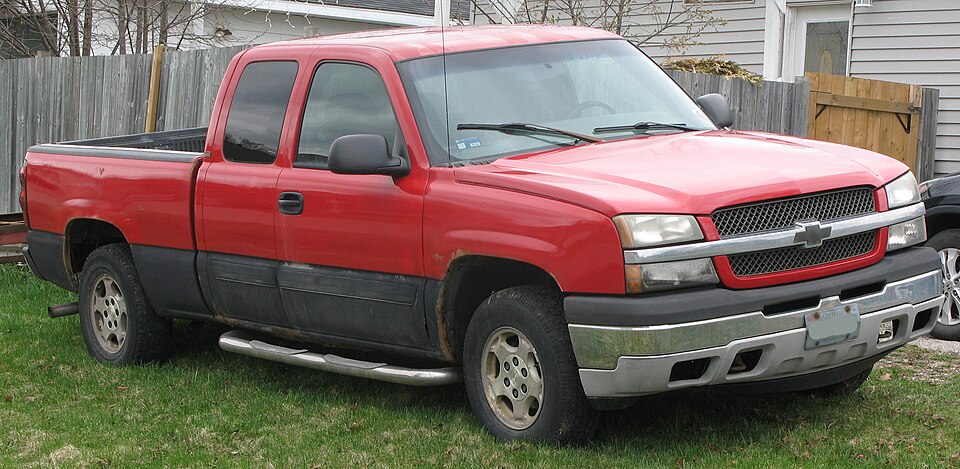
2004 Chevrolet Silverado recalls and problems

The 2004 Chevrolet Silverado has 8 recalls and 622 owner complaints on file with NHTSA; the most reported problem area is service brakes.

2004 Chevrolet Silverado
Photo: 2004 Chevrolet Silverado by SsmIntrigue, CC BY-SA 4.0, via Wikimedia Commons
How the 2004 compares
Fewest complaintsMost complaints

High complaint count among 18 Silverado model years — 5th most.

8recalls
622complaints
56crashes
10fires
36injuries
47,000median miles

Owner complaints filed with NHTSA, not verified and not adjusted for sales. Ranking compares this model's own years only.

Does your car have an open recall?
Recalls apply to specific vehicles. Only a VIN lookup on NHTSA's official site shows whether yours is affected and still unrepaired.
Check your VIN →

8 recalls

Air Bags

Oct 31, 2006 · NHTSA campaign 06V417000 · 794 vehicles

Problem: Certain vehicles originally built with cloth seats that were equipped with an automatic air bag passenger sensing system and later reupholstered with aftermarket leather seat cover kits are involved. Testing has indicated that the aftermarket leather seat covers can cause the passenger sensing system to malfunction.

Original NHTSA wording

CERTAIN VEHICLES ORIGINALLY BUILT WITH CLOTH SEATS THAT WERE EQUIPPED WITH AN AUTOMATIC AIR BAG PASSENGER SENSING SYSTEM AND LATER REUPHOLSTERED WITH AFTERMARKET LEATHER SEAT COVER KITS ARE INVOLVED. TESTING HAS INDICATED THAT THE AFTERMARKET LEATHER SEAT COVERS CAN CAUSE THE PASSENGER SENSING SYSTEM TO MALFUNCTION.

Risk: If the passenger sensing system malfunctions, the front air bag on the passenger side May be disabled when it should be enabled, or enabled when it should be disabled. In either case, in the event of a crash that requires air bag deployment, a front passenger's level of injury May be increased.

Original NHTSA wording

IF THE PASSENGER SENSING SYSTEM MALFUNCTIONS, THE FRONT AIR BAG ON THE PASSENGER SIDE MAY BE DISABLED WHEN IT SHOULD BE ENABLED, OR ENABLED WHEN IT SHOULD BE DISABLED. IN EITHER CASE, IN THE EVENT OF A CRASH THAT REQUIRES AIR BAG DEPLOYMENT, A FRONT PASSENGER'S LEVEL OF INJURY MAY BE INCREASED.

Remedy & notes

Because a replacement leather seat cover that is compatible with the passenger sensing system is not available, general motors (gm) will repurchase these vehicles in accordance with the terms stated in gm's letter to owners. The recall began on November 6, 2006. Owners should contact gm at 1-877-477-1022 to begin the process of repurchasing their vehicle.

Gm recall no. 06102.customers May also contact the national highway traffic safety administration's vehicle safety hotline at 1-888-327-4236 (tty 1-800-424-9153), or go to http://www.safercar.gov.

Engine

Aug 3, 2006 · NHTSA campaign 06V289000 · 38,439 vehicles

Problem: On certain trucks equipped with an 8.1L V8 (rpo L8-VIN g) engine have a condition in which the engine fuel rail pulse damper retainer clip May fracture resulting in inadequate retention of the damper.

Original NHTSA wording

ON CERTAIN TRUCKS EQUIPPED WITH AN 8.1L V8 (RPO L8-VIN G) ENGINE HAVE A CONDITION IN WHICH THE ENGINE FUEL RAIL PULSE DAMPER RETAINER CLIP MAY FRACTURE RESULTING IN INADEQUATE RETENTION OF THE DAMPER.

Risk: If the damper comes loose, a fuel leak May result. Fuel leakage, in the presence of an ignition source, could result in a fire.

Original NHTSA wording

IF THE DAMPER COMES LOOSE, A FUEL LEAK MAY RESULT. FUEL LEAKAGE, IN THE PRESENCE OF AN IGNITION SOURCE, COULD RESULT IN A FIRE.

Remedy & notes

Dealers will replace the engine fuel rail pulse damper retainer clip free of charge. The recall began on August 31, 2006. Owners May contact Chevrolet at 1-800-630-2438 and GMC trucks at 1-866-996-9463.

Gm recall no. 06080.customers May also contact the national highway traffic safety administration's vehicle safety hotline at 1-888-327-4236 (tty 1-800-424-9153), or go to http://www.safercar.gov.

Seat Belts

Apr 22, 2005 · NHTSA campaign 05V163000 · 1,359,824 vehicles

Problem: On certain crew cab pickup trucks and sport utility vehicles, the 2ND row center occupant seat belt routing May make it difficult to position the lap portion of the safety belt low around the hips of occupants, especially smaller occupants, seated in this position. Appropriate use of a child seat or booster seat, as recommended for small children, does improve the fit condition for this user group. In addition to instructions on proper infant and young child restraint (with child seats or boosters), special verbiage for restraining older child is included in the owner's manual. Also, the suggested seat belt fit/routing for adults, irrespective of seating position, is described in the owner's manual text.

Original NHTSA wording

ON CERTAIN CREW CAB PICKUP TRUCKS AND SPORT UTILITY VEHICLES, THE 2ND ROW CENTER OCCUPANT SEAT BELT ROUTING MAY MAKE IT DIFFICULT TO POSITION THE LAP PORTION OF THE SAFETY BELT LOW AROUND THE HIPS OF OCCUPANTS, ESPECIALLY SMALLER OCCUPANTS, SEATED IN THIS POSITION. APPROPRIATE USE OF A CHILD SEAT OR BOOSTER SEAT, AS RECOMMENDED FOR SMALL CHILDREN, DOES IMPROVE THE FIT CONDITION FOR THIS USER GROUP. IN ADDITION TO INSTRUCTIONS ON PROPER INFANT AND YOUNG CHILD RESTRAINT (WITH CHILD SEATS OR BOOSTERS), SPECIAL VERBIAGE FOR RESTRAINING OLDER CHILD IS INCLUDED IN THE OWNER'S MANUAL. ALSO, THE SUGGESTED SEAT BELT FIT/ROUTING FOR ADULTS, IRRESPECTIVE OF SEATING POSITION, IS DESCRIBED IN THE OWNER'S MANUAL TEXT.

Risk: A lap portion of the seat belt routing that is not low and snug on the hips can allow the lap belt to ride up on an occupant's abdomen instead of fitting low around their hipbones, and therefore, can expose them to more risk of abdominal and internal organ injury.

Original NHTSA wording

A LAP PORTION OF THE SEAT BELT ROUTING THAT IS NOT LOW AND SNUG ON THE HIPS CAN ALLOW THE LAP BELT TO RIDE UP ON AN OCCUPANT'S ABDOMEN INSTEAD OF FITTING LOW AROUND THEIR HIPBONES, AND THEREFORE, CAN EXPOSE THEM TO MORE RISK OF ABDOMINAL AND INTERNAL ORGAN INJURY.

Remedy & notes

Dealers will cut open the guide loop, remove a portion of the loop, and then the remaining two sides should be folded over and secured with a retainer free of charge. The recall began on July 21, 2005. Owners May contact Cadillac at 1-866-982-2339, Chevrolet at 1-800-630-2438, GMC at 1-866-996-9463, or Hummer at 1-800-732-5493.

Gm recall no. 05037.customers May also contact the national highway traffic safety administration's vehicle safety hotline at 1-888-327-4236 (tty 1-800-424-9153), or go to http://www.safercar.gov.

Parking Brake

Apr 22, 2005 · NHTSA campaign 05V161000 · 90,242 vehicles

Problem: On certain pickup trucks equipped with manual transmissions and built with either pbr parking brake systems or trw parking brake systems, the parking brake friction linings May wear to an extent where the parking brake can become ineffective in immobilizing a parked vehicle.

Original NHTSA wording

ON CERTAIN PICKUP TRUCKS EQUIPPED WITH MANUAL TRANSMISSIONS AND BUILT WITH EITHER PBR PARKING BRAKE SYSTEMS OR TRW PARKING BRAKE SYSTEMS, THE PARKING BRAKE FRICTION LININGS MAY WEAR TO AN EXTENT WHERE THE PARKING BRAKE CAN BECOME INEFFECTIVE IN IMMOBILIZING A PARKED VEHICLE.

Risk: If the parking brake does not hold, unintended vehicle movement could occur, which could result in a crash.

Original NHTSA wording

IF THE PARKING BRAKE DOES NOT HOLD, UNINTENDED VEHICLE MOVEMENT COULD OCCUR, WHICH COULD RESULT IN A CRASH.

Remedy & notes

Dealers will install a low-force spring clip retainer for vehicles equipped with a pbr parking brake system. On vehicles equipped with the trw parking brake system, dealers will install a redesigned parking brake cable assembly. The recall began on July 29, 2005. Owners May contact Chevrolet at 1-800-630-2438 or GMC at 1-866-996-9463.

Gm recall no. 05042.customers May also contact the national highway traffic safety administration's vehicle safety hotline at 1-888-327-4236 (tty 1-800-424-9153), or go to http://www.safercar.gov.

Service Brakes

Feb 8, 2005 · NHTSA campaign 05V043000 · 77,411 vehicles

Problem: Certain trucks, sport utility vehicles, and vans equipped with Bosch hydro-boost brake assemblies, the hydraulic brake booster pressure accumulator May crack and separate from the hydro-boost assembly during normal operating conditions.

Original NHTSA wording

CERTAIN TRUCKS, SPORT UTILITY VEHICLES, AND VANS EQUIPPED WITH BOSCH HYDRO-BOOST BRAKE ASSEMBLIES, THE HYDRAULIC BRAKE BOOSTER PRESSURE ACCUMULATOR MAY CRACK AND SEPARATE FROM THE HYDRO-BOOST ASSEMBLY DURING NORMAL OPERATING CONDITIONS.

Risk: If a separation occurred and the hood of the vehicle were open, fragments from the accumulator could cause injury to people in the immediate area. The presence of this crack or fractured surface could allow the hydraulic fluid to leak from the accumulator circuit of the booster assembly. The loss of fluid would cause increased steering and braking effort and a crash May occur without prior warning.

Original NHTSA wording

IF A SEPARATION OCCURRED AND THE HOOD OF THE VEHICLE WERE OPEN, FRAGMENTS FROM THE ACCUMULATOR COULD CAUSE INJURY TO PEOPLE IN THE IMMEDIATE AREA. THE PRESENCE OF THIS CRACK OR FRACTURED SURFACE COULD ALLOW THE HYDRAULIC FLUID TO LEAK FROM THE ACCUMULATOR CIRCUIT OF THE BOOSTER ASSEMBLY. THE LOSS OF FLUID WOULD CAUSE INCREASED STEERING AND BRAKING EFFORT AND A CRASH MAY OCCUR WITHOUT PRIOR WARNING.

Remedy & notes

Dealers will test the hydro-boost assembly for functional operation of the two-function valve. If the hydro-boost assembly fails the test, dealers will replace the assembly free of charge. The recall began on March 23, 2005. Owners May contact Chevrolet at 1-800-630-2438, GMC trucks at 1-866-996-9463 and Hummer at 1-800-732-5493.

Gm recall no. 05006.customers May also contact the national highway traffic safety administration's vehicle safety hotline at 1-888-327-4236 (tty 1-800-424-9153), or go to http://www.safercar.gov.

Seat Belts

May 11, 2004 · NHTSA campaign 04V225000 · 736 vehicles

Problem: Certain extended and regular cab pickup trucks and cargo vans converted to compressed natural gas (CNG) fail to conform to the requirements of federal motor vehicle safety standard no. 225, 'child restraint anchorage systems.' these vehicles have one seating position, the center rear seat, equipped with child restraint lower anchorages.

Original NHTSA wording

CERTAIN EXTENDED AND REGULAR CAB PICKUP TRUCKS AND CARGO VANS CONVERTED TO COMPRESSED NATURAL GAS (CNG) FAIL TO CONFORM TO THE REQUIREMENTS OF FEDERAL MOTOR VEHICLE SAFETY STANDARD NO. 225, 'CHILD RESTRAINT ANCHORAGE SYSTEMS.' THESE VEHICLES HAVE ONE SEATING POSITION, THE CENTER REAR SEAT, EQUIPPED WITH CHILD RESTRAINT LOWER ANCHORAGES.

Risk: The standard requires child seat lower anchorages in two seating positions for vehicles with three rear seating positions. The standard cab and cargo van vehicles, which only have front seating positions, have an air bag off switch to disable the front passenger air bag and do not have child restraint lower anchorages in the passenger seat. The standard requires passenger seat child seat lower anchorages in vehicles with an air bag off switch. However, the standard does not require vehicles with only front seating positions to have lower anchorage provisions if the vehicle is not equipped with an air bag off switch.

Original NHTSA wording

THE STANDARD REQUIRES CHILD SEAT LOWER ANCHORAGES IN TWO SEATING POSITIONS FOR VEHICLES WITH THREE REAR SEATING POSITIONS. THE STANDARD CAB AND CARGO VAN VEHICLES, WHICH ONLY HAVE FRONT SEATING POSITIONS, HAVE AN AIR BAG OFF SWITCH TO DISABLE THE FRONT PASSENGER AIR BAG AND DO NOT HAVE CHILD RESTRAINT LOWER ANCHORAGES IN THE PASSENGER SEAT. THE STANDARD REQUIRES PASSENGER SEAT CHILD SEAT LOWER ANCHORAGES IN VEHICLES WITH AN AIR BAG OFF SWITCH. HOWEVER, THE STANDARD DOES NOT REQUIRE VEHICLES WITH ONLY FRONT SEATING POSITIONS TO HAVE LOWER ANCHORAGE PROVISIONS IF THE VEHICLE IS NOT EQUIPPED WITH AN AIR BAG OFF SWITCH.

Remedy & notes

To bring the standard cab and cargo van vehicles into compliance, dealers will inject epoxy into the air bag off switch to prevent air bag activation, relocate the switch behind the instrument panel and then install a cover over the resulting opening. The sun visor label and owner's manual will also be changed. The correction for the extended cab vehicle will consist of changing the front passenger seat to a seat that has child restraint lower anchorages. The recall began on September 9, 2004. Owners should contact Chevrolet at 1-800-630-2438 or GMC at 1-866-996-9463.

Gm recall no. 04038.customers can also contact the national highway traffic safety administration's auto safety hotline at 1-888-DASH-2-DOT (1-888-327-4236).

Structure

Mar 17, 2004 · NHTSA campaign 04V129000 · 3,662,211 vehicles

Problem: On certain pickup trucks and sport utility vehicles, the galvanized steel tailgate support cables that retain the tailgate in the full open (horizontal) position May corrode, weaken, and eventually fracture. If both cables fractured, the tailgate would suddenly drop and strike the top surface of the rear bumper.

Original NHTSA wording

ON CERTAIN PICKUP TRUCKS AND SPORT UTILITY VEHICLES, THE GALVANIZED STEEL TAILGATE SUPPORT CABLES THAT RETAIN THE TAILGATE IN THE FULL OPEN (HORIZONTAL) POSITION MAY CORRODE, WEAKEN, AND EVENTUALLY FRACTURE. IF BOTH CABLES FRACTURED, THE TAILGATE WOULD SUDDENLY DROP AND STRIKE THE TOP SURFACE OF THE REAR BUMPER.

Risk: Anyone sitting or standing on the horizontal surface of the tailgate when both cables fractured could be injured by falling from the tailgate. On vehicles that have had the bumper removed, the tailgate May drop even lower. Additionally, if there is cargo on the tailgate the cargo May fall off if the support cables fracture.

Original NHTSA wording

ANYONE SITTING OR STANDING ON THE HORIZONTAL SURFACE OF THE TAILGATE WHEN BOTH CABLES FRACTURED COULD BE INJURED BY FALLING FROM THE TAILGATE. ON VEHICLES THAT HAVE HAD THE BUMPER REMOVED, THE TAILGATE MAY DROP EVEN LOWER. ADDITIONALLY, IF THERE IS CARGO ON THE TAILGATE THE CARGO MAY FALL OFF IF THE SUPPORT CABLES FRACTURE.

Remedy & notes

Dealers will replace the cables. Interim owner notification began on April 7, 20004. The recall began on September 24, 2004, when replacement parts were available, and will continue through October 29, 2004. Owners should contact Cadillac at 1-866-982-2339, Chevrolet at 1-800-630-2438 or GMC at 1-866-996-9463, or visit www.mygmlink.com, and enter your vehicle identification number.

Gm recall no. 04007.customers can also contact the national highway traffic safety administration's auto safety hotline at 1-888-DASH-2-DOT (1-888-327-4236).

Service Brakes

Feb 4, 2004 · NHTSA campaign 04V045000 · 68,875 vehicles

Problem: Certain sport utility vehicles, pickup trucks, and passenger vans fail to comply with the requirements of federal motor vehicle safety standard no. 135, ?passenger car brake systems.? Some of these vehicles were produced with an out-of-specification brake hydro-boost housing relief valve bore.

Original NHTSA wording

CERTAIN SPORT UTILITY VEHICLES, PICKUP TRUCKS, AND PASSENGER VANS FAIL TO COMPLY WITH THE REQUIREMENTS OF FEDERAL MOTOR VEHICLE SAFETY STANDARD NO. 135, ?PASSENGER CAR BRAKE SYSTEMS.? SOME OF THESE VEHICLES WERE PRODUCED WITH AN OUT-OF-SPECIFICATION BRAKE HYDRO-BOOST HOUSING RELIEF VALVE BORE.

Risk: Consequently, the valve o-ring seal May fracture. Steering efforts May be slightly increased while braking or parking. Under certain driving conditions, a fractured seal May require a slight increase in the applied brake pedal effort to achieve the same vehicle deceleration rate as prior to the seat fracture.

Original NHTSA wording

CONSEQUENTLY, THE VALVE O-RING SEAL MAY FRACTURE. STEERING EFFORTS MAY BE SLIGHTLY INCREASED WHILE BRAKING OR PARKING. UNDER CERTAIN DRIVING CONDITIONS, A FRACTURED SEAL MAY REQUIRE A SLIGHT INCREASE IN THE APPLIED BRAKE PEDAL EFFORT TO ACHIEVE THE SAME VEHICLE DECELERATION RATE AS PRIOR TO THE SEAT FRACTURE.

Remedy & notes

Dealers are to replace the hydro-boost relief valve. The recall began on June 18, 2004. Owners should contact Cadillac at 1-866-982-2339; Chevrolet at 1-800-630-2438; GMC at 1-866-996-9463; or Hummer at 1-866-486-6376.

Gm recall no. 04004.customers can also contact the national highway traffic safety administration's auto safety hotline at 1-888-DASH-2-DOT (1-888-327-4236).

Recall text as published by NHTSA and the manufacturer.

What owners complain about

Owner complaints filed with NHTSA; one complaint can name several areas. Not verified by NHTSA.

Complaints by year filed

2003: 3 complaints20032004: 83 complaints2005: 120 complaints20051202006: 62 complaints2007: 97 complaints20072008: 32 complaints2009: 18 complaints20092010: 20 complaints2011: 19 complaints20112012: 24 complaints2013: 48 complaints20132014: 65 complaints2015: 24 complaints20152016: 6 complaints2022: 1 complaints20221

NHTSA investigations

HYDRAULIC PUMP FAILRES

EA04012 · opened Apr 30, 2004 · closed Feb 28, 2005 · led to recall 05V005000
Summary

GM IS CONDUCTING A RECALL ON ALL SUBJECT VEHICLES BUILD BETWEEN MAY 1999 AND OCTOBER 14, 1999.SIGNIFICANT CHANGES WERE INCORPORATED INTO PRODUCTION IN EARLY OCTOBER 1999, AND VEHICLES BUILT AFTER THAT DATE HAVE LOWER WARRANTY FAILURE RATES.THE COMPLAINT AND WARRANTY DATA APPEAR TO SUPPORT THE EFFECTIVENESS OF THESE CHANGES. GM MADE ADDITIONAL CHANGES IN NOVEMBER 1999, FEBRUARY 2000, MAY 2001, AND FEBRUARY 2004.ODI WILL CONTINUE TO MONITOR THIS PROBLEM AND WILL TAKE FURTHER ACTION, IF WARRANTED, IN THE FUTURE.FOR FURTHER TECHNICAL DETAILS SEE THE ATTACHED ENGINEERING ANALYSIS REPORT.

2004 vs. other Chevrolet Silverado years

Owner complaints by model year; the darker bar is the 2004. Click a bar to switch year.

Questions

Does the 2004 Chevrolet Silverado have recalls?

Yes — NHTSA lists 8 recall campaigns covering the 2004 Chevrolet Silverado, the latest from Oct 31, 2006 (air bags). A recall applies to specific vehicles: enter your VIN at nhtsa.gov/recalls to see whether yours is affected and still open.

What are the most common problems with the 2004 Chevrolet Silverado?

Owner complaints filed with NHTSA most often mention service brakes (207), electrical system (159), power train (49). Complaints are consumer reports and are not verified by NHTSA.