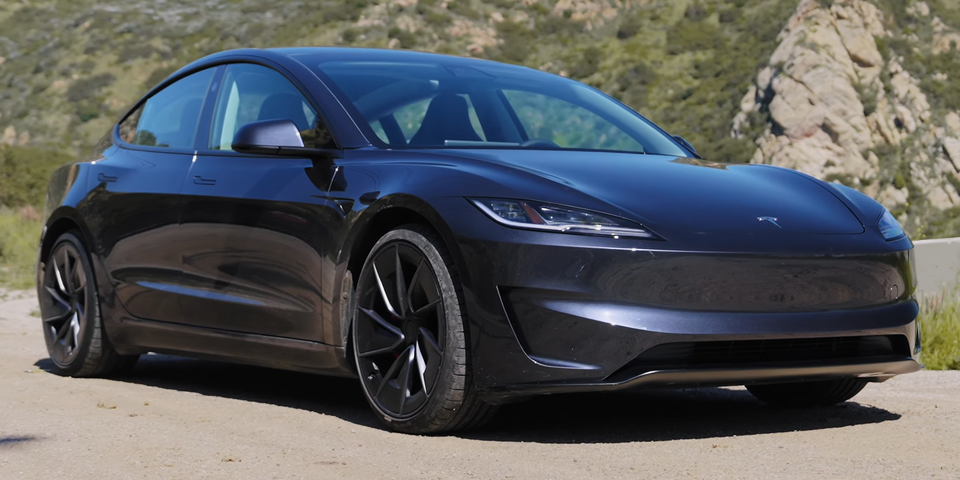
2024 Tesla Model 3 recalls and problems

The 2024 Tesla Model 3 has 5 recalls and 224 owner complaints on file with NHTSA; the most reported problem area is unknown or other.

2024 Tesla Model 3
Photo: 2024 Tesla Model 3 by iMoD Official, CC BY 3.0, via Wikimedia Commons
How the 2024 compares
Fewest complaintsMost complaints

Low complaint count among 10 Model 3 model years — 7th most.

5recalls
224complaints
28crashes
1fires
19injuries
15,000median miles

Owner complaints filed with NHTSA, not verified and not adjusted for sales. Ranking compares this model's own years only.

Does your car have an open recall?
Recalls apply to specific vehicles. Only a VIN lookup on NHTSA's official site shows whether yours is affected and still unrepaired.
Check your VIN →

5 recalls

Air Bags

Jul 7, 2026 · NHTSA campaign 26V445000 · 15 vehicles

Problem: Tesla, Inc. (Tesla) is recalling certain 2026 Model Y and 2024 Model 3 vehicles. The vehicles were originally built for a foreign market and do not have knee air bags, may not be equipped with certain interior safety countermeasures, and may not have been tested for bumper impact resistance procedures. As such, these vehicles fail to comply with the requirements of Federal Motor Vehicle Safety Standard numbers, 208, "Occupant Crash Protection," 201, "Occupant Protection in Interior Impact," and Part 581, "Bumper Standards."

Risk: A noncompliant vehicle may have reduced occupant protections, increasing the risk of injury during a crash.

Remedy

Tesla will repurchase noncompliant vehicles currently registered in the United States, free of charge. Owner notification letters were mailed September 4, 2026. Owners may contact Tesla customer service at 1-877-798-3752 or resolutions@tesla.com. Tesla's number for this recall is SB-26-00-004.

Back Over Prevention

Jan 6, 2025 · NHTSA campaign 25V002000 · 239,382 vehicles

Problem: Tesla, Inc. (Tesla) is recalling certain 2024-2025 Model 3, Model S, 2023-2025 Model X, and Model Y vehicles. The computer circuit board may short, resulting in the loss of the rearview camera image. As such, these vehicles fail to comply with the requirements of Federal Motor Vehicle Safety Standard (FMVSS) number 111, "Rear Visibility."

Risk: A rearview camera that does not display an image reduces the driver's rear view, increasing the risk of a crash.

Remedy & notes

Tesla released an over-the-air (OTA) software update, free of charge. Tesla will also identify any vehicles that experienced a circuit board failure, or stress that may lead to a circuit board failure, and replace the affected computers, free of charge. Owner notification letters were mailed March 7, 2025. Owners may contact Tesla customer service at 1-877-798-3752. Tesla's number for this recall is SB-25-00-001.

Owners may also contact the National Highway Traffic Safety Administration Vehicle Safety Hotline at 1-888-327-4236 (TTY 1-800-424-9153) or go to nhtsa.gov.

Tires

Dec 17, 2024 · NHTSA campaign 24V935000 · 696,281 vehicles

Problem: Tesla, Inc. (Tesla) is recalling certain 2024 Cybertruck, 2017-2025 Model 3, and 2020-2025 Model Y vehicles. The tire pressure monitoring system (TPMS) warning light may not remain illuminated between drive cycles, failing to warn the driver of low tire pressure. As such, these vehicles fail to comply with the requirements of Federal Motor Vehicle Safety Standard number 138, "Tire Pressure Monitoring Systems."

Risk: Driving with improperly inflated tires increases the risk of a crash.

Remedy & notes

Tesla released an over-the-air (OTA) software update, free of charge. Owner notification letters were mailed February 15, 2025. Owners may contact Tesla customer service at 1-877-798-3752. Tesla's number for this recall is SB-24-00-018.

Owners may also contact the National Highway Traffic Safety Administration Vehicle Safety Hotline at 1-888-327-4236 (TTY 1-800-424-9153), or go to www.nhtsa.gov.

Electrical System

Jul 24, 2024 · NHTSA campaign 24V554000 · 1,849,638 vehicles

Problem: Tesla, Inc. (Tesla) is recalling certain 2021-2024 Model 3, Model S, Model X, and 2020-2024 Model Y vehicles. The hood latch assembly may fail to detect an unlatched hood condition after the hood has been opened.

Risk: An unlatched hood can fully open, obstructing the driver's view and increasing the risk of a crash.

Remedy & notes

Tesla has released an over-the-air (OTA) software update, free of charge. Owner notification letters were mailed September 24, 2024. Owners may contact Tesla customer service at 1-877-798-3752. Tesla's number for this recall is SB-24-00-012.

Owners may also contact the National Highway Traffic Safety Administration Vehicle Safety Hotline at 1-888-327-4236 (TTY 1-800-424-9153), or go to www.nhtsa.gov.

Air Bags

Apr 19, 2024 · NHTSA campaign 24V284000 · 1 vehicles

Problem: Tesla, Inc. (Tesla) is recalling one 2024 Model 3 vehicle. The driver seat side air bag module was assembled without a deflector that directs gas flow during deployment.

Risk: Without a deflector, the air bag may deploy improperly, increasing the risk of injury during a crash.

Remedy & notes

Tesla service replaced the side air bag, free of charge. The affected vehicle was repaired April 12, 2024. Owners may contact Tesla customer service at 1-877-798-3752. Tesla's number for this recall is SB-24-13-001.

Owners may also contact the National Highway Traffic Safety Administration Vehicle Safety Hotline at 1-888-327-4236 (TTY 1-800-424-9153), or go to www.nhtsa.gov.

Recall text as published by NHTSA and the manufacturer.

What owners complain about

Owner complaints filed with NHTSA; one complaint can name several areas. Not verified by NHTSA.

Complaints by year filed

2024: 96 complaints2024962025: 83 complaints20252026: 45 complaints202645

NHTSA investigations

FSD Collisions in Reduced Roadway Visibility Conditions

EA26002 · opened Mar 18, 2026 · open
Summary

The Office of Defects Investigation (ODI) is opening this Engineering Analysis to evaluate Tesla’s Full Self Driving Beta and Full Self Driving (Supervised) (collectively, FSD) degradation detection system. The focus of this investigation will be to assess the system’s ability, when encountering reduced roadway visibility conditions, to detect degradation and alert the driver with sufficient time to respond. ODI will evaluate the performance of FSD in degraded roadway conditions and the updates or modifications by Tesla to the degradation detection system, including the timing, purpose, and capabilities of the updates, and Tesla’s assessment of their safety impact. Tesla’s FSD is an advanced driver assistance system (ADAS) that relies exclusively on vision-based cameras and the related FSD software to detect and respond to the roadway ahead, projecting a path forward based on traffic control devices, vehicles, pedestrians, and the roadway itself. When Tesla began transitioning away from using both cameras and radars to an exclusively camera-based approach, known as Tesla Vision, in mid-2021, it developed and implemented a degradation detection system that it deployed by a software update to existing and new Tesla vehicles. On June 28, 2024, the day after Tesla submitted the SGO report of the November 28, 2023 fatal crash listed in this document, Tesla began developing an update to the degradation detection system. At this time, ODI does not have information on when th…

Traffic safety violations while Full Self Driving ("FSD") is engaged

PE25012 · opened Oct 7, 2025 · open
Summary

The Office of Defects Investigation (“ODI”) is opening this Preliminary Evaluation (PE) to assess the scope, frequency, and potential safety consequences of FSD executing driving maneuvers that constitute traffic safety violations. This investigation concerns versions of FSD that Tesla has labeled as "FSD (Supervised)" and "FSD (Beta)." Tesla characterizes FSD as an SAE Level 2 partial automation system requiring a fully attentive driver who is engaged in the driving task at all times. Level 2 partial automation systems are designed to support and assist the driver in performing certain aspects of the driving task, requiring a driver to supervise and intervene as necessary.  The driver remains fully responsible at all times for driving the vehicle, including complying with applicable traffic laws. ODI’s investigation will therefore focus, in particular, on whether certain driving inputs within the control authority of FSD forestall the driver’s supervision when they are unexpectedly performed. ODI has identified a number of incidents in which the inputs to the dynamic driving task commanded by FSD induced vehicle behavior that violated traffic safety laws. Although reports of this nature span a variety of behaviors, the reports appear to most commonly involve two types of scenarios. The first type of scenario involves a vehicle operating with FSD proceeding into an intersection in violation of a red traffic signal. The second type of scenario involves FSD commandin…

Compliance with Standing General Order 2021-01 Reporting Requirements

AQ25002 · opened Aug 20, 2025 · open
Summary

The Office of Defects Investigation (“ODI”) has identified numerous incident reports submitted by Tesla, Inc. (“Tesla”) in response to Standing General Order 2021-01 (the “SGO”), in which the reported crashes occurred several months or more before the dates of the reports. The majority of these reports involved crashes in which the Standing General Order in place at the time required a report to be submitted within one or five days of Tesla receiving notice of the crash. When the reports were submitted, Tesla submitted them in one of two ways. Many of the reports were submitted as part of a single batch, while others were submitted on a rolling basis. Preliminary engagement between ODI and Tesla on the issue indicates that the timing of the reports was due to an issue with Tesla’s data collection, which, according to Tesla, has now been fixed. NHTSA is opening this Audit Query, a standard process for reviewing compliance with legal requirements, to evaluate the cause of the potential delays in reporting, the scope of any such delays, and the mitigations that Tesla has developed to address them. As part of this review, NHTSA will assess whether any reports of prior incidents remain outstanding and whether the reports that were submitted include all of the required and available data. The SGO reports cited in the Opening Resume, can be found at NHTSA.gov/SGOCrashReporting under the following SGO 2021-01 report IDs: 13781-11020-1 13781-10844-1 13781-10843-1 13781-1…

Actually Smart Summon sessions resulting in low-speed impacts.

PE24033 · opened Jan 6, 2025 · closed Apr 3, 2026
Summary

On January 6, 2025, the Office of Defects Investigations (ODI) opened Preliminary Evaluation 24003 (PE24033) to investigate Actually Smart Summon (Summon) sessions resulting in crashes during active sessions. According to Tesla, Summon is a short-distance SAE Level 2 system, controlled by the user from a cell phone within a certain distance and intended for use in parking lots and on private property. ODI analyzed complaint data provided by Tesla as well as complaints submitted to ODI from consumers to identify Summon incidents resulting in crashes. ODI's analysis indicates that almost all Summon reported crashes involved minor property damage claims with no reported incidents involving a vulnerable road user, injury, fatality, or major property damage as indicated by an air bag deployment or vehicle tow away. Out of millions of Summon sessions, a fraction of 1% resulted in an incident. Almost all those incidents took place where, typically early in a Summon session, the system or person using the app failed to fully detect or respond appropriately to vehicle surroundings resulting in minor impacts. Incidents took place when app users did not have a complete 360-degree view of the surroundings in the app to assess situational awareness. This limited the app user’s ability to determine whether an impact was imminent during initial vehicle maneuvers such as reversing in close proximity to an obstacle or a curb. ODI found that the impacts most often occurred with parking gates…

FSD Collisions in Reduced Roadway Visibility Conditions

PE24031 · opened Oct 17, 2024 · closed Mar 18, 2026
Summary

On October 17, 2024, NHTSA’s Office of Defects Investigation (ODI) opened a Preliminary Evaluation (PE24031) of Tesla’s Full Self Driving Beta and Full Self Driving (Supervised) (collectively, FSD) to assess: the ability of the FSD system to detect and respond appropriately to reduced roadway visibility conditions; whether any other FSD crashes had occurred under degraded roadway visibility conditions that are similar in nature to the four SGO-reported crashes identified in the opening document, and if so, the contributing circumstances for each of those crashes; and any updates or modifications by Tesla to the FSD system that may affect the performance of FSD in degraded roadway visibility conditions, including the timing, purpose, and capabilities of any such updates, and Tesla’s assessment of their safety impact. Tesla’s FSD is an advanced driver assistance system (ADAS) that relies exclusively on vision-based cameras and the related FSD software to detect and respond to the roadway ahead, projecting a path forward based on traffic control devices, vehicles, pedestrians, and the roadway itself. During this phase of the investigation, ODI reviewed the materials provided by Tesla detailing any actions taken, or changes, modifications, and updates made that may relate to the alleged defect. ODI reviewed information related to Tesla’s transition to a vision-only perception system, and its deployment of the strategy in vehicles. ODI’s findings include information on…

Recall 23V838 Remedy Effectiveness

RQ24009 · opened Apr 25, 2024 · open
Summary

The Office of Defects Investigation (ODI) is opening a Recall Query to assess the remedy adequacy of Recall 23V838. On December 12, 2023, Tesla filed a Defect Information Report (Recall 23V838) applicable to all Tesla models produced and equipped with any version of its Autopilot system, which Tesla described as an SAE Level 2 (L2) Advanced Driver Assistance System (ADAS). Autopilot is the simultaneous engagement of Tesla’s Traffic-Aware Cruise Control (TACC) and Autosteer. In describing the safety defect, Tesla’s Defect Information Report (DIR) explained that “the prominence and scope of the system’s controls may be insufficient to prevent driver misuse,” and Tesla committed to the deployment of a multipart remedy aimed at improving system and engagement controls and reducing mode confusion. EA22002 (upgraded from PE21020) was opened to investigate whether Tesla’s Autopilot contained a defect that created an unreasonable risk to motor vehicle safety and involved extensive crash analysis, human factors analysis, vehicle evaluations, and assessment of vehicle control authority and driver engagement technologies. The work conducted in these investigations aligns with Tesla’s conclusion in its 23V838 recall filing. During EA22002, ODI identified at least 13 crashes involving one or more fatalities and many more involving serious injuries in which foreseeable driver misuse of the system played an apparent role. Tesla filed Recall 23V838 to address concerns regarding…

Unexpected Brake Activation

PE22002 · opened Feb 16, 2022 · closed Jun 29, 2026
Summary

On February 16, 2022, the Office of Defects Investigation (ODI) opened a Preliminary Evaluation (PE22002) to investigate reports of unexpected deceleration while driving with the adaptive cruise control system engaged in Model Year (MY) 2021 – 2022 Model 3 and Model Y vehicles manufactured by Tesla. The subject systems include Autopilot (all versions), Full Self-Driving (FSD) and Traffic Aware Cruise Control (TACC). These complaints have been colloquially referred to as “phantom braking”. ODI opened PE22002 to determine the scope and severity of the potential problem and to assess any resulting safety issues in the subject vehicles. The alleged defect is an unexpected and unrequested vehicle deceleration triggered by the subject system during subject system engagement. The alleged defect does not occur when the subject system is not in use and is separate and distinct from Automated Emergency Braking (AEB). During vehicle operation, AEB is actively monitoring in the subject vehicles regardless of subject system and its intervention is accompanied by audible and visual collision warnings. A Vehicle Owners Questionnaire (VOQ) trend originating in November 2021 prompted ODI to open PE22002. VOQ narratives reported unexpected brake activation while using TACC, Autopilot or FSD. The trend grew from 99 by the end of 2021 to 314 by February 16, 2022, when PE22002 was opened. ODI sent Information Request (IR) Letters to Tesla on May 4, 2022, and July 11, 2024, to request salien…

2024 vs. other Tesla Model 3 years

Owner complaints by model year; the darker bar is the 2024. Click a bar to switch year.

Questions

Does the 2024 Tesla Model 3 have recalls?

Yes — NHTSA lists 5 recall campaigns covering the 2024 Tesla Model 3, the latest from Jul 7, 2026 (air bags). A recall applies to specific vehicles: enter your VIN at nhtsa.gov/recalls to see whether yours is affected and still open.

What are the most common problems with the 2024 Tesla Model 3?

Owner complaints filed with NHTSA most often mention unknown or other (72), forward collision avoidance (49), electrical system (47). Complaints are consumer reports and are not verified by NHTSA.