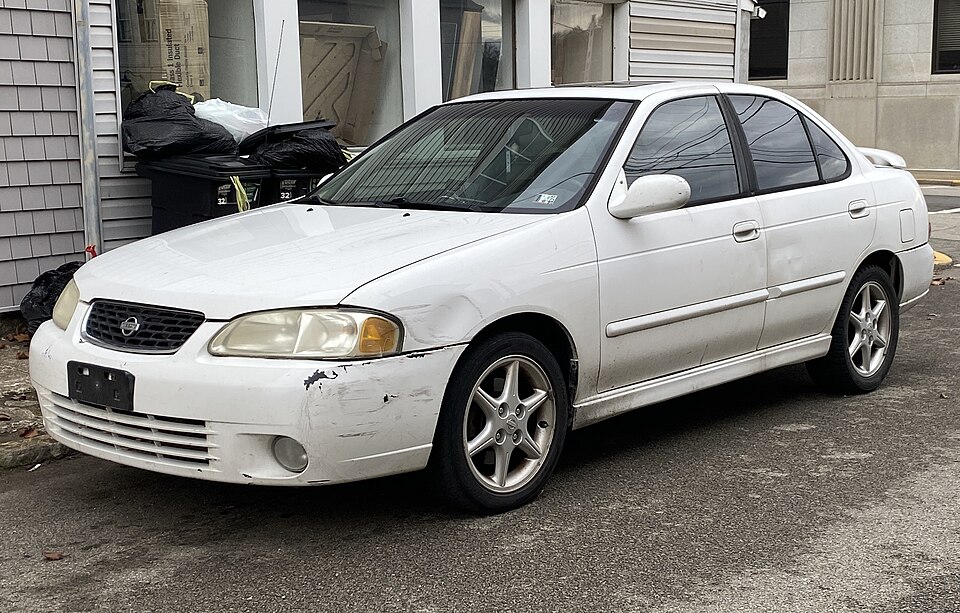
2001 Nissan Sentra recalls and problems

The 2001 Nissan Sentra has 7 recalls and 236 owner complaints on file with NHTSA; the most reported problem area is engine.

2001 Nissan Sentra
Photo: 2001 Nissan Sentra by Cutlass, CC0, via Wikimedia Commons
How the 2001 compares
Fewest complaintsMost complaints

High complaint count among 27 Sentra model years — 6th most.

7recalls
236complaints
20crashes
2fires
12injuries
61,000median miles

Owner complaints filed with NHTSA, not verified and not adjusted for sales. Ranking compares this model's own years only.

Does your car have an open recall?
Recalls apply to specific vehicles. Only a VIN lookup on NHTSA's official site shows whether yours is affected and still unrepaired.
Check your VIN →

7 recalls

Engine

Dec 10, 2003 · NHTSA campaign 03V511000 · 70 vehicles

Problem: On certain electric vehicles, the front suspension transverse link's ball joint bracket May break from stress concentration at a notch created by surface roughness and the shape of the material cut-line.

Original NHTSA wording

ON CERTAIN ELECTRIC VEHICLES, THE FRONT SUSPENSION TRANSVERSE LINK'S BALL JOINT BRACKET MAY BREAK FROM STRESS CONCENTRATION AT A NOTCH CREATED BY SURFACE ROUGHNESS AND THE SHAPE OF THE MATERIAL CUT-LINE.

Remedy & notes

Dealers will replace the bracket on these vehicles. Owner notification began December 15, 2003. Owners should contact Nissan at 1-800-647-7261.

Customers can also contact the national highway traffic safety administration's auto safety hotline at 1-888-DASH-2-DOT (1-888-327-4236).

Engine

Nov 17, 2003 · NHTSA campaign 03V455000 · 630,000 vehicles

Problem: On certain passenger vehicles, the circuit board for the crank position sensor or cam position sensor May have an improper solder joint due to solder deformation caused by heat stress accelerated by the existence of flux residue during the soldering process.

Original NHTSA wording

ON CERTAIN PASSENGER VEHICLES, THE CIRCUIT BOARD FOR THE CRANK POSITION SENSOR OR CAM POSITION SENSOR MAY HAVE AN IMPROPER SOLDER JOINT DUE TO SOLDER DEFORMATION CAUSED BY HEAT STRESS ACCELERATED BY THE EXISTENCE OF FLUX RESIDUE DURING THE SOLDERING PROCESS.

Risk: This could cause the "service engine soon" warning light to come on, create a no start condition, cause reduced engine power, or cause the engine to stop running without warning during vehicle operation, which could result in a crash.

Original NHTSA wording

THIS COULD CAUSE THE "SERVICE ENGINE SOON" WARNING LIGHT TO COME ON, CREATE A NO START CONDITION, CAUSE REDUCED ENGINE POWER, OR CAUSE THE ENGINE TO STOP RUNNING WITHOUT WARNING DURING VEHICLE OPERATION, WHICH COULD RESULT IN A CRASH.

Remedy & notes

Dealers will replace the crank position sensors. Camshaft position sensor(s), and in some cases, the variable timing control sensor(s). Vehicles involved in a previous recall campaign, 01V357, are also included in this new campaign. The replacement sensors used in that campaign are also affected. Owner notification began on December 22, 2003. Owners should contact Nissan at 1-800-647-7261 or Infiniti at 1-800-662-6200.

Nissan recall no. R3022/Infiniti recall no. R3021.customers can also contact the national highway traffic safety administration's auto safety hotline at 1-888-DASH-2-DOT (1-888-327-4236).

Electrical System

Nov 14, 2003 · NHTSA campaign 03V477000 · 276,000 vehicles

Problem: On certain passenger vehicles equipped with the QG18DE engine or QR25DE engines, the foam material used for the interior lining of the electronic control module (ECM) box emits sulfur as it cures.

Original NHTSA wording

ON CERTAIN PASSENGER VEHICLES EQUIPPED WITH THE QG18DE ENGINE OR QR25DE ENGINES, THE FOAM MATERIAL USED FOR THE INTERIOR LINING OF THE ELECTRONIC CONTROL MODULE (ECM) BOX EMITS SULFUR AS IT CURES.

Risk: If one of the resistors inside the ECM has a crack on the surface coating, the gas May cause corrosion of the resistor. This could cause the malfunction indicator light to come on, poor drivability (idle instability, poor accelerator), or the engine to stop running during vehicle operation, which could result in a crash.

Original NHTSA wording

IF ONE OF THE RESISTORS INSIDE THE ECM HAS A CRACK ON THE SURFACE COATING, THE GAS MAY CAUSE CORROSION OF THE RESISTOR. THIS COULD CAUSE THE MALFUNCTION INDICATOR LIGHT TO COME ON, POOR DRIVABILITY (IDLE INSTABILITY, POOR ACCELERATOR), OR THE ENGINE TO STOP RUNNING DURING VEHICLE OPERATION, WHICH COULD RESULT IN A CRASH.

Remedy & notes

Dealers will remove the inside lining material from the ECM box. Owner notification began on December 22, 2003. Owners should contact Nissan at 1-800-647-7261.

Nissan recall no. P3163.customers can also contact the national highway traffic safety administration's auto safety hotline at 1-888-DASH-2-DOT (1-888-327-4236).

Exterior Lighting

Dec 12, 2001 · NHTSA campaign 01V376000 · 81,393 vehicles

Problem: Vehicle description: Certain passenger vehicles fail to comply with requirements of federal motor vehicle safety standard no. 108, "lamps, reflective devices, and associated equipment." these vehicles were missing tamperproof caps that prevent horizontal headlamp adjustment.

Original NHTSA wording

VEHICLE DESCRIPTION: CERTAIN PASSENGER VEHICLES FAIL TO COMPLY WITH REQUIREMENTS OF FEDERAL MOTOR VEHICLE SAFETY STANDARD NO. 108, "LAMPS, REFLECTIVE DEVICES, AND ASSOCIATED EQUIPMENT." THESE VEHICLES WERE MISSING TAMPERPROOF CAPS THAT PREVENT HORIZONTAL HEADLAMP ADJUSTMENT.

Risk: These caps are installed to prevent misadjustment of the headlamps.

Original NHTSA wording

THESE CAPS ARE INSTALLED TO PREVENT MISADJUSTMENT OF THE HEADLAMPS.

Remedy & notes

Dealers will install a tamperproof cap over the horizontal adjustment screw for both headlamps. Owner notification began January 14, 2002. Owners who take their vehicles to an authorized dealer on an agreed upon service date and do not receive the free remedy within a reasonable time should contact Nissan at 1-800-647-7261.

Also contact the national highway traffic safety administration's auto safety hotline at 1-888-DASH-2-DOT (1-888-327-4236).

Engine

Nov 16, 2001 · NHTSA campaign 01V357000 · 103,000 vehicles

Problem: Vehicle description: Passenger vehicles equipped with a 1.8 liter engine. The engine could stop running while being driven due to a defective crank position sensor. This could also result in the "service engine soon" warning light coming on or reduced engine power.

Original NHTSA wording

VEHICLE DESCRIPTION: PASSENGER VEHICLES EQUIPPED WITH A 1.8 LITER ENGINE. THE ENGINE COULD STOP RUNNING WHILE BEING DRIVEN DUE TO A DEFECTIVE CRANK POSITION SENSOR. THIS COULD ALSO RESULT IN THE "SERVICE ENGINE SOON" WARNING LIGHT COMING ON OR REDUCED ENGINE POWER.

Risk: If the engine stops running while the vehicle is in motion, it could result in a crash.

Original NHTSA wording

IF THE ENGINE STOPS RUNNING WHILE THE VEHICLE IS IN MOTION, IT COULD RESULT IN A CRASH.

Remedy & notes

Dealers will replace the crank position sensors. Owner notification began December 10, 2001. Owners who take their vehicles to an authorized dealer on an agreed upon service date and do not receive the free remedy within a reasonable time should contact Nissan at 1-800-647-7261.

Also contact the national highway traffic safety administration's auto safety hotline at 1-888-DASH-2-DOT (1-888-327-4236).

Wheels

Aug 29, 2001 · NHTSA campaign 01V277000 · 115,000 vehicles

Problem: Vehicle description: Passenger vehicles. The cooling holes in the steel wheel May have burrs on their edges as a result of improper manufacturing. These burrs can cause cracks as the vehicle is being driven. Cracks can propagate between adjacent cooling holes. If enough cracks develop between the cooling holes, the wheel could fail and separate from the mounting hub without prior warning.

Original NHTSA wording

VEHICLE DESCRIPTION: PASSENGER VEHICLES. THE COOLING HOLES IN THE STEEL WHEEL MAY HAVE BURRS ON THEIR EDGES AS A RESULT OF IMPROPER MANUFACTURING. THESE BURRS CAN CAUSE CRACKS AS THE VEHICLE IS BEING DRIVEN. CRACKS CAN PROPAGATE BETWEEN ADJACENT COOLING HOLES. IF ENOUGH CRACKS DEVELOP BETWEEN THE COOLING HOLES, THE WHEEL COULD FAIL AND SEPARATE FROM THE MOUNTING HUB WITHOUT PRIOR WARNING.

Risk: Separation of the wheel from the vehicle while being operated could result in a vehicle crash.

Original NHTSA wording

SEPARATION OF THE WHEEL FROM THE VEHICLE WHILE BEING OPERATED COULD RESULT IN A VEHICLE CRASH.

Remedy & notes

Dealers will inspect for cracks and replace the wheel if cracks are discovered. Owner notification will be conducted in two phases. The first mailing began October 1, 2001, asking owners to bring their vehicles in to a dealer for inspection of the wheels. Any wheels with cracks will be replaced. A second owner notification will begin in early December, at which time Nissan will have an adequate number of replacement wheels, requesting owners to return to their dealers to have the wheels replaced. Owners who take their vehicles to an authorized dealer on an agreed upon service date and do not receive the free remedy within a reasonable time should contact Nissan at 1-800-647-7261.

Also contact the national highway traffic safety administration's auto safety hotline at 1-888-DASH-2-DOT (1-888-327-4236).

Suspension

May 23, 2001 · NHTSA campaign 01V174000 · 101,000 vehicles

Problem: Vehicle description: Passenger vehicles. One or more of the three bolts used to attach each front suspension lower control arm to the body on the left and right sides May not have been properly manufactured.

Original NHTSA wording

VEHICLE DESCRIPTION: PASSENGER VEHICLES. ONE OR MORE OF THE THREE BOLTS USED TO ATTACH EACH FRONT SUSPENSION LOWER CONTROL ARM TO THE BODY ON THE LEFT AND RIGHT SIDES MAY NOT HAVE BEEN PROPERLY MANUFACTURED.

Risk: The bolts could fracture, increasing the risk of a crash.

Original NHTSA wording

THE BOLTS COULD FRACTURE, INCREASING THE RISK OF A CRASH.

Remedy & notes

Dealers will replace the lower control arm attachment bolts. Owner notification began June 30, 2001. Owners who take their vehicles to an authorized dealer on an agreed upon service date and do not receive the free remedy within a reasonable time should contact Nissan at 1-800-647-7261.

Also contact the national highway traffic safety administration's auto safety hotline at 1-888-DASH-2-DOT (1-888-327-4236).

Recall text as published by NHTSA and the manufacturer.

What owners complain about

Owner complaints filed with NHTSA; one complaint can name several areas. Not verified by NHTSA.

Complaints by year filed

2001: 23 complaints20012002: 29 complaints2003: 47 complaints2003472004: 42 complaints2005: 21 complaints20052006: 7 complaints2007: 13 complaints20072008: 13 complaints2009: 3 complaints20092010: 5 complaints2011: 6 complaints20112012: 3 complaints2013: 3 complaints20132014: 6 complaints2015: 5 complaints20152016: 3 complaints2017: 3 complaints20172019: 1 complaints2021: 1 complaints20212022: 1 complaints2026: 1 complaints20261

2001 vs. other Nissan Sentra years

Owner complaints by model year; the darker bar is the 2001. Click a bar to switch year.

Questions

Does the 2001 Nissan Sentra have recalls?

Yes — NHTSA lists 7 recall campaigns covering the 2001 Nissan Sentra, the latest from Dec 10, 2003 (engine). A recall applies to specific vehicles: enter your VIN at nhtsa.gov/recalls to see whether yours is affected and still open.

What are the most common problems with the 2001 Nissan Sentra?

Owner complaints filed with NHTSA most often mention engine (108), electrical system (44), service brakes (24). Complaints are consumer reports and are not verified by NHTSA.