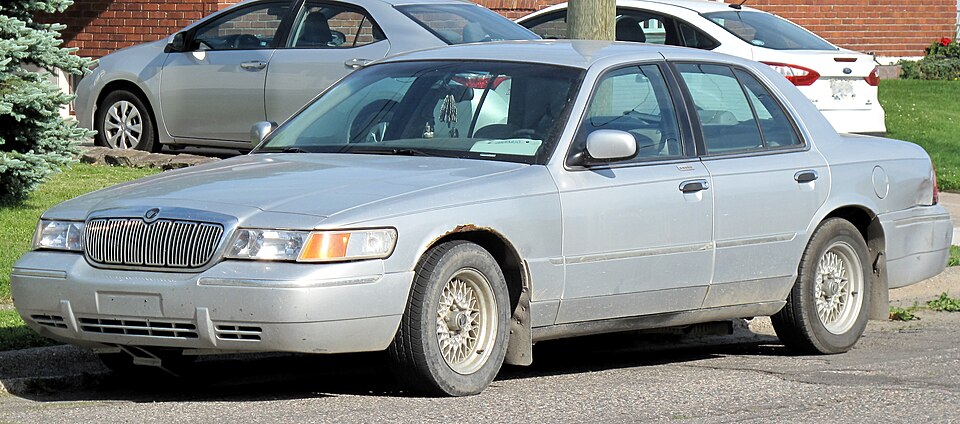
2000 Mercury Grand Marquis recalls and problems

The 2000 Mercury Grand Marquis has 6 recalls and 162 owner complaints on file with NHTSA; the most reported problem area is engine.

2000 Mercury Grand Marquis
Photo: 2000 Mercury Grand Marquis by Elise240SX, CC BY-SA 4.0, via Wikimedia Commons
How the 2000 compares
Fewest complaintsMost complaints

High complaint count among 12 Grand Marquis model years — 4th most.

6recalls
162complaints
14crashes
5fires
10injuries
73,825median miles

Owner complaints filed with NHTSA, not verified and not adjusted for sales. Ranking compares this model's own years only.

Does your car have an open recall?
Recalls apply to specific vehicles. Only a VIN lookup on NHTSA's official site shows whether yours is affected and still unrepaired.
Check your VIN →

6 recalls

Equipment

Jul 18, 2000 · NHTSA campaign 00V200000 · 875,000 vehicles

Problem: Vehicle description: Passenger vehicles. These vehicles have jacking instructions which, if followed, could cause the vehicle operator to place the jack on a frame weld when attempting to raise a rear wheel. If the vehicle is jacked up with the jack placed on the frame weld and if the vehicle is free to roll (wheels not blocked or chocked), the jack could yield and the vehicle May drop suddenly.

Original NHTSA wording

VEHICLE DESCRIPTION: PASSENGER VEHICLES. THESE VEHICLES HAVE JACKING INSTRUCTIONS WHICH, IF FOLLOWED, COULD CAUSE THE VEHICLE OPERATOR TO PLACE THE JACK ON A FRAME WELD WHEN ATTEMPTING TO RAISE A REAR WHEEL. IF THE VEHICLE IS JACKED UP WITH THE JACK PLACED ON THE FRAME WELD AND IF THE VEHICLE IS FREE TO ROLL (WHEELS NOT BLOCKED OR CHOCKED), THE JACK COULD YIELD AND THE VEHICLE MAY DROP SUDDENLY.

Risk: If this occurs and any portion of the operator's body is under the vehicle, the potential for personal injury exists.

Original NHTSA wording

IF THIS OCCURS AND ANY PORTION OF THE OPERATOR'S BODY IS UNDER THE VEHICLE, THE POTENTIAL FOR PERSONAL INJURY EXISTS.

Remedy & notes

Owners will be provided with a revised jack instruction and stowage card and jack warning label, as well as a supplement to the owner guide.

Owner notification began August 3, 2000.owners who do not receive the free instructions and label within a reasonable time should contact Ford at 1-800-392-3673.also contact the national highway traffic safety administration's auto safety hotline at 1-888-DASH-2-DOT (1-888-327-4236).

Seat Belts

Jun 12, 2000 · NHTSA campaign 00V157002 · 1,129 vehicles

Problem: Vehicle description: Passenger vehicles using aftermarket front passenger side seat belt assemblies that were sold by Ford parts departments from January 1, through June 13, 2000. These seat belt assemblies fail to comply with the requirements of FMVSS no. 209, "seat belt assemblies." the equipment involved is service stock seat belt assemblies, model nos. H 9977, h 9979, t 9063, and t 9217, built by trw vehicle safety systems, INC. (trw) manufactured from June 1, 1998 through May 21, 2000. Some of these seat belt assemblies May have been installed as service replacement equipment on the vehicles involved in the recall.

Original NHTSA wording

VEHICLE DESCRIPTION: PASSENGER VEHICLES USING AFTERMARKET FRONT PASSENGER SIDE SEAT BELT ASSEMBLIES THAT WERE SOLD BY FORD PARTS DEPARTMENTS FROM JANUARY 1, THROUGH JUNE 13, 2000. THESE SEAT BELT ASSEMBLIES FAIL TO COMPLY WITH THE REQUIREMENTS OF FMVSS NO. 209, "SEAT BELT ASSEMBLIES." THE EQUIPMENT INVOLVED IS SERVICE STOCK SEAT BELT ASSEMBLIES, MODEL NOS. H 9977, H 9979, T 9063, AND T 9217, BUILT BY TRW VEHICLE SAFETY SYSTEMS, INC. (TRW) MANUFACTURED FROM JUNE 1, 1998 THROUGH MAY 21, 2000. SOME OF THESE SEAT BELT ASSEMBLIES MAY HAVE BEEN INSTALLED AS SERVICE REPLACEMENT EQUIPMENT ON THE VEHICLES INVOLVED IN THE RECALL.

Risk: In the event of a collision, these seat belts May not restrain an occupant increasing the risk of injury.

Original NHTSA wording

IN THE EVENT OF A COLLISION, THESE SEAT BELTS MAY NOT RESTRAIN AN OCCUPANT INCREASING THE RISK OF INJURY.

Remedy & notes

Dealers will inspect these vehicles and replace the service seat belt assemblies that were installed in these vehicles from January 1 through June 13, 2000.

Owner notification began September 28, 2000. Owners who take their vehicles to an authorized dealer on an agreed upon service date and do not receive the free remedy within a reasonable time should contact Ford at 1-800-392-3673.also contact the national highway traffic safety administration's auto safety hotline at 1-888-DASH-2-DOT (1-888-327-4236).

Seat Belts

Jun 12, 2000 · NHTSA campaign 00V157001 · 1,167 vehicles

Problem: Vehicle description: Passenger vehicles using aftermarket driver's seat belt assemblies that were sold by Ford parts departments from January 1, through June 13, 2000. These seat belt assemblies fail to comply with the requirements of FMVSS no. 209, "seat belt assemblies." the equipment involved is service stock seat belt assemblies, model nos. H 9977, h 9979, t 9063, and t 9217, built by trw vehicle safety systems, INC. (trw) manufactured from June 1, 1998 through May 21, 2000. Some of these seat belt assemblies May have been installed as service replacement equipment on the vehicles involved in the recall.

Original NHTSA wording

VEHICLE DESCRIPTION: PASSENGER VEHICLES USING AFTERMARKET DRIVER'S SEAT BELT ASSEMBLIES THAT WERE SOLD BY FORD PARTS DEPARTMENTS FROM JANUARY 1, THROUGH JUNE 13, 2000. THESE SEAT BELT ASSEMBLIES FAIL TO COMPLY WITH THE REQUIREMENTS OF FMVSS NO. 209, "SEAT BELT ASSEMBLIES." THE EQUIPMENT INVOLVED IS SERVICE STOCK SEAT BELT ASSEMBLIES, MODEL NOS. H 9977, H 9979, T 9063, AND T 9217, BUILT BY TRW VEHICLE SAFETY SYSTEMS, INC. (TRW) MANUFACTURED FROM JUNE 1, 1998 THROUGH MAY 21, 2000. SOME OF THESE SEAT BELT ASSEMBLIES MAY HAVE BEEN INSTALLED AS SERVICE REPLACEMENT EQUIPMENT ON THE VEHICLES INVOLVED IN THE RECALL.

Risk: In the event of a collision, these seat belts May not restrain an occupant increasing the risk of injury.

Original NHTSA wording

IN THE EVENT OF A COLLISION, THESE SEAT BELTS MAY NOT RESTRAIN AN OCCUPANT INCREASING THE RISK OF INJURY.

Remedy & notes

Dealers will inspect these vehicles and replace the service seat belt assemblies that were installed in these vehicles from January 1 through June 13, 2000.

Owner notification began September 28, 2000. Owners who take their vehicles to an authorized dealer on an agreed upon service date and do not receive the free remedy within a reasonable time should contact Ford at 1-800-392-3673.also contact the national highway traffic safety administration's auto safety hotline at 1-888-DASH-2-DOT (1-888-327-4236).

Visibility

May 17, 2000 · NHTSA campaign 00V138000 · 23,000 vehicles

Problem: Vehicle description: A windshield wiper control module May not be capable of carrying the current required during high load conditions on the wipers (i.e., ice, snow, or other debris).

Original NHTSA wording

VEHICLE DESCRIPTION: A WINDSHIELD WIPER CONTROL MODULE MAY NOT BE CAPABLE OF CARRYING THE CURRENT REQUIRED DURING HIGH LOAD CONDITIONS ON THE WIPERS (I.E., ICE, SNOW, OR OTHER DEBRIS).

Risk: This condition could result in inoperative wipers with no advance warning.

Original NHTSA wording

THIS CONDITION COULD RESULT IN INOPERATIVE WIPERS WITH NO ADVANCE WARNING.

Remedy & notes

Dealers will inspect the wiper control modules and replace if necessary.

Owner notification began May 19, 2000. Owners who take their vehicles to an authorized dealer on an agreed upon service date and do not receive the free remedy within a reasonable time should contact Ford at 1-800-392-3673.also contact the national highway traffic safety administration's auto safety hotline at 1-888-DASH-2-DOT (1-888-327-4236).

Seat Belts

Mar 20, 2000 · NHTSA campaign 00V083000 · 83 vehicles

Problem: Vehicle description: Passenger vehicles. These vehicles May have been built with the left rear seat belt retractor attaching bolts incorrectly tightened.

Original NHTSA wording

VEHICLE DESCRIPTION: PASSENGER VEHICLES. THESE VEHICLES MAY HAVE BEEN BUILT WITH THE LEFT REAR SEAT BELT RETRACTOR ATTACHING BOLTS INCORRECTLY TIGHTENED.

Risk: In the event of a crash, the vehicle occupant May not be properly restrained, increasing the risk of personal injury.

Original NHTSA wording

IN THE EVENT OF A CRASH, THE VEHICLE OCCUPANT MAY NOT BE PROPERLY RESTRAINED, INCREASING THE RISK OF PERSONAL INJURY.

Remedy & notes

Dealers will tighten the retractor mounting bolts to the specified torque.

All vehicles are either at the st. Thomas assembly plant or at dealerships.no vehicles have been delivered to customers.no owner notification will be required.

Air Bags

Feb 17, 2000 · NHTSA campaign 00V050000 · 39 vehicles

Problem: Vehicle description: Passenger vehicles. These vehicles May have been built with lower than the intended level of torque on the bolts that attach the air bag electronic crash sensor module to the vehicle.

Original NHTSA wording

VEHICLE DESCRIPTION: PASSENGER VEHICLES. THESE VEHICLES MAY HAVE BEEN BUILT WITH LOWER THAN THE INTENDED LEVEL OF TORQUE ON THE BOLTS THAT ATTACH THE AIR BAG ELECTRONIC CRASH SENSOR MODULE TO THE VEHICLE.

Risk: A loose module could result in a delayed air bag deployment in the event of a vehicle crash.

Original NHTSA wording

A LOOSE MODULE COULD RESULT IN A DELAYED AIR BAG DEPLOYMENT IN THE EVENT OF A VEHICLE CRASH.

Remedy & notes

Dealers will tighten the air bag electronic crash sensor attaching bolts.

All vehicles are either at the st. Thomas assembly plant or at dealerships.no vehicles have been delivered to customers.no owner notification will be required.

Recall text as published by NHTSA and the manufacturer.

What owners complain about

Owner complaints filed with NHTSA; one complaint can name several areas. Not verified by NHTSA.

Complaints by year filed

2000: 17 complaints20002001: 18 complaints2002: 15 complaints20022003: 14 complaints2004: 10 complaints20042005: 19 complaints192006: 6 complaints20062007: 2 complaints2008: 6 complaints20082009: 2 complaints2010: 3 complaints20102011: 7 complaints2012: 5 complaints20122013: 3 complaints2014: 4 complaints20142015: 5 complaints2016: 4 complaints20162017: 6 complaints2018: 5 complaints20182019: 3 complaints2020: 4 complaints20202022: 2 complaints2023: 2 complaints20232

NHTSA investigations

SPARK PLUG EJECTION FROM CYLINDER HEAD

DP05005 · opened Sep 22, 2005 · closed Jan 4, 2006
Summary

ON SEPTEMBER 6, 2005, ODI RECEIVED A PETITION REQUESTING THAT THE AGENCY INVESTIGATE ALLEGATIONS OF ENGINE SPARK PLUG EJECTION IN CERTAIN MODEL YEAR 1997 THROUGH 2004 FORD VEHICLES WITH TRITON V-8 AND V-10 ENGINES.ODI RECEIVED A TOTAL OF 474 NON-DUPLICATIVE COMPLAINTS ON THE SUBJECT VEHICLES WHERE THE COMPLAINANT, OR THE DEALER REPAIRING THE VEHICLE, REPORTED THAT A SPARK PLUG DETACHED FROM THE CYLINDER AND/OR EJECTED FROM THE ENGINE.AS OF DECEMBER 8, 2005, ODI IS NOT AWARE OF ANY ALLEGATIONS WHERE THE ALLEGED DEFECT RESULTED IN A LOSS OF VEHICLE CONTROL, A CRASH, AN INJURY, OR A FATALITY IN ANY OF THE 10,319,810 SUBJECT VEHICLES.IN ADDITION, ODI IS AWARE OF ONLY TWO INCIDENTS WHERE THE VEHICLE STALLED WITHOUT RESTART.INFORMATION CONTAINED IN THE ODI CONSUMER COMPLAINTS AND OBTAINED FROM 72 TELEPHONE INTERVIEWS WITH COMPLAINANTS SHOWED THE FOLLOWING:(1) 99% OF THE COMPLAINTS WERE ON MY 1997 TO 2002 SUBJECT VEHICLES.(2) MOST THE COMPLAINANTS REPORTED HEARING A LOUD POP WHILE DRIVING OR UPON STARTING UP THE VEHICLE FOLLOWED BY A LOUD, REPETITIVE CLICKING OR POPPING SOUND.(3) MANY OF THE COMPLAINANTS REPORTED THAT THE POPPING SOUND WAS ACCOMPANIED BY SOME LOSS OF VEHICLE POWER; HOWEVER, IN 99% OF THE INCIDENTS REPORTED, THE VEHICLE DID NOT STALL.IN THE VERY FEW INCIDENTS WHERE THE VEHICLE DID STALL, MOST VEHICLES COULD BE RESTARTED.(4) ONLY A SMALL PERCENTAGE OF THE COMPLAINANTS CITED THAT THEY SMELLED GAS OR A SLIGHT BURNING SMELL WHEN THE INCIDENT OCCURRED.(5) IN ALL BUT A VER…

FUEL-FED FIRES

DP02007 · opened Aug 22, 2002 · closed Dec 4, 2002
Summary

THE FARS DATA SHOWS THAT THE RISK OF FIRE FROM IMPACT IN ALL DIRECTIONS IN THE SUBJECT VEHICLES IS THE SAME AS ALL OTHER SEDANS.THE SUBJECT VEHICLES ARE NOT OVER REPRESENTED WITH RESPECT TO THE RISK OF FIRE IN REAL-WORLD HIGH-ENERGY CRASHES.A FURTHER DISCUSSION OF ISSUES RELATED TO POST CRASH FIRES IN THE SUBJECT VEHICLES IS SET OUT IN THE CLOSING REPORT FOR SQ 01-014 AND THAT REPORT IS IN THE DOCKET FOR THIS PETITION.AFTER REVIEWING THE PETITION AND ITS SUPPORTING MATERIALS, AS WELL AS INFORMATION FURNISHED BY FORD AND GM, AND INFORMATION WITHIN THE AGENCY'S POSSESSION FROM PREVIOUS INVESTIGATIONS AND OTHER RELATED ACTIONS,NHTSA HAS CONCLUDED THAT FUTHER INVESTIGATION CONCERNING POST-CRASH FIRES IN THE SUBJECT VEHICLES IS NOT LIKELY TO LEAD TO A DECISION THAT THE VEHICLES CONTAIN A SAFETY DEFECT.

POST REAR END COLLISION FIRES

SQ01014 · opened Nov 27, 2001 · closed Oct 3, 2002 · led to recall 02I003000
Summary

There is no summary currently available

2000 vs. other Mercury Grand Marquis years

Owner complaints by model year; the darker bar is the 2000. Click a bar to switch year.

Questions

Does the 2000 Mercury Grand Marquis have recalls?

Yes — NHTSA lists 6 recall campaigns covering the 2000 Mercury Grand Marquis, the latest from Jul 18, 2000 (equipment). A recall applies to specific vehicles: enter your VIN at nhtsa.gov/recalls to see whether yours is affected and still open.

What are the most common problems with the 2000 Mercury Grand Marquis?

Owner complaints filed with NHTSA most often mention engine (25), exterior lighting (21), service brakes (18). Complaints are consumer reports and are not verified by NHTSA.