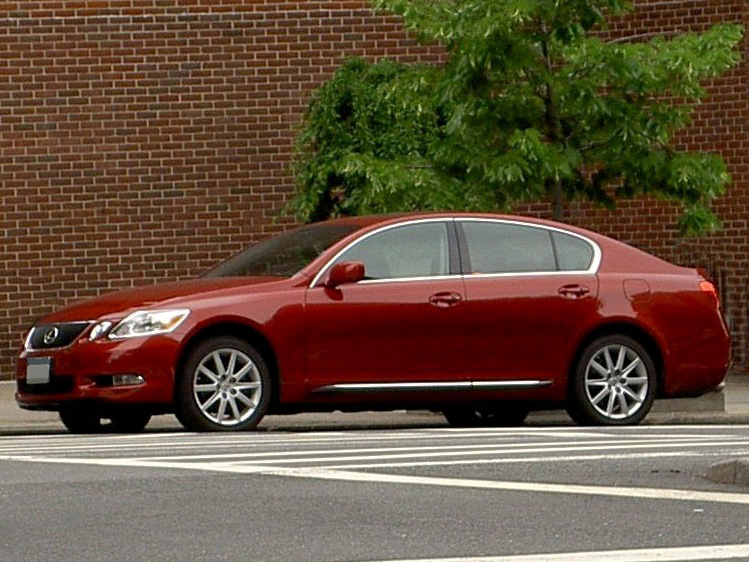
2006 Lexus GS300 recalls and problems

The 2006 Lexus GS300 has 2 recalls and 124 owner complaints on file with NHTSA; the most reported problem area is exterior lighting.

2006 Lexus Gs300
Photo: 2006 Lexus Gs300 by Kentaro Matsui, Public domain, via Wikimedia Commons
How the 2006 compares
Fewest complaintsMost complaints

Highest complaint count among 9 GS300 model years — the most of any year.

2recalls
124complaints
9crashes
1fires
6injuries
75,500median miles

Owner complaints filed with NHTSA, not verified and not adjusted for sales. Ranking compares this model's own years only.

Does your car have an open recall?
Recalls apply to specific vehicles. Only a VIN lookup on NHTSA's official site shows whether yours is affected and still unrepaired.
Check your VIN →

2 recalls

Fuel System

Oct 15, 2014 · NHTSA campaign 14V647000 · 422,509 vehicles

Problem: Toyota Motor Engineering & Manufacturing (Toyota) is recalling certain model year 2007-2010 Lexus LS vehicles manufactured May 9, 2006, to July 20, 2010, 2006-2011 Lexus GS vehicles manufactured January 6, 2005, to September 10, 2010, and 2006-2011 Lexus IS vehicles manufactured August 30, 2005, to September 10, 2010. Due to anti-corrosion plating remnants, fuel may leak from where the fuel pressure sensor is attached to the fuel delivery pipe.

Risk: A fuel leak in the presence of an ignition source increases the risk of a fire.

Remedy & notes

Toyota will notify owners, and dealers will clean and reseal the fuel pressure sensor mounting area, free of charge. The recall began March 3, 2015. Owners may contact Toyota customer service at 1-800-331-4331.

Owners may also contact the National Highway Traffic Safety Administration Vehicle Safety Hotline at 1-888-327-4236 (TTY 1-800-424-9153), or go to www.safercar.gov.

Vehicle Speed Control

Feb 24, 2011 · NHTSA campaign 11V115000 · 19,647 vehicles

Problem: Toyota is recalling certain model year 2006 and 2007 Lexus GS300 and GS350 all wheel drive (AWD) vehicles. There is a possibility that the plastic pad embedded into the floor carpet May interfere with the operation of the accelerator pedal.

Original NHTSA wording

TOYOTA IS RECALLING CERTAIN MODEL YEAR 2006 AND 2007 LEXUS GS300 AND GS350 ALL WHEEL DRIVE (AWD) VEHICLES. THERE IS A POSSIBILITY THAT THE PLASTIC PAD EMBEDDED INTO THE FLOOR CARPET MAY INTERFERE WITH THE OPERATION OF THE ACCELERATOR PEDAL.

Risk: The accelerator pedal could temporarily become stuck in a partially depressed position rather than return to the idle position. A stuck accelerator pedal May result in unintended and sustained vehicle speeds and make it difficult to stop increasing the risk of a crash.

Original NHTSA wording

THE ACCELERATOR PEDAL COULD TEMPORARILY BECOME STUCK IN A PARTIALLY DEPRESSED POSITION RATHER THAN RETURN TO THE IDLE POSITION. A STUCK ACCELERATOR PEDAL MAY RESULT IN UNINTENDED AND SUSTAINED VEHICLE SPEEDS AND MAKE IT DIFFICULT TO STOP INCREASING THE RISK OF A CRASH.

Remedy & notes

Dealers will modify the plastic pad on the floor carpet free of charge. The manufacturer has not yet provided an owner notification schedule. Owners May contact Toyota at 1-800-331-4331.

Owners May also contact the national highway traffic safety administration's vehicle safety hotline at 1-888-327-4236 (tty 1-800-424-9153), or go to <a href=http://www.safercar.gov>http://www.safercar.gov</a> .

Recall text as published by NHTSA and the manufacturer.

What owners complain about

Owner complaints filed with NHTSA; one complaint can name several areas. Not verified by NHTSA.

Complaints by year filed

2005: 3 complaints20052006: 6 complaints2007: 6 complaints20072008: 4 complaints2009: 5 complaints20092010: 17 complaints172011: 15 complaints20112012: 9 complaints2013: 6 complaints20132014: 4 complaints2015: 8 complaints20152016: 17 complaints2017: 7 complaints20172018: 12 complaints2019: 5 complaints20195

NHTSA investigations

Unintended and Uncontrolled Acceleration

RQ10003 · opened Feb 16, 2010 · closed Mar 1, 2011 · led to recall 11V112000
Summary

On February 16, 2010, NHTSA's Office of Defects Investigation (ODI) opened RQ10-003 to determine whether the scope of prior Toyota recalls relating to potential unintended acceleration were sufficiently broad, including, among others, Toyota recalls 07E-082, 09V-388, 10V-017, and 10V-023.NHTSA also requested information regarding potential electronic causes of unintended acceleration in Toyota and Lexus vehicles.I. Pedal Interference from Floor mats, Carpet Covers and Plastic Pads in Carpets.During the RQ10-003 investigation, ODI reviewed a large volume of documents to assess whether additional vehicles should be recalled.Following the agency's analysis, NHTSA requested that Toyota recall additional vehicles.Toyota complied with the agency's request.The details of these recalls are set forth more fully in Toyota's reports to NHTSA pursuant to 49 CFR Part 573.These recalls are as follows:Recall 11V-112: (1) model year (MY) 2004-2006 Toyota Highlander and Highlander Hybrid; and, (2) MY 2004-2007 Lexus RX330,RX350, and RX400h (hybrid model). The total estimated population under this recall is 769,379 vehicles.This recall remedies potential accelerator pedal entrapment caused by a loose floor carpet cover (trim panel). Recall 11V-113: (1) MY 2003-2009 through 2009 Toyota 4Runner; (2) MY 2006-2010 Toyota RAV4; and, (3) MY 2008-2011 Lexus LX570.The total estimated population under this recall is 1,381,000 vehicles.This recall supplements recall 09V-388 and remedies potential accele…

2006 vs. other Lexus GS300 years

Owner complaints by model year; the darker bar is the 2006. Click a bar to switch year.

Questions

Does the 2006 Lexus GS300 have recalls?

Yes — NHTSA lists 2 recall campaigns covering the 2006 Lexus GS300, the latest from Oct 15, 2014 (fuel system). A recall applies to specific vehicles: enter your VIN at nhtsa.gov/recalls to see whether yours is affected and still open.

What are the most common problems with the 2006 Lexus GS300?

Owner complaints filed with NHTSA most often mention exterior lighting (35), engine (22), power train (13). Complaints are consumer reports and are not verified by NHTSA.