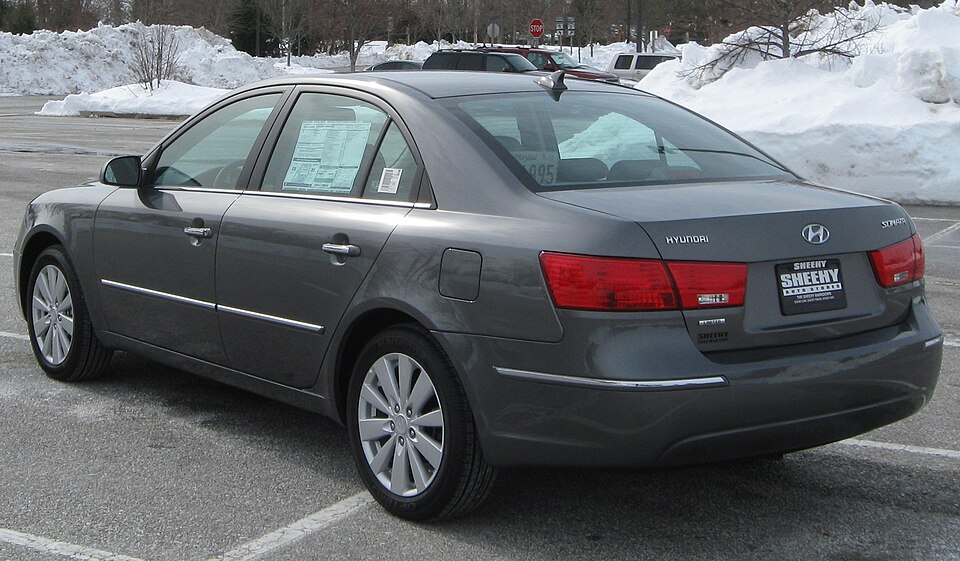
2010 Hyundai Sonata recalls and problems

The 2010 Hyundai Sonata has 2 recalls and 345 owner complaints on file with NHTSA; the most reported problem area is structure.

2010 Hyundai Sonata
Photo: 2010 Hyundai Sonata by IFCAR, Public domain, via Wikimedia Commons
How the 2010 compares
Fewest complaintsMost complaints

Average complaint count among 27 Sonata model years — 13th most.

2recalls
345complaints
19crashes
3fires
19injuries
65,000median miles

Owner complaints filed with NHTSA, not verified and not adjusted for sales. Ranking compares this model's own years only.

Does your car have an open recall?
Recalls apply to specific vehicles. Only a VIN lookup on NHTSA's official site shows whether yours is affected and still unrepaired.
Check your VIN →

2 recalls

Suspension

Aug 12, 2013 · NHTSA campaign 13V354000 · 364,502 vehicles

Problem: Hyundai is recalling certain model year 2006-2010 Sonata vehicles manufactured March 1, 2005, through January 21, 2010; and model year 2006-2011 Azera vehicles manufactured September 27, 2005, through November 22, 2010 originally sold in, or currently registered in, Connecticut, Delaware, Illinois, Indiana, Iowa, Maine, Maryland, Massachusetts, Michigan, Minnesota, Missouri, New Hampshire, New Jersey, New York, Ohio, Pennsylvania, Rhode Island, Vermont, West Virginia, Wisconsin and the District of Columbia. Road salt and water can enter portions of the rear crossmember, leading to corrosion of the crossmember steel. This may lead to detachment of one of the rear control arms.

Risk: Control arm separation may suddenly change the rear wheel alignment, affecting the handling of the vehicle, increasing the risk of a crash.

Remedy & notes

Hyundai will notify owners, and dealers will repair or replace the crossmember assembly. The recall began on October 8, 2013. Owners may contact Hyundai Customer Care Center at 1-800-633-5151. Hyundai's recall number is 113.

Owners may also contact the National Highway Traffic Safety Administration Vehicle Safety Hotline at 1-888-327-4236 (TTY 1-800-424-9153), or go to www.safercar.gov.

Exterior Lighting

Apr 1, 2013 · NHTSA campaign 13V113000 · 1,712,336 vehicles

Problem: Hyundai Motor Company (Hyundai) is recalling certain model year 2006-2009 Accent, model year 2007-2011 Azera, Sonata and Sante Fe,2006-2011 Tucson, 2009-2011 Elantra Touring, 2007-2010 Elantra, 2008-2011 Veracruz, 2009-2011 Genesis, 2010-2011 Genesis Coupe, 2007-2008 Entourage, and 2006-2008 Tiburon vehicles. Originally, in April 2013, Hyundai recalled 1,059,824 model year 2007-2009 Accent and Tucson, model year 2007-2010 Elantra, model year 2007-2011 Santa Fe, model year 2008-2009 Veracruz, model year 2010-2011 Genesis Coupe, and model year 2011 Sonata vehicles. In September 2013, Hyundai informed the agency that it was adding more vehicles to this campaign, representing an additional 652,512 units. The total number of vehicles being recalled is now 1,712,336. In the affected vehicles, the stop lamp switch may malfunction. A malfunctioning stop lamp switch may cause the brake lights to not illuminate when the brake pedal is depressed or may cause an inability to deactivate the cruise control by depressing the brake pedal. Additionally, a malfunctioning stop lamp switch may also result in intermittent operation of the push-button start feature, affect the operation of the brake transmission shift interlock feature, preventing the shifter from being moved out of the PARK position and cause the Electronic Stability Control (ESC) malfunction light to illuminate.

Risk: Failure to illuminate the stop lamps during braking or inability to disengage the cruise control could increase the risk of a crash. Additionally, when the ignition is in the 'ON' position, the transmission shifter may be able to be moved out of Park without first applying the brake. This may lead to unintentional movement of the car which may increase the risk of a crash.

Remedy & notes

Hyundai will notify owners, and dealers will replace the stop lamp switch, free of charge. The safety recall began on April 22, 2013. Owners may contact Hyundai at 1-800-633-5151. Hyundai's recall campaign number is 110.

Owners may also contact the National Highway Traffic Safety Administration Vehicle Safety Hotline at 1-888-327-4236 (TTY 1-800-424-9153), or go to www.safercar.gov.

Recall text as published by NHTSA and the manufacturer.

What owners complain about

Owner complaints filed with NHTSA; one complaint can name several areas. Not verified by NHTSA.

Complaints by year filed

2010: 19 complaints20102011: 10 complaints2012: 4 complaints20122013: 47 complaints2014: 66 complaints2014662015: 45 complaints2016: 43 complaints20162017: 27 complaints2018: 23 complaints20182019: 24 complaints2020: 16 complaints20202021: 4 complaints2022: 4 complaints20222023: 5 complaints2024: 3 complaints20242025: 5 complaints20255

NHTSA investigations

Loss of Motive Power

DP22003 · opened Sep 12, 2022 · closed Dec 12, 2023
Summary

The National Highway Traffic Safety Administration (NHTSA) received a letter dated July 13, 2022, petitioning the Agency to initiate a safety defect investigation into loss of motive power allegations attributed to oil drain pan assembly failures on certain Hyundai Motor America, Inc. and Kia America, Inc. vehicles spanning Model Years (MY) 2005-2021. The Petitioners cited examples of complaints indicating that the subject vehicles were experiencing rapid loss of engine oil due to oil drain plug back outs, resulting in loss of motive power and/or catastrophic engine damage. Additional complaints were provided which alleged that the oil drain pans lack sufficient structural integrity and are susceptible to cracking. The petition itself can be reviewed at NHTSA.gov under ODI number 11481745. On September 12, 2022, the Office of Defects Investigation (ODI) opened Defect Petition (DP22-003) to evaluate the Petitioners’ request. The Petitioners have provided additional complaints within four supplemental letters dated January 31, 2023, March 21, 2023, May 23, 2023, and August 4, 2023. ODI’s evaluation included the review and analysis of the complaints and supporting information submitted by the Petitioners, as well as additional complaints submitted directly to NHTSA which referenced either the oil drain plug or a crack in the oil pan. After reviewing the available data, ODI has not identified evidence that would support opening a defect investigation into the oil drain pan as…

Throttle control system vulnerabilities

DP21003 · opened Nov 12, 2021 · closed Jun 20, 2023
Summary

The Office of Defects Investigation (ODI) of the National Highway Traffic Safety Administration (NHTSA) received a petition letter dated October 10, 2021, requesting an investigation of possible defects in the electronic throttle control (ETC) system on certain Kia vehicles resulting in the opening of DP21-003. Accordingly, Model Year (MY) 2005-2016 Kia Optima/K5, MY 2006-2015 Kia Sorento, MY 2007-2016 Hyundai Elantra, MY 2007-2016 Hyundai Santa Fe, MY 2006-2015 Hyundai Sonatas are all part of the subject population. The petition was originally filed as a Vehicle Owner Questionnaire that can be reviewed at NHTSA.gov under reference (ODI) number 11439675.On November 12, 2021, ODI opened Defect Petition DP21-003 to evaluate the petitioner?s request. ODI performed trend analyses of the VOQs related to vehicle speed control issues for all the subject vehicles and found that none of the 52 Model/Model Year Hyundai/Kia vehicles demonstrated any actionable trend that warranted an investigation.Petitioners submitted 1119 VOQs and non-VOQ cases in which sudden uncommanded acceleration (SUA) or loss of motive power (LOMP) incidents were alleged.For the 1119 reports, 220 were incidents involving crashes, from which 69 subject Hyundai-Kia vehicles were inspected by Hyundai/Kia dealer technicians, Hyundai/Kia engineers, and/or third-party representatives.ODI found the inspections identified no vehicle defects related to the ETC system.Of the 220 crash-involved reports, 13 Event Data Recor…

Rear Control Arm Failure

PE13007 · opened Mar 25, 2013 · closed Aug 20, 2013 · led to recall 13V354000
Summary

In a letter dated August 9, 2013, Hyundai-Kia America Technical Center, Inc. (Hyundai) notified NHTSA that Hyundaiis conducting a safety recall (13V-354) involving approximately 239,000 vehicles involving model year (MY) 2006 through 2010 Hyundai Sonata vehicles (approximately 215,000)produced beginning on March 1, 2005 through January 21, 2010 and model year (MY) 2006 through 2011 Hyundai Azera vehicles (approximately 24,000) produced beginning on September 27, 2005 through November 22, 2010 that are registered in and operated or originally sold in the following 20 salt belt states and the District of Columbia: Connecticut, Delaware, Illinois, Indiana, Iowa, Maine, Maryland, Massachusetts, Michigan, Minnesota, Missouri, New Hampshire, New Jersey, New York, Ohio, Pennsylvania, Rhode Island, Vermont, West Virginia, and Wisconsin.Hyundai will also inform dealers to inspect/repair vehicles that were previously registered in salt belt states but are currently registered elsewhere. Hyundai is conducting the recall to remedy a defect involving internal corrosion of the rear sub frame that may lead to separation of the rear upper/lower control arm(s) at their respective mounting points and/or separation of the axle from the transaxle where they meet.This could result in a loss of vehicle control and/or vehicle disablement which may increase the risk of a vehicle crash.In response to NHTSA?s Information Request (IR) letter, Hyundai stated the Azera vehicles utilizes the identical cro…

2010 vs. other Hyundai Sonata years

Owner complaints by model year; the darker bar is the 2010. Click a bar to switch year.

Questions

Does the 2010 Hyundai Sonata have recalls?

Yes — NHTSA lists 2 recall campaigns covering the 2010 Hyundai Sonata, the latest from Aug 12, 2013 (suspension). A recall applies to specific vehicles: enter your VIN at nhtsa.gov/recalls to see whether yours is affected and still open.

What are the most common problems with the 2010 Hyundai Sonata?

Owner complaints filed with NHTSA most often mention structure (164), unknown or other (36), service brakes (30). Complaints are consumer reports and are not verified by NHTSA.