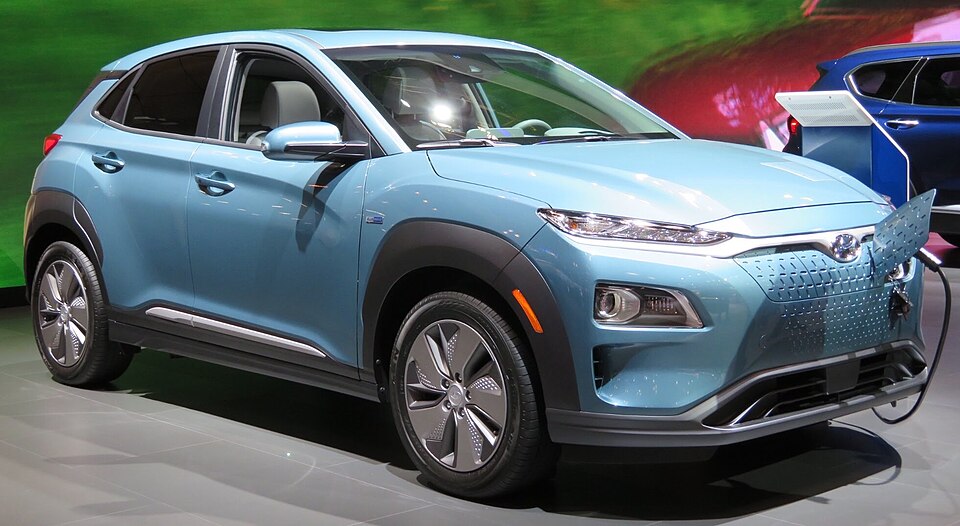
2019 Hyundai Kona Electric recalls and problems

The 2019 Hyundai Kona Electric has 4 recalls and 54 owner complaints on file with NHTSA; the most reported problem area is electrical system.

Park outside warning. Owners are advised to park outside and away from buildings until the repair is done, because of a fire risk. Campaigns: 21V127000, 20V630000.
2019 Hyundai Kona Electric
Photo: 2019 Hyundai Kona Electric by Kevauto, CC BY-SA 4.0, via Wikimedia Commons
How the 2019 compares
Fewest complaintsMost complaints

Highest complaint count among 7 Kona Electric model years — the most of any year.

4recalls
54complaints
2crashes
2fires
1injuries
18,180median miles

Owner complaints filed with NHTSA, not verified and not adjusted for sales. Ranking compares this model's own years only.

Does your car have an open recall?
Recalls apply to specific vehicles. Only a VIN lookup on NHTSA's official site shows whether yours is affected and still unrepaired.
Check your VIN →

4 recalls

Air Bags

Nov 2, 2026 · NHTSA campaign 26V728000 · 37,901 vehicles

Problem: Hyundai Motor America (Hyundai) is recalling certain 2019-2022 Veloster N, 2019-2023 Kona Electric vehicles. A software error in the air bag control unit (ACU) may improperly deactivate the air bag system and seat belt pretensioners.

Risk: Air bags and seat belt pretensioners that do not activate in a crash increases the risk of injury.

Remedy

Dealers will update the ACU software, free of charge. Owner notification letters are expected to be mailed January 1, 2027. Owners may contact Hyundai customer service at 1-855-371-9460. Hyundai's number for this recall is 311. Vehicle Identification Numbers (VINs) involved in this recall will become searchable on NHTSA.gov on November 6, 2026.

Electrical System

Mar 1, 2021 · NHTSA campaign 21V127000 · 4,696 vehicles
Park outside

Problem: Hyundai Motor America (Hyundai) is recalling certain 2019-2020 Kona Electric and 2020 Ioniq Electric vehicles. The lithium-ion (Li-ion) battery may short-circuit.

Risk: An electrical short in the Li-ion battery increases the risk of a fire.

Remedy & notes

Owners are advised to park their vehicles outside and away from structures until the interim action is complete. Hyundai will notify owners, and as an interim action, owners have the option to follow provided instructions to perform a battery update through the vehicle's infotainment system or request a Hyundai dealer to provide the update. Once parts are available, dealers will inspect the Battery System Assembly (BSA), and replace it if necessary. Repairs will be performed free of charge. Owners were notified of the safety risk, and the interim action, with a letter mailed April 9, 2021. Final owner notification letters were mailed June 17, 2021. Owners may contact Hyundai customer service at 1-855-371-9460. Hyundai's number for this recall is 200.

Owners may also contact the National Highway Traffic Safety Administration Vehicle Safety Hotline at 1-888-327-4236 (TTY 1-800-424-9153), or go to www.safercar.gov.

Service Brakes

Dec 1, 2020 · NHTSA campaign 20V748000 · 8,176 vehicles

Problem: Hyundai Motor America (Hyundai) is recalling certain 2019-2020 Nexo Fuel Cell and 2019-2021 Kona Electric vehicles. The Integrated Electronic Brake (IEB) system may detect an abnormal sensor signal and as a result, may significantly reduce braking performance.

Risk: Reduced braking power could lengthen the distance required to stop the vehicle, increasing the risk of a crash.

Remedy & notes

Hyundai will notify owners, and dealers will update the IEB software, free of charge. The recall began January 25, 2021. Owners may contact Hyundai customer service at 1-855-371-9460. Hyundai's number for this recall is 199.

Owners may also contact the National Highway Traffic Safety Administration Vehicle Safety Hotline at 1-888-327-4236 (TTY 1-800-424-9153), or go to www.safercar.gov.

Electrical System

Oct 13, 2020 · NHTSA campaign 20V630000 · 6,707 vehicles
Park outside

Problem: Hyundai Motor America (Hyundai) is recalling certain 2019-2020 Kona Electric vehicles. The lithium-ion (Li-ion) battery may short-circuit.

Risk: An electrical short in the Li-ion battery increases the risk of a fire.

Remedy & notes

Hyundai will notify owners, and dealers will update the Battery Management System (BMS) software and inspect the Li-ion battery, replacing it if necessary, free of charge. Owners are advised to park their vehicles outside and away from structures until the repair is complete. The recall began November 13, 2020. Owners may contact Hyundai customer service at 1-855-371-9460. Hyundai's number for this recall is 196.

Owners may also contact the National Highway Traffic Safety Administration Vehicle Safety Hotline at 1-888-327-4236 (TTY 1-800-424-9153), or go to www.safercar.gov.

Recall text as published by NHTSA and the manufacturer.

What owners complain about

Owner complaints filed with NHTSA; one complaint can name several areas. Not verified by NHTSA.

Complaints by year filed

2020: 2 complaints20202021: 33 complaints2021332022: 11 complaints20222023: 4 complaints20232025: 4 complaints20254

NHTSA investigations

Pedestrian alert sounds

DP22005 · opened Jan 27, 2023 · closed Aug 7, 2023 · led to recall 22V063000
Summary

NHTSA received a petition on or about July 18, 2022, requesting that Federal Motor Vehicle Safety Standard (FMVSS) 141 be applied to all electric and hybrid vehicles operating in the United States. The petition can be reviewed at NHTSA.gov under ODI Number 11486072. FMVSS 141 establishes performance requirements for pedestrian alert sounds for motor vehicles. The standard applies to hybrid and electric vehicles that have a gross vehicle weight rating of 4,536 KG or less or are defined as low-speed vehicles. The standard became fully applicable to all such vehicles manufactured on or after March 1, 2021.On January 27, 2023, NHTSA opened Defect Petition (DP) 22-005 to evaluate the subject matter described in the petition. On June 24, 2023 and as supplemented on June 25, 2023, the petitioner notified NHTSA he was withdrawing his petition. The petitioner indicated that, based on his review of data, there is no justification for asserting potential benefits that could be derived from actions sought by my petition. Based on the petitioner's withdrawal, DP22-005 is closed. Closure of this DP does not represent a determination by NHTSA regarding the subject matter of the petition.

2019 vs. other Hyundai Kona Electric years

Owner complaints by model year; the darker bar is the 2019. Click a bar to switch year.

Questions

Does the 2019 Hyundai Kona Electric have recalls?

Yes — NHTSA lists 4 recall campaigns covering the 2019 Hyundai Kona Electric, the latest from Nov 2, 2026 (air bags). A recall applies to specific vehicles: enter your VIN at nhtsa.gov/recalls to see whether yours is affected and still open.

What are the most common problems with the 2019 Hyundai Kona Electric?

Owner complaints filed with NHTSA most often mention electrical system (42), fuel system (10), engine (5). Complaints are consumer reports and are not verified by NHTSA.

Is it safe to drive the 2019 Hyundai Kona Electric?

2 recalls advise parking outside because of a fire risk. Only vehicles with the recall open are affected — check your VIN at nhtsa.gov/recalls.