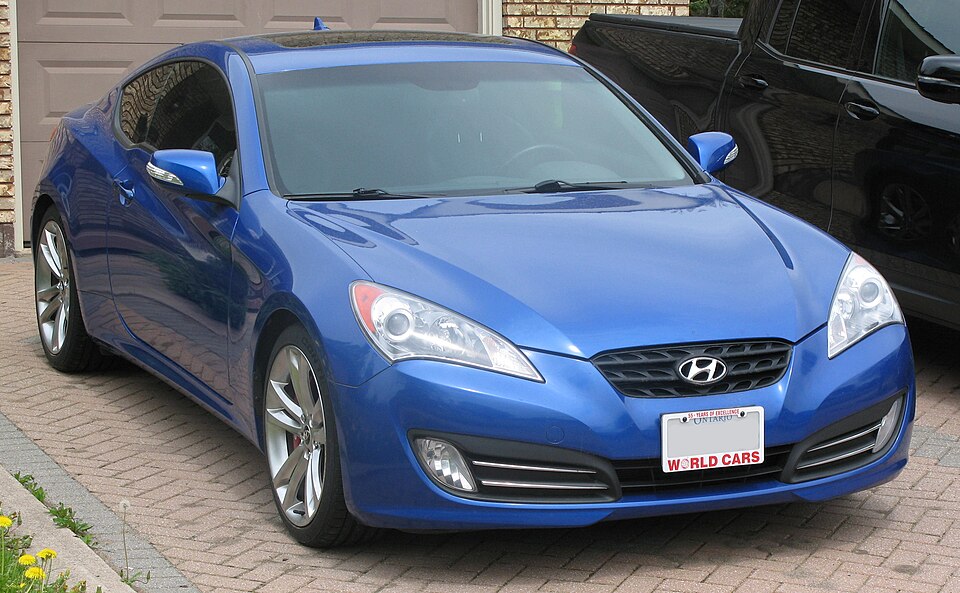
The 2011 Hyundai Genesis Coupe has 4 recalls and 24 owner complaints on file with NHTSA; the most reported problem area is service brakes.
Park outside warning. Owners are advised to park outside and away from buildings until the repair is done, because of a fire risk. Campaign: 23V651000.
High complaint count among 7 Genesis Coupe model years — 3rd most.
4recalls
24complaints
3crashes
1fires
3injuries
53,000median miles
Owner complaints filed with NHTSA, not verified and not adjusted for sales. Ranking compares this model's own years only.
Does your car have an open recall? Recalls apply to specific vehicles. Only a VIN lookup on NHTSA's official site shows whether yours is affected and still unrepaired.
Problem: Hyundai Motor America (Hyundai) is recalling certain 2010-2013 Genesis Coupe vehicles. A return spring in the ignition lock switch may fracture, which can result in unintended vehicle movement when the vehicle is started in gear, without the parking brake applied.
Risk: Unintended vehicle movement can increase the risk of a crash.
Remedy & notes
Dealers will replace the ignition lock switch, free of charge. Owner notification letters were mailed September 4, 2024. Owners may contact Hyundai customer service at 1-855-371-9460. Hyundai's number for this recall is 266.
Owners may also contact the National Highway Traffic Safety Administration Vehicle Safety Hotline at 1-888-327-4236 (TTY 1-800-424-9153), or go to www.safercar.gov.
Problem: Hyundai Motor America (Hyundai) is recalling certain 2011-2015 Elantra, Genesis Coupe, Sonata Hybrid, 2012-2015 Accent, Azera, Veloster, 2013-2015 Elantra Coupe, Santa Fe, 2014-2015 Equus, 2010-2012 Veracruz, 2010-2013 Tucson, 2015 Tucson Fuel Cell, and 2013 Santa Fe Sport vehicles. The Anti-Lock Brake System (ABS) module may leak brake fluid internally and cause an electrical short, which can result in an engine compartment fire while parked or driving.
Risk: An engine compartment fire while parked or driving can increase the risk of injury.
Remedy & notes
Owners are advised to park outside and away from structures until the recall repair is complete. Dealers will replace the ABS fuse, free of charge. Owner notification letters were mailed April 10, 2024 through October 11, 2024. Owners may contact Hyundai customer service at 1-855-371-9460. Hyundai's number for this recall is 251.
Owners may also contact the National Highway Traffic Safety Administration Vehicle Safety Hotline at 1-888-327-4236 (TTY 1-800-424-9153), or go to www.nhtsa.gov.
Air Bags
Oct 7, 2016 · NHTSA campaign 16V722000 · 84,500 vehicles
Problem: Hyundai Motor America (Hyundai) is recalling certain model year 2010-2016 Genesis Coupe vehicles manufactured December 12, 2008, to June 11, 2016. The electrical harness connector for the front passenger seat Occupant Classification System (OCS) may dislodge when the seat is moved.
Risk: In the event of a crash necessitating deployment of the passenger frontal air bag, the disconnected OCS would, by default, cause the first stage, and only the first stage, of the air bag to deploy, whether there is a child seat in the front seat and the bag should not deploy or if the crash is severe and both stages should deploy. Either scenario increases the risk of injury to the front seat occupant.
Remedy & notes
Hyundai will notify owners, and dealers will secure the OCS connector to prevent it from disconnecting, free of charge. Parts are not currently available and a second letter will be sent to owners when parts are available. Owners may contact Hyundai customer service at 1-855-371-9460. Hyundai's number for this recall is 151.
Owners may also contact the National Highway Traffic Safety Administration Vehicle Safety Hotline at 1-888-327-4236 (TTY 1-800-424-9153), or go to www.safercar.gov.
Problem: Hyundai Motor Company (Hyundai) is recalling certain model year 2006-2009 Accent, model year 2007-2011 Azera, Sonata and Sante Fe,2006-2011 Tucson, 2009-2011 Elantra Touring, 2007-2010 Elantra, 2008-2011 Veracruz, 2009-2011 Genesis, 2010-2011 Genesis Coupe, 2007-2008 Entourage, and 2006-2008 Tiburon vehicles. Originally, in April 2013, Hyundai recalled 1,059,824 model year 2007-2009 Accent and Tucson, model year 2007-2010 Elantra, model year 2007-2011 Santa Fe, model year 2008-2009 Veracruz, model year 2010-2011 Genesis Coupe, and model year 2011 Sonata vehicles. In September 2013, Hyundai informed the agency that it was adding more vehicles to this campaign, representing an additional 652,512 units. The total number of vehicles being recalled is now 1,712,336. In the affected vehicles, the stop lamp switch may malfunction. A malfunctioning stop lamp switch may cause the brake lights to not illuminate when the brake pedal is depressed or may cause an inability to deactivate the cruise control by depressing the brake pedal. Additionally, a malfunctioning stop lamp switch may also result in intermittent operation of the push-button start feature, affect the operation of the brake transmission shift interlock feature, preventing the shifter from being moved out of the PARK position and cause the Electronic Stability Control (ESC) malfunction light to illuminate.
Risk: Failure to illuminate the stop lamps during braking or inability to disengage the cruise control could increase the risk of a crash. Additionally, when the ignition is in the 'ON' position, the transmission shifter may be able to be moved out of Park without first applying the brake. This may lead to unintentional movement of the car which may increase the risk of a crash.
Remedy & notes
Hyundai will notify owners, and dealers will replace the stop lamp switch, free of charge. The safety recall began on April 22, 2013. Owners may contact Hyundai at 1-800-633-5151. Hyundai's recall campaign number is 110.
Owners may also contact the National Highway Traffic Safety Administration Vehicle Safety Hotline at 1-888-327-4236 (TTY 1-800-424-9153), or go to www.safercar.gov.
Recall text as published by NHTSA and the manufacturer.
Owner complaints filed with NHTSA; one complaint can name several areas. Not verified by NHTSA.
Complaints by year filed
NHTSA investigations
Hyundai and Kia ABS Module Fires
AQ23002 · opened Nov 17, 2023 · open
Summary
The Office of Defects Investigation (ODI) has received eight Hyundai Motor America (Hyundai) and eight Kia America, Inc. (Kia) Part 573 Recall Reports between 2016 and 2023. The combined 16 safety recalls all involve the antilock braking system (ABS) modules or Hydraulic Electronic Control Units (HECU) manufactured by the equipment supplier Mando. The Part 573 Recall Reports contain varying defect descriptions and differing remedy descriptions for the same or similar equipment supplied by Mando. Safety recalls included in this Audit Query (AQ) review include: Hyundai recalls 20V-520, 20V-543, 21V-161, 21V-160, 21V-303, 22V-056, 22V-810, and 23V-651. Kia recalls 16V-815, 20V-518, 20V-519, 21V-137, 21V-331, 22V-051, 22V-800, and 23V-652 The purpose of this AQ is to evaluate the timeliness and scoping of Hyundai and Kiaâs defect decision making and adherence with reporting requirements; and understand the varying defect descriptions and remedies between these recalls.
Brake hydraulic control module failure
PE13033 · opened Oct 17, 2013 · closed Apr 4, 2014 · led to recall 13V489000
Summary
On October 28, 2013, Hyundai Motor Company (Hyundai) submitted a Defect Information Report (DIR) to NHTSA describing a safety defect in the braking system of approximately 43,500 model year (MY) 2009 through 2012 Hyundai Genesis sedans (NHTSA Recall No. 13V-489).The Hyundai report indicates that the recalled vehicles may contain brake fluid that does not sufficiently inhibit corrosion on the zinc plating of control valve armatures in the Hydraulic Electronic Control Unit (HECU) module. The DIR indicated that, over time, the build-up of corrosion products may affect operation of HECU control valves, resulting in a low/soft brake pedal with reduced brake effectiveness, which may increase the risk of a crash.In October 2011, the HECU supplier notified Hyundai that the brake fluid used in production plants was causing corrosion of valve armatures in the control module.The supplier changed the coating of the valve armatures in late March 2012 to correct the problem in production vehicles.Hyundai's recall includes Genesis vehicles produced prior to the implementation of the HECU change.In March 2013, Hyundai initiated a Service Campaign (TL6) to replace brake fluid in the subject vehicles with brake fluid with better corrosion resistance properties.According to Hyundai's DIR letter, after PE13-033 was opened, the company noted that some of the vehicles serviced in the TL6 campaign subsequently required HECU replacement.This was an indication that internal corrosion had progressed e…
2011 vs. other Hyundai Genesis Coupe years
Owner complaints by model year; the darker bar is the 2011. Click a bar to switch year.
Questions
Does the 2011 Hyundai Genesis Coupe have recalls?
Yes — NHTSA lists 4 recall campaigns covering the 2011 Hyundai Genesis Coupe, the latest from Jul 25, 2024 (electrical system). A recall applies to specific vehicles: enter your VIN at nhtsa.gov/recalls to see whether yours is affected and still open.
What are the most common problems with the 2011 Hyundai Genesis Coupe?
Owner complaints filed with NHTSA most often mention service brakes (8), air bags (3), engine (3). Complaints are consumer reports and are not verified by NHTSA.
Is it safe to drive the 2011 Hyundai Genesis Coupe?
1 recall advises parking outside because of a fire risk. Only vehicles with the recall open are affected — check your VIN at nhtsa.gov/recalls.
 Recalls by Model