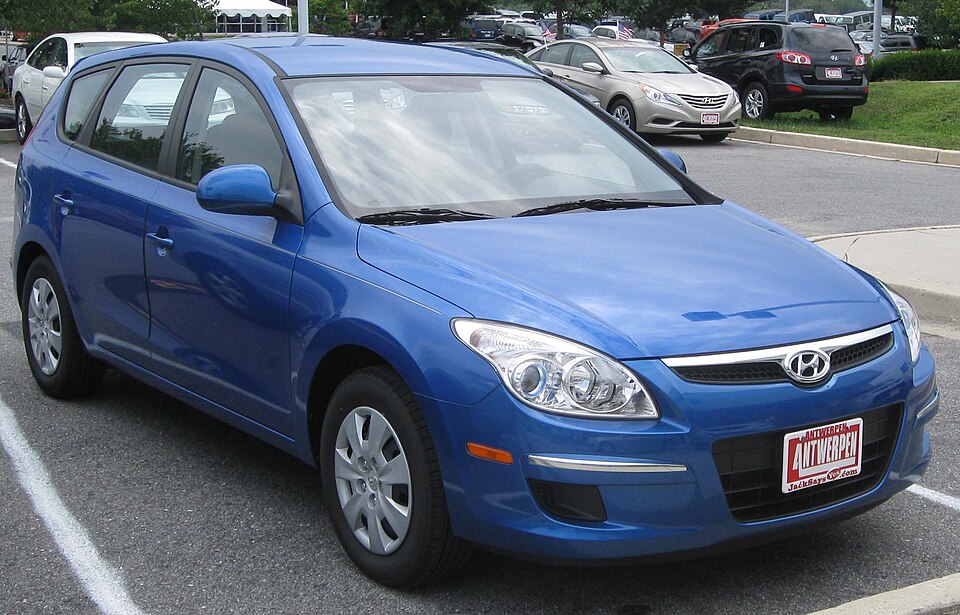
Highest complaint count among 6 Elantra Touring model years — the most of any year.
4recalls
75complaints
4crashes
4fires
5injuries
54,390median miles
Owner complaints filed with NHTSA, not verified and not adjusted for sales. Ranking compares this model's own years only.
Does your car have an open recall? Recalls apply to specific vehicles. Only a VIN lookup on NHTSA's official site shows whether yours is affected and still unrepaired.
Feb 4, 2020 · NHTSA campaign 20V061000 · 476,111 vehicles
Problem: Hyundai Motor America (Hyundai) is recalling certain 2007-2010 Elantra and 2009-2011 Elantra Touring vehicles. On February 21, 2020 Hyundai expanded the recall to include 46,425 model year 2007-2008 Entourage and 2007 Santa Fe vehicles. Moisture may enter the Anti-lock Brake (ABS) Module and result in an electrical short.
Risk: An electrical short within the ABS Module may cause an engine compartment fire, even when the car is turned off, increasing the risk of an injury.
Remedy & notes
Hyundai will notify owners, and dealers will install a relay in the vehicle's main junction box to prevent the risk of an ABS short-circuit while the car is turned off, free of charge. The recall began April 2, 2020. Owners may contact Hyundai customer service at 1-855-371-9460. Hyundai's number for this recall is 188.
Owners may also contact the National Highway Traffic Safety Administration Vehicle Safety Hotline at 1-888-327-4236 (TTY 1-800-424-9153), or go to www.safercar.gov.
Steering
Feb 23, 2015 · NHTSA campaign 15V100000 · 204,768 vehicles
Problem: Hyundai Motor America (Hyundai) is recalling certain model year 2008-2010 Elantra vehicles manufactured June 1, 2008, to April 30, 2010, and 2009-2010 Elantra Touring vehicles manufactured November 1, 2008, to April 30, 2010. The electronic power steering (EPS) electronic control unit (ECU) may sense a discrepancy in the steering input signals and, as a result, disable the steering power assist.
Risk: If power steering assist is lost, greater driver effort would be required to steer the vehicle at low speeds, increasing the risk of a crash.
Remedy & notes
Hyundai will verify the proper operation of the Electronic Power Steering (EPS) and update the EPS control unit, free of charge. The recall began April 14, 2015. Owners may contact Hyundai customer service at 1-855-671-3059. Hyundai's number for this recall is 127.
Owners may also contact the National Highway Traffic Safety Administration Vehicle Safety Hotline at 1-888-327-4236 (TTY 1-800-424-9153), or go to www.safercar.gov.
Structure
Jun 10, 2014 · NHTSA campaign 14V310000 · 35,000 vehicles
Problem: Hyundai Motor Company (Hyundai) is recalling certain model year 2010-2012 Elantra Touring vehicles manufactured December 15, 2009, through May 7, 2012. The affected vehicles have a support bracket attached to the headliner that may become displaced during a side curtain airbag deployment.
Risk: If the headliner support bracket makes contact with an occupant during a crash, it may cause a laceration injury.
Remedy & notes
Hyundai will notify owners, and dealers will apply adhesive strips to the headliner, free of charge. The recall began on July 28, 2014. Owners may contact Hyundai customer service at 1-800-633-5151. Hyundai's number for this recall is 117.
Owners may also contact the National Highway Traffic Safety Administration Vehicle Safety Hotline at 1-888-327-4236 (TTY 1-800-424-9153), or go to www.safercar.gov.
Problem: Hyundai Motor Company (Hyundai) is recalling certain model year 2006-2009 Accent, model year 2007-2011 Azera, Sonata and Sante Fe,2006-2011 Tucson, 2009-2011 Elantra Touring, 2007-2010 Elantra, 2008-2011 Veracruz, 2009-2011 Genesis, 2010-2011 Genesis Coupe, 2007-2008 Entourage, and 2006-2008 Tiburon vehicles. Originally, in April 2013, Hyundai recalled 1,059,824 model year 2007-2009 Accent and Tucson, model year 2007-2010 Elantra, model year 2007-2011 Santa Fe, model year 2008-2009 Veracruz, model year 2010-2011 Genesis Coupe, and model year 2011 Sonata vehicles. In September 2013, Hyundai informed the agency that it was adding more vehicles to this campaign, representing an additional 652,512 units. The total number of vehicles being recalled is now 1,712,336. In the affected vehicles, the stop lamp switch may malfunction. A malfunctioning stop lamp switch may cause the brake lights to not illuminate when the brake pedal is depressed or may cause an inability to deactivate the cruise control by depressing the brake pedal. Additionally, a malfunctioning stop lamp switch may also result in intermittent operation of the push-button start feature, affect the operation of the brake transmission shift interlock feature, preventing the shifter from being moved out of the PARK position and cause the Electronic Stability Control (ESC) malfunction light to illuminate.
Risk: Failure to illuminate the stop lamps during braking or inability to disengage the cruise control could increase the risk of a crash. Additionally, when the ignition is in the 'ON' position, the transmission shifter may be able to be moved out of Park without first applying the brake. This may lead to unintentional movement of the car which may increase the risk of a crash.
Remedy & notes
Hyundai will notify owners, and dealers will replace the stop lamp switch, free of charge. The safety recall began on April 22, 2013. Owners may contact Hyundai at 1-800-633-5151. Hyundai's recall campaign number is 110.
Owners may also contact the National Highway Traffic Safety Administration Vehicle Safety Hotline at 1-888-327-4236 (TTY 1-800-424-9153), or go to www.safercar.gov.
Recall text as published by NHTSA and the manufacturer.
Owner complaints filed with NHTSA; one complaint can name several areas. Not verified by NHTSA.
Complaints by year filed
NHTSA investigations
Headliner Bracket Detachment
RQ13004 · opened Dec 4, 2013 · closed Jun 24, 2014 · led to recall 14V310000
Summary
Hyundai is conducting a safety recall to reinforce the attachment of the metal support bracket to the headliner assembly in approximately 35,000 model year (MY) 2010-2012 Hyundai Elantra Touring vehicles built from December 15, 2009 through May 7, 2012 (see NHTSA recall 14V-310 for more information).These Elantra Touring vehicles have a common headliner bracket design while the earlier MY 2009-2010 Elantra Touring vehicles have a headliner bracket design that utilizes a shorter length bracket which, should it become separated from the headliner, is unlikely to be displaced into the path of the driver or any occupant.During this investigation, ODI identified a MY 2010 subject vehicle in a salvage yard with a deployed driver-side curtain air bag that showed the headliner bracket displaced downward into the driver's window area.Also, during a static side curtain air bag deployment test conducted by Hyundai, the headliner bracket almost completely separated from the headliner.The headliner tested came out of a MY 2010 subject vehicle.Finally, ODI identified two warranty claims on the subject vehicles that indicate potential headliner bracket issues.Warranty records for these claims indicate vehicle owners complaining of noise or rattling coming from the headliner area and Hyundai dealer technicians reported finding brackets that came loose or unglued from the headliner.ODI is not aware of any related injury allegations.This investigation was opened to evaluate the scope of NHTSA …
2010 vs. other Hyundai Elantra Touring years
Owner complaints by model year; the darker bar is the 2010. Click a bar to switch year.
Questions
Does the 2010 Hyundai Elantra Touring have recalls?
Yes — NHTSA lists 4 recall campaigns covering the 2010 Hyundai Elantra Touring, the latest from Feb 4, 2020 (service brakes). A recall applies to specific vehicles: enter your VIN at nhtsa.gov/recalls to see whether yours is affected and still open.
What are the most common problems with the 2010 Hyundai Elantra Touring?
Owner complaints filed with NHTSA most often mention steering (38), electrical system (10), electronic stability control (9). Complaints are consumer reports and are not verified by NHTSA.
 Recalls by Model