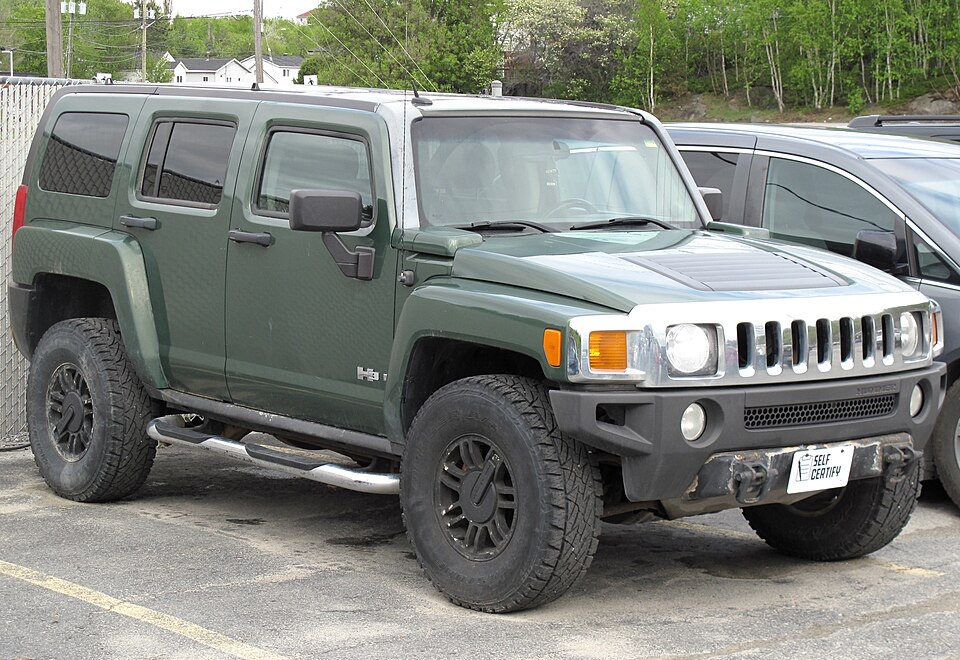
Highest complaint count among 6 H3 model years — the most of any year.
4recalls
361complaints
10crashes
27fires
8injuries
75,000median miles
Owner complaints filed with NHTSA, not verified and not adjusted for sales. Ranking compares this model's own years only.
Does your car have an open recall? Recalls apply to specific vehicles. Only a VIN lookup on NHTSA's official site shows whether yours is affected and still unrepaired.
Problem: General Motors LLC (GM) is recalling certain model year 2006-2010 Hummer H3 vehicles manufactured February 5, 2005, to May 24, 2010, and 2009-2010 Hummer H3T vehicles manufactured May 21, 2008, to May 24, 2010. In the affected vehicles, the connector module that controls the blower motor speed for the heating, ventilation and air conditioning system may overheat.
Risk: If the blower motor connector module overheats, it can increase the risk of a fire.
Remedy & notes
GM will notify owners, and dealers will replace part of the blower motor connector and harness, free of charge. The recall began February 26, 2016. Owners may contact Hummer customer service at 1-800-732-5493. GM's number for this recall is 15042.
Owners may also contact the National Highway Traffic Safety Administration Vehicle Safety Hotline at 1-888-327-4236 (TTY 1-800-424-9153), or go to www.safercar.gov.
Problem: Gm is recalling certain model year 2006 through 2010 Hummer H3 vehicles. Some of these vehicles have a condition in which the integral clip-tabs on the louver on the hood May fracture, causing the hood louver rattle against the hood and become loose. If this indicator is unnoticed, additional clips could fracture and the hood louver could detach from the vehicle.
Original NHTSA wording
GM IS RECALLING CERTAIN MODEL YEAR 2006 THROUGH 2010 HUMMER H3 VEHICLES. SOME OF THESE VEHICLES HAVE A CONDITION IN WHICH THE INTEGRAL CLIP-TABS ON THE LOUVER ON THE HOOD MAY FRACTURE, CAUSING THE HOOD LOUVER RATTLE AGAINST THE HOOD AND BECOME LOOSE. IF THIS INDICATOR IS UNNOTICED, ADDITIONAL CLIPS COULD FRACTURE AND THE HOOD LOUVER COULD DETACH FROM THE VEHICLE.
Risk: If the vehicle is being driving when this occurs, it could strike a following vehicle and cause injury and/or property damage.
Original NHTSA wording
IF THE VEHICLE IS BEING DRIVING WHEN THIS OCCURS, IT COULD STRIKE A FOLLOWING VEHICLE AND CAUSE INJURY AND/OR PROPERTY DAMAGE.
Remedy & notes
Dealers will apply an adhesive to the hood louver to secure it to the hood. This service will be performed free of charge. The safety recall began on April 12, 2010. Owners May contact Hummer at 800-732-5493 or at the owner center at www.gmownercenter.com.
General motors recall no. N100088.owners May also contact the national highway traffic safety administration's vehicle safety hotline at 1-888-327-4236 (tty 1-800-424-9153), or go to <a href=http://www.safercar.gov>http://www.safercar.gov</a> .
Air Bags
Oct 31, 2006 · NHTSA campaign 06V417000 · 794 vehicles
Problem: Certain vehicles originally built with cloth seats that were equipped with an automatic air bag passenger sensing system and later reupholstered with aftermarket leather seat cover kits are involved. Testing has indicated that the aftermarket leather seat covers can cause the passenger sensing system to malfunction.
Original NHTSA wording
CERTAIN VEHICLES ORIGINALLY BUILT WITH CLOTH SEATS THAT WERE EQUIPPED WITH AN AUTOMATIC AIR BAG PASSENGER SENSING SYSTEM AND LATER REUPHOLSTERED WITH AFTERMARKET LEATHER SEAT COVER KITS ARE INVOLVED. TESTING HAS INDICATED THAT THE AFTERMARKET LEATHER SEAT COVERS CAN CAUSE THE PASSENGER SENSING SYSTEM TO MALFUNCTION.
Risk: If the passenger sensing system malfunctions, the front air bag on the passenger side May be disabled when it should be enabled, or enabled when it should be disabled. In either case, in the event of a crash that requires air bag deployment, a front passenger's level of injury May be increased.
Original NHTSA wording
IF THE PASSENGER SENSING SYSTEM MALFUNCTIONS, THE FRONT AIR BAG ON THE PASSENGER SIDE MAY BE DISABLED WHEN IT SHOULD BE ENABLED, OR ENABLED WHEN IT SHOULD BE DISABLED. IN EITHER CASE, IN THE EVENT OF A CRASH THAT REQUIRES AIR BAG DEPLOYMENT, A FRONT PASSENGER'S LEVEL OF INJURY MAY BE INCREASED.
Remedy & notes
Because a replacement leather seat cover that is compatible with the passenger sensing system is not available, general motors (gm) will repurchase these vehicles in accordance with the terms stated in gm's letter to owners. The recall began on November 6, 2006. Owners should contact gm at 1-877-477-1022 to begin the process of repurchasing their vehicle.
Gm recall no. 06102.customers May also contact the national highway traffic safety administration's vehicle safety hotline at 1-888-327-4236 (tty 1-800-424-9153), or go to http://www.safercar.gov.
Equipment
Dec 7, 2005 · NHTSA campaign 05V552000 · 32,068 vehicles
Problem: Certain trucks and sport utility vehicles fail to conform to the requirements of federal motor vehicle safety standard no. 110, "tire selection and rims." these vehicles were shipped with tire and loading information labels listing an inacccurate vehicle capacity weight.
Original NHTSA wording
CERTAIN TRUCKS AND SPORT UTILITY VEHICLES FAIL TO CONFORM TO THE REQUIREMENTS OF FEDERAL MOTOR VEHICLE SAFETY STANDARD NO. 110, "TIRE SELECTION AND RIMS." THESE VEHICLES WERE SHIPPED WITH TIRE AND LOADING INFORMATION LABELS LISTING AN INACCCURATE VEHICLE CAPACITY WEIGHT.
Risk: A misprinted label could lead to improper vehicle loading specifications or tire inflation which could result in a tire failure, increasing the risk of a crash.
Original NHTSA wording
A MISPRINTED LABEL COULD LEAD TO IMPROPER VEHICLE LOADING SPECIFICATIONS OR TIRE INFLATION WHICH COULD RESULT IN A TIRE FAILURE, INCREASING THE RISK OF A CRASH.
Remedy & notes
Owners will be provided with corrected labels and installation instructions. At the customer's option, a dealer can install the label for them. The recall began on March 31, 2006. Owners May contact Buick at 1-866-608-8080, Cadillac at 1-866-982-2339, Chevrolet at 1-800-630-2438, GMC at 1-866-996-9463, Hummer at 1-800-732-5493, Pontiac at 1-800-620-7668, Saturn at 1-800-972-8876, or Isuzu at 1-800-255-6727.
Gm recall no. 05109.customers May also contact the national highway traffic safety administration's vehicle safety hotline at 1-888-327-4236 (tty 1-800-424-9153), or go to http://www.safercar.gov.
Recall text as published by NHTSA and the manufacturer.
Owner complaints filed with NHTSA; one complaint can name several areas. Not verified by NHTSA.
Complaints by year filed
2006 vs. other Hummer H3 years
Owner complaints by model year; the darker bar is the 2006. Click a bar to switch year.
Questions
Does the 2006 Hummer H3 have recalls?
Yes — NHTSA lists 4 recall campaigns covering the 2006 Hummer H3, the latest from Jul 1, 2015 (visibility). A recall applies to specific vehicles: enter your VIN at nhtsa.gov/recalls to see whether yours is affected and still open.
What are the most common problems with the 2006 Hummer H3?
Owner complaints filed with NHTSA most often mention electrical system (96), engine (87), visibility (59). Complaints are consumer reports and are not verified by NHTSA.
 Recalls by Model