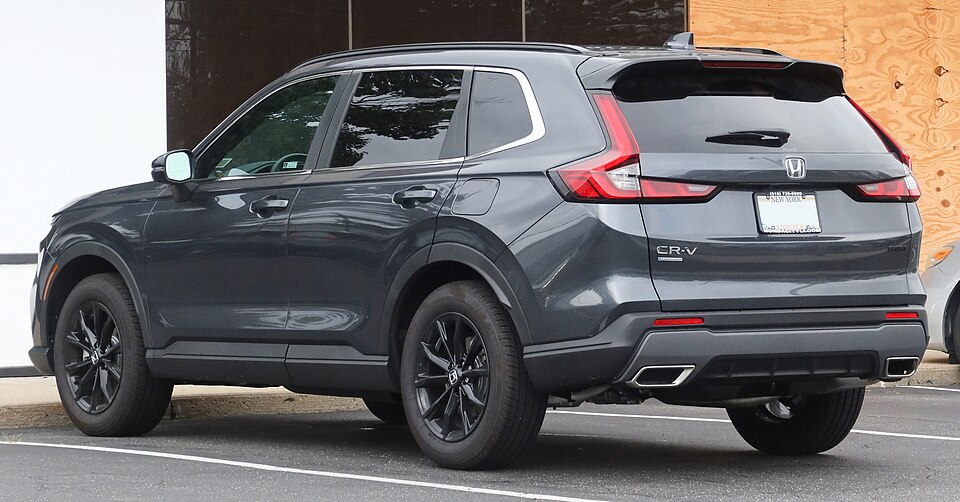
2022 Honda CR-V Hybrid recalls and problems

The 2022 Honda CR-V Hybrid has 4 recalls and 82 owner complaints on file with NHTSA; the most reported problem area is electrical system.

2023 Honda Cr-V Hybrid
Pictured: a 2023 model; the 2022 may differ in details. Photo: 2023 Honda Cr-V Hybrid by Kevauto, CC BY-SA 4.0, via Wikimedia Commons
How the 2022 compares
Fewest complaintsMost complaints

Low complaint count among 7 CR-V Hybrid model years — 5th most.

4recalls
82complaints
7crashes
1fires
2injuries
60,000median miles

Owner complaints filed with NHTSA, not verified and not adjusted for sales. Ranking compares this model's own years only.

Does your car have an open recall?
Recalls apply to specific vehicles. Only a VIN lookup on NHTSA's official site shows whether yours is affected and still unrepaired.
Check your VIN →

4 recalls

Air Bags

May 21, 2026 · NHTSA campaign 26V332000 · 98,892 vehicles

Problem: Honda (American Honda Motor Co.) is recalling certain 2018-2021, 2023 Acura TLX, 2019-2024 RDX, 2017-2020, 2022-2026 MDX, 2017-2021, 2023, 2025 Honda Ridgeline, 2017-2022 Pilot, 2019-2021 Passport, 2018-2026 Odyssey, 2019-2022 Insight, 2019-2021 HR-V, 2018-2020 Fit, 2020-2022 CR-V Hybrid, 2017-2022 CR-V, 2017-2018, 2021 Civic Type R, 2017-2021 Civic hatchback, 2016-2020 Civic coupe, 2016-2022 Civic, 2017-2022 Accord Hybrid, and 2016-2022 Accord vehicles. The front passenger seat weight sensor may crack and short circuit, which can cause the air bags to deploy unintentionally during a crash.

Risk: Air bags that deploy unintentionally during a crash increase the risk of injury.

Remedy

Dealers will replace the seat weight sensors, free of charge. Owner notification letters were mailed July 7, 2026. Owners may contact Honda's customer service at 1-888-234-2138. Honda's numbers for this recall are BOL, WO9, OOA, WOM, XOH, NOC, POD, BOE, UOF, POB, EOG, AOI, QO8, TOJ, DO7, and SOK. This recall expands previous NHTSA recall number 24V064. Vehicle Identification Numbers (VINs) involved in this recall will be searchable on NHTSA.gov beginning May 29, 2026.

Electrical System

Dec 13, 2023 · NHTSA campaign 23V844000 · 106,030 vehicles

Problem: Honda (American Honda Motor Co.) is recalling certain 2020-2022 CR-V Hybrid vehicles. The 12-Volt battery cable routed outside of the body frame is missing a fuse on the power circuit, which can allow the battery cable to short circuit or overheat during a crash.

Risk: An overheated battery cable or short circuit can increase the risk of a fire or injury in a crash.

Remedy & notes

Dealers will replace the battery cable, free of charge. Owner notification letters were mailed January 29, 2024. Owners may contact Honda customer service at 1-888-234-2138. Honda's number for this recall is FGB.

Owners may also contact the National Highway Traffic Safety Administration Vehicle Safety Hotline at 1-888-327-4236 (TTY 1-800-424-9153), or go to www.nhtsa.gov.

Power Train

Dec 2, 2021 · NHTSA campaign 21V939000 · 279 vehicles

Problem: Honda (American Honda Motor Co.) is recalling certain 2021 Acura RDX and 2022 CR-V Hybrid vehicles. A component in the right or left front driveshaft may have been improperly heat-treated, which could result in driveshaft failure.

Risk: Driveshaft failure can cause a sudden loss of drive power, or cause the vehicle to roll away when parked if the parking brake is not applied. Either condition can increase the risk of a crash or injury.

Remedy & notes

Dealers will replace the right or left front driveshaft as necessary, free of charge. Owner notification letters were mailed January 24, 2022. Owners may contact Honda customer service 1-888-234-2138. Honda's numbers for this recall are BBY, NBW, and OBX.

Owners may also contact the National Highway Traffic Safety Administration Vehicle Safety Hotline at 1-888-327-4236 (TTY 1-800-424-9153), or go to www.nhtsa.gov.

Seat Belts

Nov 18, 2021 · NHTSA campaign 21V900000 · 4,346 vehicles

Problem: Honda (American Honda Motor Co.) is recalling certain 2021 Accord Sedan, Accord Hybrid, CR-V, Ridgeline, 2022 Insight and CR-V Hybrid vehicles. The automatic locking retractor on the second-row center seat belt assembly may deactivate improperly, which can result in an unsecured child restraint system. As such, these vehicles fail to comply with the requirements of Federal Motor Vehicle Safety Standard number 208, "Occupant Crash Protection."

Risk: An unsecured child restraint system can increase the risk of injury during a crash.

Remedy & notes

Dealers will replace the second-row center seat belt assembly, free of charge. Owner notification letters were mailed January 14, 2022. Owners may contact Honda customer service at 1-888-234-2138.

Owners may also contact the National Highway Traffic Safety Administration Vehicle Safety Hotline at 1-888-327-4236 (TTY 1-800-424-9153), or go to www.nhtsa.gov.

Recall text as published by NHTSA and the manufacturer.

What owners complain about

Owner complaints filed with NHTSA; one complaint can name several areas. Not verified by NHTSA.

Complaints by year filed

2021: 1 complaints20212022: 12 complaints20222023: 13 complaints20232024: 28 complaints2024282025: 17 complaints20252026: 11 complaints202611

NHTSA investigations

Loss of Motive Power

PE25016 · opened Oct 28, 2025 · open
Summary

The Office of Defects Investigation (ODI) has received 48 Vehicle Owner Questionnaire (VOQ) reports and some Early Warning Reporting (EWR) field reports alleging intermittent loss of motive power in Model Year (MY) 2020–2022 Honda CR-V Hybrid vehicles.  These incidents are alleged to occur without warning at highway speeds and are accompanied by a flashing check engine light immediately before the loss of motive power occurs.  Motive power can be restored by turning the ignition off and back on.  However, this action also clears the check engine light and any fault codes that were set.  The fault’s intermittent nature, combined with the lack of fault codes, often results in many visits to repair facilities yielding no repairs. Honda indicated it was unaware of any related complaint or repair trends. ODI is opening this Preliminary Evaluation (PE) to determine the scope and severity of the alleged fault and to fully assess the possible safety consequences. To review the ODI reports cited in the Opening Resume ODI Report Identification Number document, go to NHTSA.gov.

Inadvertent Automatic Emergency Braking

EA24002 · opened Apr 15, 2024 · open
Summary

On February 21, 2022, the Office of Defects Investigation (ODI) opened Preliminary Evaluation (PE22003) to assess reports of inadvertent activation of the Collision Mitigation Braking System (CMBS), an automatic emergency braking (AEB) system, in model year 2017-2019 Honda CR-V and 2018-2019 Honda Accord vehicles.  The reports allege that activation of the AEB system occurs while driving with no apparent obstruction in the vehicle's forward path, resulting in sudden vehicle deceleration. Honda indicated that they were aware of a total of X,XXX reports that may relate to the alleged defect. Honda provided analysis of the alleged defect and alleges that some customers possibly had an inadequate understanding of the CMBS and its limitations.  However, many consumer complaints allege that Honda dealerships were unable to reproduce the condition or state that they were informed that this is considered normal CMBS operation. To date, ODI has received a total of 1,294 consumer complaints of inadvertent activation of CMBS in 2017-2022 Honda CR-V and 2018-2022 Honda Accord vehicles. A total of 31 complaints alleged a crash and 50 alleged an injury.  The Total column in the Failure Report Summary removes duplicate reports and shows the total number of reports with unique VINs from all Manufacturer, ODI, and EWR data sources.  In some cases, there were multiple reports associated with a particular vehicle in which recurring failures were alleged.  In total, there were X,XXX reports…

Pedestrian alert sounds

DP22005 · opened Jan 27, 2023 · closed Aug 7, 2023 · led to recall 22V063000
Summary

NHTSA received a petition on or about July 18, 2022, requesting that Federal Motor Vehicle Safety Standard (FMVSS) 141 be applied to all electric and hybrid vehicles operating in the United States. The petition can be reviewed at NHTSA.gov under ODI Number 11486072. FMVSS 141 establishes performance requirements for pedestrian alert sounds for motor vehicles. The standard applies to hybrid and electric vehicles that have a gross vehicle weight rating of 4,536 KG or less or are defined as low-speed vehicles. The standard became fully applicable to all such vehicles manufactured on or after March 1, 2021.On January 27, 2023, NHTSA opened Defect Petition (DP) 22-005 to evaluate the subject matter described in the petition. On June 24, 2023 and as supplemented on June 25, 2023, the petitioner notified NHTSA he was withdrawing his petition. The petitioner indicated that, based on his review of data, there is no justification for asserting potential benefits that could be derived from actions sought by my petition. Based on the petitioner's withdrawal, DP22-005 is closed. Closure of this DP does not represent a determination by NHTSA regarding the subject matter of the petition.

2022 vs. other Honda CR-V Hybrid years

Owner complaints by model year; the darker bar is the 2022. Click a bar to switch year.

Questions

Does the 2022 Honda CR-V Hybrid have recalls?

Yes — NHTSA lists 4 recall campaigns covering the 2022 Honda CR-V Hybrid, the latest from May 21, 2026 (air bags). A recall applies to specific vehicles: enter your VIN at nhtsa.gov/recalls to see whether yours is affected and still open.

What are the most common problems with the 2022 Honda CR-V Hybrid?

Owner complaints filed with NHTSA most often mention electrical system (25), unknown or other (17), engine (16). Complaints are consumer reports and are not verified by NHTSA.