2013 Honda Accord Crosstour recalls and problems

The 2013 Honda Accord Crosstour has 1 recall and 11 owner complaints on file with NHTSA; the most reported problem area is steering.

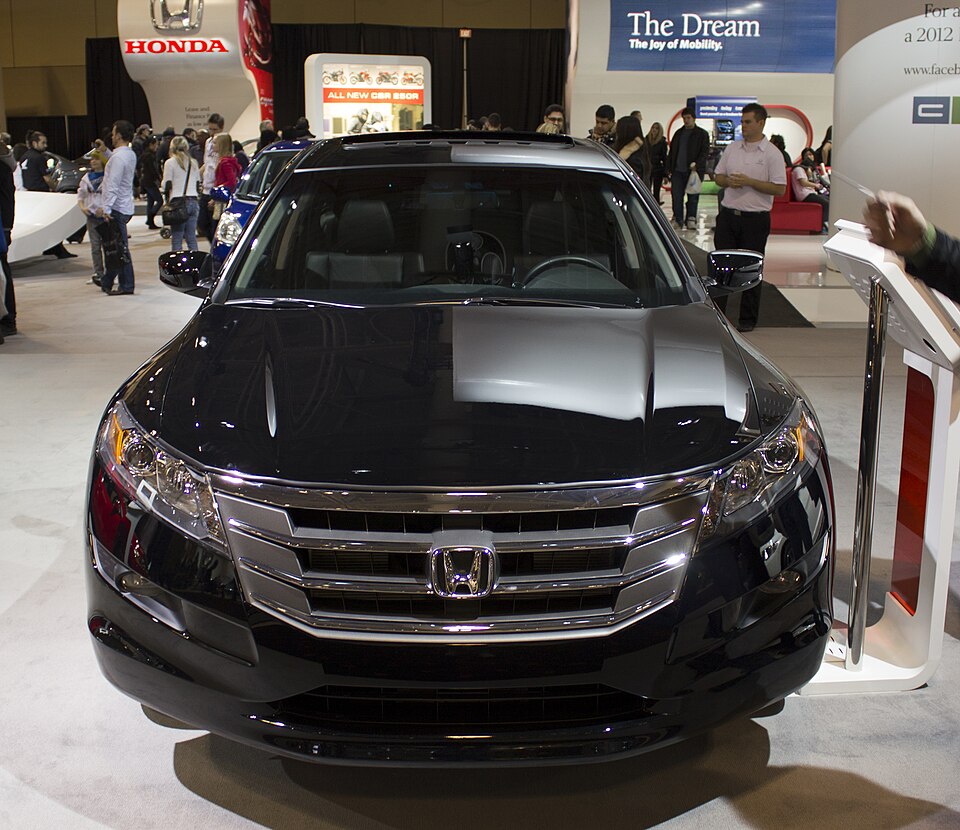
2012 Honda Accord Crosstour
Pictured: a 2012 model; the 2013 may differ in details. Photo: 2012 Honda Accord Crosstour by Tabercil, CC BY-SA 3.0, via Wikimedia Commons
How the 2013 compares
Fewest complaintsMost complaints

Low complaint count among 4 Accord Crosstour model years — 3rd most.

1recalls
11complaints
0crashes
0fires
0injuries
85,000median miles

Owner complaints filed with NHTSA, not verified and not adjusted for sales. Ranking compares this model's own years only.

Does your car have an open recall?
Recalls apply to specific vehicles. Only a VIN lookup on NHTSA's official site shows whether yours is affected and still unrepaired.
Check your VIN →

1 recall

Air Bags

Jan 9, 2018 · NHTSA campaign 18V042000 · 691,726 vehicles

Problem: Honda (American Honda Motor Co.) is recalling certain 2010-2013 Acura TSX, ZDX, Honda Accord Crosstour, Fit, Insight and Pilot vehicles, 2011-13 Acura TSX Sportswagon, 2010-2012 Honda Accord,, 2010-2011 Honda Civic, Civic NGV, Civic Hybrid and CR-V vehicles and 2013 Honda FCX Clarity and Fit EV vehicles ever registered in the states of Alabama, California, Florida, Georgia, Hawaii, Louisiana, Mississippi, South Carolina, Texas, Puerto Rico, American Samoa, Guam, the Northern Mariana Islands (Saipan), and the U.S. Virgin Islands or "Zone A." Additionally, Honda is recalling certain 2010-2012 Acura TSX, Honda Accord, Accord Crosstour, Fit and Pilot, 2010-2011 Honda Civic, Civic NGV, Civic Hybrid and CR-V, and 2010 Acura ZDX and Honda Insight vehicles ever registered in the states of Arizona, Arkansas, Delaware, District of Columbia, Illinois, Indiana, Kansas, Kentucky, Maryland, Missouri, Nebraska, Nevada, New Jersey, New Mexico, North Carolina, Ohio, Oklahoma, Pennsylvania, Tennessee, Virginia, and West Virginia or "Zone B." Unless included in Zones A or B above, Honda is recalling certain 2009 Acura TSX, Honda Accord, Civic, Civic NGV, Civic Hybrid, CR-V, Fit, and Pilot vehicles ever registered in the states of Alaska, Colorado, Connecticut, Idaho, Iowa, Maine, Massachusetts, Michigan, Minnesota, Montana, New Hampshire, New York, North Dakota, Oregon, Rhode Island, South Dakota, Utah, Vermont, Washington, Wisconsin, and Wyoming or "Zone C." These vehicles are equipped with certain air bag inflators assembled as part of the frontal air bag modules, and used as original equipment or replacement equipment (such as after a vehicle crash necessitating replacement of the original air bags), may explode due to propellant degradation occurring after long-term exposure to higher absolute humidity, temperature and temperature cycling.

Risk: An inflator explosion may result in sharp metal fragments striking the driver or other occupants resulting in serious injury or death.

Remedy & notes

Honda will notify owners, and dealers will replace the passenger frontal air bag inflator, free of charge. The recall began February 16, 2018. Owners may contact Honda customer service at 1-888-234-2138. Honda's numbers for this recall are B0K and L0J.

Owners may also contact the National Highway Traffic Safety Administration Vehicle Safety Hotline at 1-888-327-4236 (TTY 1-800-424-9153), or go to www.safercar.gov.

Recall text as published by NHTSA and the manufacturer.

What owners complain about

Owner complaints filed with NHTSA; one complaint can name several areas. Not verified by NHTSA.

NHTSA investigations

Loss of Direction Control

EA21001 · opened May 6, 2021 · closed Aug 25, 2023
Summary

On May 6, 2021, the Office of Defects Investigation (ODI) opened Engineering Analysis (EA21-001) to assess a sudden loss of steering control, in Model Year (MY) 2013-2015 Honda Accord vehicles. Consumers alleged while driving the steering wheel would pull to the left or the right independently. Steering pull may pose a risk of loss of directional control. Honda stated that they believed the inadvertent steering input was caused by a loose magnet located within the electronic power steering (EPS) system. Due to poor formulation of the adhesive, this magnet can become loose and move up to 2 degrees around the steering column. When the magnet moves, the torque sensor generates a signal that results in unwanted steering in either direction. Honda stated the steering force required to maintain directional control with a loose magnet is a maximum of 3-pound feet. The maximum force of the unwanted steering input can be overcome by the driver and is similar to driving on grooved pavement.The Vehicle Research Test Center (VRTC) sent over 4,000 questionnaires to 2013-2015 Honda Accord vehicle owners. Of the 637 responses, 58 consumers experienced unwanted steering. Consumers experiencing unwanted steering did not report difficulties maintaining directional control. There were no crashes or injuries reported to VRTC. Testing done by VRTC was not able to reproduce the allegations. Analysis of all relevant data indicates that the subject condition has a relatively low failure rate. The po…

2013 vs. other Honda Accord Crosstour years

Owner complaints by model year; the darker bar is the 2013. Click a bar to switch year.

Questions

Does the 2013 Honda Accord Crosstour have recalls?

Yes — NHTSA lists 1 recall campaign covering the 2013 Honda Accord Crosstour, the latest from Jan 9, 2018 (air bags). A recall applies to specific vehicles: enter your VIN at nhtsa.gov/recalls to see whether yours is affected and still open.

What are the most common problems with the 2013 Honda Accord Crosstour?

Owner complaints filed with NHTSA most often mention steering (7), electrical system (3), power train (1). Complaints are consumer reports and are not verified by NHTSA.