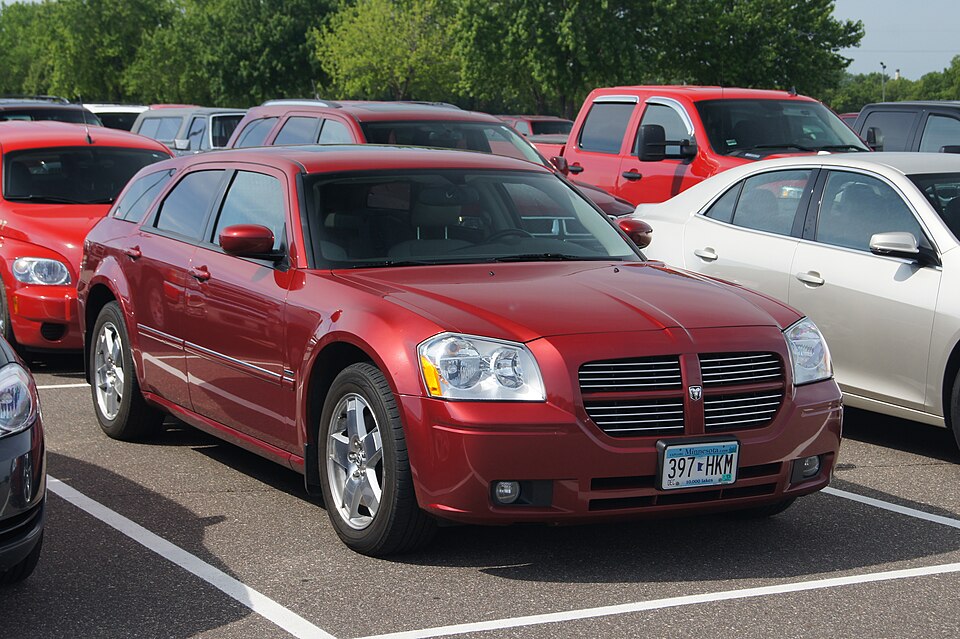
2005 Dodge Magnum recalls and problems

The 2005 Dodge Magnum has 7 recalls and 638 owner complaints on file with NHTSA; the most reported problem area is fuel system.

Do not drive warning. NHTSA and the manufacturer advise owners not to drive affected vehicles until the recall repair is done. Affected campaigns: 16V352000, 15V313000.
2005 Dodge Magnum
Photo: 2005 Dodge Magnum by Greg Gjerdingen from Willmar, USA, CC BY 2.0, via Wikimedia Commons
How the 2005 compares
Fewest complaintsMost complaints

Highest complaint count among 6 Magnum model years — the most of any year.

7recalls
638complaints
22crashes
9fires
36injuries
70,000median miles

Owner complaints filed with NHTSA, not verified and not adjusted for sales. Ranking compares this model's own years only.

Does your car have an open recall?
Recalls apply to specific vehicles. Only a VIN lookup on NHTSA's official site shows whether yours is affected and still unrepaired.
Check your VIN →

7 recalls

Air Bags

May 24, 2016 · NHTSA campaign 16V352000 · 4,648,270 vehicles
Do not drive

Problem: Chrysler (FCA US LLC) expanded the affected population to include 73,712 2005-2009 RAM 2500 trucks produced at the St. Louis North Assembly Plant. With this change, Chrysler is recalling certain model year 2004-2008 RAM 1500, 2005-2009 RAM 2500, 2006-2009 RAM 3500, 2007-2010 RAM 3500 Cab Chassis, 2008-2010 RAM 4500 and 5500 Cab Chassis, 2004-2009 Dodge Durango, 2007-2009 Chrysler Aspen, 2007-2012 Jeep Wrangler, 2008-2012 Dodge Challenger, 2005-2008 Dodge Magnum, 2005-2012 Chrysler 300, 2006-2012 Dodge Charger, 2005-2011 Dodge Dakota, and 2006-2009 Mitsubishi Raider vehicles originally sold, or ever registered, in AL, CA, FL, GA, HI, LA, MS, SC, TX, Puerto Rico, American Samoa, Guam, the Northern Mariana Islands (Saipan), and the U.S. Virgin Islands, or "Zone A." Additionally, unless included in "Zone A" above, Chrysler is also recalling 2004-2008 RAM 1500, 2005-2009 RAM 2500, 2006-2009 RAM 3500, 2007-2009 RAM 3500 Cab Chassis, 2008-2009 RAM 4500 and 5500 Cab Chassis, 2004-2009 Dodge Durango, 2007-2009 Chrysler Aspen, 2007-2009 Jeep Wrangler, 2008-2009 Dodge Challenger, 2005-2008 Dodge Magnum, 2005-2009 Chrysler 300, 2006-2009 Dodge Charger, 2005-2009 Dodge Dakota and 2006-2009 Mitsubishi Raider vehicles originally sold, or ever registered, in AZ, AR, DE, Washington D.C., IL, IN, KS, KY, MD, MO, NE, NV, NJ, NM, NC, OH, OK, PA, TN, VA, and WV, or "Zone B." Lastly, unless included in "Zone A" or "Zone B" above, Chrysler is recalling certain 2005-2008 RAM 2500, 2006-2008 RAM 3500, 2007-2008 RAM 3500 Cab Chassis, 2008 RAM 4500 and 5500 Cab Chassis, 2004-2008 Dodge Durango, 2007-2008 Chrysler Aspen, 2007-2008 Jeep Wrangler, 2008 Dodge Challenger, 2005-2008 Dodge Magnum, 2005-2008 Chrysler 300, 2006-2008 Dodge Charger, 2005-2008 Dodge Dakota, and 2006-2008 Mitsubishi Raider vehicles originally sold, or registered, in AK, CO, CT, ID, IA, ME, MA, MI, MN, MT, NH, NY, ND, OR, RI, SD, UT, VT, WA, WI, and WY.

Risk: These vehicles are equipped with certain air bag inflators assembled as part of the passenger frontal air bag modules, and used as original equipment or replacement equipment. These inflators may rupture due to propellant degradation occurring after long-term exposure to absolute humidity and temperature cycling. An inflator rupture may result in metal fragments striking the vehicle occupants resulting in serious injury or death.

Remedy & notes

Owners are advised not to drive their vehicle until the recall repair is complete. Chrysler will notify the Chrysler, Dodge, Jeep and RAM owners. Mitsubishi owners will be notified by their company. Dealers will replace the passenger frontal air bag inflator, free of charge. The recall began on March 27, 2017. Owners may contact Chrysler customer service at 1-800-853-1403. Chrysler's number for this recall is S43. Note: This recall supersedes recall 14V-7700.

Owners may also contact the National Highway Traffic Safety Administration Vehicle Safety Hotline at 1-888-327-4236 (TTY 1-800-424-9153), or go to www.safercar.gov.

Air Bags

May 26, 2015 · NHTSA campaign 15V313000 · 4,077,169 vehicles
Do not drive

Problem: Chrysler (FCA US LLC) is recalling certain model year 2005-2009 Dodge Ram 2500, 2004-2008 Dodge Ram 1500 and Durango, 2006-2009 Dodge Ram 3500, 2008-2010 Dodge Ram 4500 and 5500, 2007-2008 Chrysler Aspen, 2005-2010 Chrysler 300, 300C, 300S, and SRT8, 2006-2010 Dodge Charger, 2005-2008 Magnum, 2005-2011 Dodge Dakota, and 2006-2009 Mitsubishi Raider vehicles. The affected vehicles are equipped with a dual-stage driver frontal air bag that may be susceptible to moisture intrusion which, over time, could cause the inflator to rupture.

Risk: In the event of a crash necessitating deployment of the driver's frontal air bag, the inflator could rupture with metal fragments striking the driver or other occupants resulting in serious injury or death.

Remedy & notes

Owners are advised not to drive their vehicle until the recall repair is complete. Chrysler will notify the affected Chrysler and Dodge owners and Mitsubishi will notify the affected Raider owners. Dealers will replace the driver's frontal air bag inflator, free of charge. The recall began for Chrylser on June 8, 2015. The recall for Mitsubishi started on June 24, 2015. Chrysler and Dodge owners may contact Chrysler customer service at 1-800-853-1403. Mitsubishi owners may call 1-888-648-7820. Chrysler's number for this recall is R25. Note: This recall supersedes recall 14V817 in its entirety. Vehicles that have had their driver side frontal air bag replaced previously need to have their air bag replaced under this recall as well.

Owners may also contact the National Highway Traffic Safety Administration Vehicle Safety Hotline at 1-888-327-4236 (TTY 1-800-424-9153), or go to www.safercar.gov.

Air Bags

Dec 3, 2014 · NHTSA campaign 14V770000 · 250,896 vehicles

Problem: Chrysler Group LLC (Chrysler) is recalling certain model year 2004-2005 Dodge Ram 1500, 2500, and 3500, 2004-2005 Dodge Durango, 2005 Dodge Dakota, 2005 Dodge Magnum and 2005 Chrysler 300, 300C and 300 SRT8 vehicles originally sold, or ever registered, in geographic locations associated with high absolute humidity. Specifically, vehicles sold, or ever registered, in Alabama, Florida, Georgia, Hawaii, Louisiana, Mississippi, Texas, Puerto Rico, U.S. Virgin Islands, Saipan, Guam, and American Samoa are addressed by this recall. Upon deployment of the passenger side frontal air bag, excessive internal pressure may cause the inflator to rupture.

Risk: In the event of a crash necessitating deployment of the passenger’s frontal air bag, the inflator could rupture with metal fragments striking the vehicle occupants potentially resulting in serious injury or death.

Remedy & notes

Chrysler will notify owners, and dealers will replace the front passenger air bag inflator, free of charge. For vehicles that were sold, or are currently registered, in Florida, Puerto Rico, Hawaii, and the U.S. Virgin Islands, owners were notified and the recall began on December 5, 2014. For all other vehicles, Chrysler notified owners and the recall began on February 3, 2015. Owners may contact Chrysler customer service at 1-800-853-1403. Chrysler's number for this recall is P40 Expanded. Note: This recall has been superseded by recall 16V-352. This recall superseded the passenger air bag portion of recall 14V-354.

Owners may also contact the National Highway Traffic Safety Administration Vehicle Safety Hotline at 1-888-327-4236 (TTY 1-800-424-9153), or go to www.safercar.gov.

Power Train

Oct 6, 2005 · NHTSA campaign 05V460000 · 256,409 vehicles

Problem: On certain pickup trucks, sport utility and passenger vehicles equipped with 42RLE automatic transmissions, the cup plug that retains the park pawl anchor shaft May be improperly installed. If the shaft moves out of position, the vehicle May not be able to achieve 'park' position.

Original NHTSA wording

ON CERTAIN PICKUP TRUCKS, SPORT UTILITY AND PASSENGER VEHICLES EQUIPPED WITH 42RLE AUTOMATIC TRANSMISSIONS, THE CUP PLUG THAT RETAINS THE PARK PAWL ANCHOR SHAFT MAY BE IMPROPERLY INSTALLED. IF THE SHAFT MOVES OUT OF POSITION, THE VEHICLE MAY NOT BE ABLE TO ACHIEVE 'PARK' POSITION.

Risk: If this occurs and the parking brake is not applied, the vehicle May roll away and cause a crash without warning.

Original NHTSA wording

IF THIS OCCURS AND THE PARKING BRAKE IS NOT APPLIED, THE VEHICLE MAY ROLL AWAY AND CAUSE A CRASH WITHOUT WARNING.

Remedy & notes

Dealers will inspect the transmissions and install a bracket to ensure the park pawl anchor shaft is retained in the proper position. The recall began on November 28, 2005. Owners May contact daimlerchrysler at 1-800-853-1403.

Daimlerchrysler recall no. E14.customers May contact the national highway traffic safety administration's vehicle safety hotline at 1-888-327-4236; (tty:1-800-424-9153); or go to http://www.safercar.gov.

Electrical System

Jul 9, 2004 · NHTSA campaign 04V334000 · 20,060 vehicles

Problem: On certain passenger vehicles, the battery cable fasteners at the bulkhead stud May not have been properly tightened.

Original NHTSA wording

ON CERTAIN PASSENGER VEHICLES, THE BATTERY CABLE FASTENERS AT THE BULKHEAD STUD MAY NOT HAVE BEEN PROPERLY TIGHTENED.

Risk: A loose fastener can cause an instrument panel fire.

Original NHTSA wording

A LOOSE FASTENER CAN CAUSE AN INSTRUMENT PANEL FIRE.

Remedy & notes

Dealers will tighten the bulkhead stud battery cable fasteners to the proper specification. Owner notification began on July 6, 2004. Owners should contact daimlerchrysler at 1-800-853-1403.

Daimlerchrysler recall no. D28.customers can also contact the national highway traffic safety administration's auto safety hotline at 1-888-DASH 2-DOT (1-888-327-4236).

Seat Belts

Jul 8, 2004 · NHTSA campaign 04V335000 · 12,211 vehicles

Problem: On certain passenger vehicles, the front shoulder belt adjustable turning loop (atl) bolts May not have been properly tightened.

Original NHTSA wording

ON CERTAIN PASSENGER VEHICLES, THE FRONT SHOULDER BELT ADJUSTABLE TURNING LOOP (ATL) BOLTS MAY NOT HAVE BEEN PROPERLY TIGHTENED.

Risk: This could cause shoulder belt separation in certain crash conditions, which can increase the risk of injury to front seat occupants.

Original NHTSA wording

THIS COULD CAUSE SHOULDER BELT SEPARATION IN CERTAIN CRASH CONDITIONS, WHICH CAN INCREASE THE RISK OF INJURY TO FRONT SEAT OCCUPANTS.

Remedy & notes

Dealers will tighten the shoulder belt adjuster turning loop bolts to the proper specification. Owner notification began on July 6, 2004. Owners should contact daimlerchrysler at 1-800-853-1403.

Daimlerchrysler recall no. D30.customers can also contact the national highway traffic safety administration's auto safety hotline at 1-888-DASH 2-DOT (1-888-327-4236).

Seat Belts

Jul 8, 2004 · NHTSA campaign 04V333000 · 21 vehicles

Problem: On certain passenger vehicles, a spot welding operation for the rear floorpan reinforcement May not have been performed.

Original NHTSA wording

ON CERTAIN PASSENGER VEHICLES, A SPOT WELDING OPERATION FOR THE REAR FLOORPAN REINFORCEMENT MAY NOT HAVE BEEN PERFORMED.

Risk: This could cause the rear seat belt anchors and/or the child seat anchors to separate in certain crash conditions, which can increase the risk of injury to rear seat passengers.

Original NHTSA wording

THIS COULD CAUSE THE REAR SEAT BELT ANCHORS AND/OR THE CHILD SEAT ANCHORS TO SEPARATE IN CERTAIN CRASH CONDITIONS, WHICH CAN INCREASE THE RISK OF INJURY TO REAR SEAT PASSENGERS.

Remedy & notes

Dealers will inspect the rear floorpan reinforcement for missing welds and install structural rivets if necessary. Owner notification began on July 6, 2004. Owners should contact daimlerchrysler at 1-800-853-1403.

Daimlerchrysler recall no. D21.owners customers can also contact the national highway traffic safety administration's auto safety hotline at 1-888-DASH 2-DOT (1-888-327-4236).

Recall text as published by NHTSA and the manufacturer.

What owners complain about

Owner complaints filed with NHTSA; one complaint can name several areas. Not verified by NHTSA.

Complaints by year filed

2004: 9 complaints20042005: 72 complaints2006: 34 complaints20062007: 23 complaints2008: 14 complaints20082009: 22 complaints2010: 43 complaints20102011: 30 complaints2012: 19 complaints20122013: 46 complaints2014: 76 complaints20142015: 77 complaints772016: 73 complaints20162017: 28 complaints2018: 22 complaints20182019: 18 complaints2020: 12 complaints20202021: 6 complaints2022: 4 complaints20222023: 3 complaints2024: 3 complaints20242025: 3 complaints2026: 1 complaints20261

NHTSA investigations

Desiccated Air Bag Inflator Rupture

EA21002 · opened Sep 17, 2021 · open
Summary

From 2000 through 2017, Takata produced millions of air bag inflators using two types of phase-stabilized ammonium nitrate ("PSAN") propellant -- propellant 2004 and propellant 2004L. After prolonged exposure to high temperature cycles and humidity, inflators using propellant 2004 can degrade, causing the propellant to burn too quickly when ignited. The rapid burning can cause the inflator to rupture during deployment, potentially causing serious or even fatal injury to vehicle occupants. See 2016 Blomquist Report at www.nhtsa.gov/sites/nhtsa.gov/files/documents/expert_report-hrblomquist.pdf.Consequently, all frontal inflators using propellant 2004 that do not contain a "desiccant" (a substance that traps and holds moisture) in US vehicles are under recall. These "non-desiccated" inflators either have been or are required to be replaced.In some cases, the remedy part for these recalled inflators was, or will be, an inflator using either propellant 2004 or 2004L that does contain a desiccant. None of these "desiccated" remedy parts (which were installed in older model year vehicles) are currently under recall for a degradation concern. Certain subsets of desiccated PSAN inflators using propellant 2004 for use as original equipment, however, have been recalled for a degradation concern. All Takata inflators produced with propellant 2004L contain desiccant, and none of these desiccated inflators using propellant 2004L are under recall for a degradation concern. There have been n…

Air Bag Inflator Rupture

EA15001 · opened Feb 24, 2015 · open · led to recall 14V668
Summary

The Office of Defects Investigation (ODI) opened PE14-016 in June 2014 based on six inflator rupture incidents involving consumer owned vehicles produced by five vehicle manufacturers.All six vehicles were operated in Florida or Puerto Rico at the time of the rupture and for the majority of their service life, and were equipped with inflators produced by Takata, a tier-one supplier of automotive air bag systems.During the course of PE14-016, ODI determined that five additional vehicle manufacturers used inflators of a similar design and vintage also supplied by Takata. No evidence of field failures was found in vehicles produced by these five additional manufacturers.Nonetheless, at ODI's insistence, all 10 vehicle manufacturers initiated a regional recall within approximately two weeks of the opening of the investigation.The regions recalled initially included Florida, Puerto Rico, Hawaii, and the U.S. Virgin Islands, areas with high absolute humidity and climatic conditions believed to be a significant factor in the inflator ruptures.As part of the recall actions, inflators removed from remedied vehicles are to be returned to Takata for testing.Takata's initial test results on passenger inflators from remedied vehicles indicated a much higher than anticipated rupture frequency for inflators returned from Florida.Accordingly ODI requested all 10 manufacturers expand the regional recalls for passenger inflators to include other geographic areas where high absolute humidity co…

Air Bag Inflator Rupture

PE14016 · opened Jun 11, 2014 · closed Mar 2, 2015 · led to recall 13V172000
Summary

The Office of Defects Investigation (ODI) opened PE14-016 in June 2014 based on six inflator rupture incidents involving consumer owned vehicles produced by five vehicle manufacturers.All six vehicles were operated in Florida or Puerto Rico at the time of the rupture and for the majority of their service life, and were equipped with inflators produced by Takata, a tier-one supplier of automotive air bag systems.During the course of PE14-016, ODI determined that five additional vehicle manufacturers used inflators of a similar design and vintage also supplied by Takata. No evidence of field failures was found in vehicles produced by these five additional manufacturers.Nonetheless, at ODI's insistence, all 10 vehicle manufacturers initiated a regional recall within approximately two weeks of the opening of the investigation.The regions recalled initially included Florida, Puerto Rico, Hawaii, and the U.S. Virgin Islands, areas with consistently high absolute humidity and climatic conditions believed to be a significant factor in the inflator ruptures.As part of the recall actions, inflators removed from remedied vehicles are to be returned to Takata for testing.Takata's initial test results on passenger inflators from remedied vehicles indicated a much higher than anticipated rupture frequency for inflators returned from Florida.Accordingly, ODI requested all 10 manufacturers expand the regional recalls for passenger inflators to include other geographic areas where high absolu…

Rear Hatch Strut Support Failure

PE10024 · opened Jul 19, 2010 · closed Nov 24, 2010
Summary

See Attached Closing Report.

2005 vs. other Dodge Magnum years

Owner complaints by model year; the darker bar is the 2005. Click a bar to switch year.

Questions

Does the 2005 Dodge Magnum have recalls?

Yes — NHTSA lists 7 recall campaigns covering the 2005 Dodge Magnum, the latest from May 24, 2016 (air bags). A recall applies to specific vehicles: enter your VIN at nhtsa.gov/recalls to see whether yours is affected and still open.

What are the most common problems with the 2005 Dodge Magnum?

Owner complaints filed with NHTSA most often mention fuel system (140), air bags (131), power train (117). Complaints are consumer reports and are not verified by NHTSA.

Is it safe to drive the 2005 Dodge Magnum?

2 recalls for this model year carry a "Do Not Drive" advisory. Only vehicles with the recall open are affected — check your VIN at nhtsa.gov/recalls.