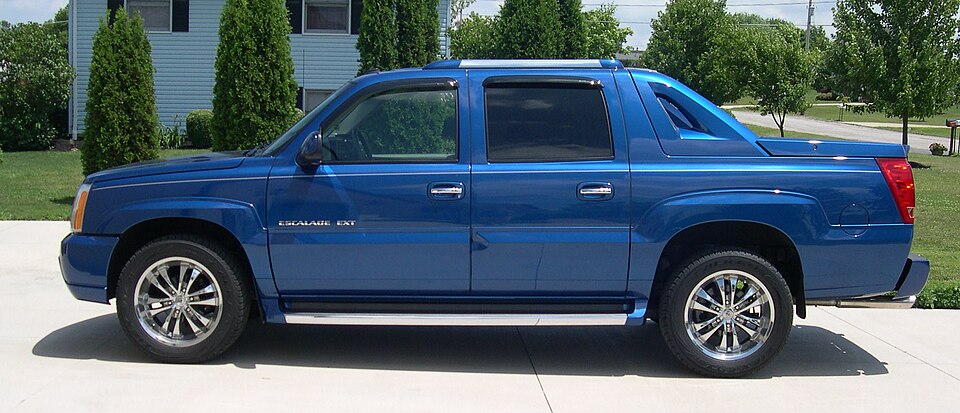
2003 Cadillac Escalade recalls and problems

The 2003 Cadillac Escalade has 4 recalls and 81 owner complaints on file with NHTSA; the most reported problem area is electrical system.

2003 Cadillac Escalade
Photo: 2003 Cadillac Escalade by No machine-readable author provided. Sfoskett~commonswiki assumed (based on copyright claims)., CC BY-SA 3.0, via Wikimedia Commons
How the 2003 compares
Fewest complaintsMost complaints

High complaint count among 28 Escalade model years — 8th most.

4recalls
81complaints
4crashes
4fires
4injuries
72,000median miles

Owner complaints filed with NHTSA, not verified and not adjusted for sales. Ranking compares this model's own years only.

Does your car have an open recall?
Recalls apply to specific vehicles. Only a VIN lookup on NHTSA's official site shows whether yours is affected and still unrepaired.
Check your VIN →

4 recalls

Seat Belts

Apr 22, 2005 · NHTSA campaign 05V163000 · 1,359,824 vehicles

Problem: On certain crew cab pickup trucks and sport utility vehicles, the 2ND row center occupant seat belt routing May make it difficult to position the lap portion of the safety belt low around the hips of occupants, especially smaller occupants, seated in this position. Appropriate use of a child seat or booster seat, as recommended for small children, does improve the fit condition for this user group. In addition to instructions on proper infant and young child restraint (with child seats or boosters), special verbiage for restraining older child is included in the owner's manual. Also, the suggested seat belt fit/routing for adults, irrespective of seating position, is described in the owner's manual text.

Original NHTSA wording

ON CERTAIN CREW CAB PICKUP TRUCKS AND SPORT UTILITY VEHICLES, THE 2ND ROW CENTER OCCUPANT SEAT BELT ROUTING MAY MAKE IT DIFFICULT TO POSITION THE LAP PORTION OF THE SAFETY BELT LOW AROUND THE HIPS OF OCCUPANTS, ESPECIALLY SMALLER OCCUPANTS, SEATED IN THIS POSITION. APPROPRIATE USE OF A CHILD SEAT OR BOOSTER SEAT, AS RECOMMENDED FOR SMALL CHILDREN, DOES IMPROVE THE FIT CONDITION FOR THIS USER GROUP. IN ADDITION TO INSTRUCTIONS ON PROPER INFANT AND YOUNG CHILD RESTRAINT (WITH CHILD SEATS OR BOOSTERS), SPECIAL VERBIAGE FOR RESTRAINING OLDER CHILD IS INCLUDED IN THE OWNER'S MANUAL. ALSO, THE SUGGESTED SEAT BELT FIT/ROUTING FOR ADULTS, IRRESPECTIVE OF SEATING POSITION, IS DESCRIBED IN THE OWNER'S MANUAL TEXT.

Risk: A lap portion of the seat belt routing that is not low and snug on the hips can allow the lap belt to ride up on an occupant's abdomen instead of fitting low around their hipbones, and therefore, can expose them to more risk of abdominal and internal organ injury.

Original NHTSA wording

A LAP PORTION OF THE SEAT BELT ROUTING THAT IS NOT LOW AND SNUG ON THE HIPS CAN ALLOW THE LAP BELT TO RIDE UP ON AN OCCUPANT'S ABDOMEN INSTEAD OF FITTING LOW AROUND THEIR HIPBONES, AND THEREFORE, CAN EXPOSE THEM TO MORE RISK OF ABDOMINAL AND INTERNAL ORGAN INJURY.

Remedy & notes

Dealers will cut open the guide loop, remove a portion of the loop, and then the remaining two sides should be folded over and secured with a retainer free of charge. The recall began on July 21, 2005. Owners May contact Cadillac at 1-866-982-2339, Chevrolet at 1-800-630-2438, GMC at 1-866-996-9463, or Hummer at 1-800-732-5493.

Gm recall no. 05037.customers May also contact the national highway traffic safety administration's vehicle safety hotline at 1-888-327-4236 (tty 1-800-424-9153), or go to http://www.safercar.gov.

Service Brakes

Feb 4, 2004 · NHTSA campaign 04V045000 · 68,875 vehicles

Problem: Certain sport utility vehicles, pickup trucks, and passenger vans fail to comply with the requirements of federal motor vehicle safety standard no. 135, ?passenger car brake systems.? Some of these vehicles were produced with an out-of-specification brake hydro-boost housing relief valve bore.

Original NHTSA wording

CERTAIN SPORT UTILITY VEHICLES, PICKUP TRUCKS, AND PASSENGER VANS FAIL TO COMPLY WITH THE REQUIREMENTS OF FEDERAL MOTOR VEHICLE SAFETY STANDARD NO. 135, ?PASSENGER CAR BRAKE SYSTEMS.? SOME OF THESE VEHICLES WERE PRODUCED WITH AN OUT-OF-SPECIFICATION BRAKE HYDRO-BOOST HOUSING RELIEF VALVE BORE.

Risk: Consequently, the valve o-ring seal May fracture. Steering efforts May be slightly increased while braking or parking. Under certain driving conditions, a fractured seal May require a slight increase in the applied brake pedal effort to achieve the same vehicle deceleration rate as prior to the seat fracture.

Original NHTSA wording

CONSEQUENTLY, THE VALVE O-RING SEAL MAY FRACTURE. STEERING EFFORTS MAY BE SLIGHTLY INCREASED WHILE BRAKING OR PARKING. UNDER CERTAIN DRIVING CONDITIONS, A FRACTURED SEAL MAY REQUIRE A SLIGHT INCREASE IN THE APPLIED BRAKE PEDAL EFFORT TO ACHIEVE THE SAME VEHICLE DECELERATION RATE AS PRIOR TO THE SEAT FRACTURE.

Remedy & notes

Dealers are to replace the hydro-boost relief valve. The recall began on June 18, 2004. Owners should contact Cadillac at 1-866-982-2339; Chevrolet at 1-800-630-2438; GMC at 1-866-996-9463; or Hummer at 1-866-486-6376.

Gm recall no. 04004.customers can also contact the national highway traffic safety administration's auto safety hotline at 1-888-DASH-2-DOT (1-888-327-4236).

Structure

Feb 6, 2003 · NHTSA campaign 03V037000 · 107 vehicles

Problem: Certain sport utility vehicles fail to comply with requirements of federal motor vehicle safety standard no. 214, "side impact protection." these vehicles are built with four welds on the rear door upper hinge. On some of these vehicles, one or two of the welds May not be to specification.

Original NHTSA wording

CERTAIN SPORT UTILITY VEHICLES FAIL TO COMPLY WITH REQUIREMENTS OF FEDERAL MOTOR VEHICLE SAFETY STANDARD NO. 214, "SIDE IMPACT PROTECTION." THESE VEHICLES ARE BUILT WITH FOUR WELDS ON THE REAR DOOR UPPER HINGE. ON SOME OF THESE VEHICLES, ONE OR TWO OF THE WELDS MAY NOT BE TO SPECIFICATION.

Risk: As a result, the door strength May be degraded during a side impact vehicle crash.

Original NHTSA wording

AS A RESULT, THE DOOR STRENGTH MAY BE DEGRADED DURING A SIDE IMPACT VEHICLE CRASH.

Remedy & notes

Dealers will inspect the welds on the left rear door upper hinge. If a weld is found out-of-specification, a bolt will be installed to secure the hinge. Owner notification began February 17, 2003. Owners who take their vehicles to an authorized dealer on an agreed upon service date and do not receive the free remedy within a reasonable time should contact Cadillac at 1-800-458-8006, Chevrolet at 1-800-222-1020, or GMC at 1-800-462-8782.

Gm recall no. 03004. Customers can also contact the national highway traffic safety administration's auto safety hotline at 1-888-DASH-2-DOT (1-888-327-4236).

Electrical System

Aug 12, 2002 · NHTSA campaign 02V224000 · 649 vehicles

Problem: Certain all-wheel drive sport utility vehicles were built without a power steering bracket to secure the positive battery cable, allowing the cable to come in contact with the steering shaft.

Original NHTSA wording

CERTAIN ALL-WHEEL DRIVE SPORT UTILITY VEHICLES WERE BUILT WITHOUT A POWER STEERING BRACKET TO SECURE THE POSITIVE BATTERY CABLE, ALLOWING THE CABLE TO COME IN CONTACT WITH THE STEERING SHAFT.

Risk: This contact could cause a wear-through of the cable insulation, exposing the wire core and result in intermittent electrical shorting. If enough current is discharged at the point of contact, an engine compartment fire could occur.

Original NHTSA wording

THIS CONTACT COULD CAUSE A WEAR-THROUGH OF THE CABLE INSULATION, EXPOSING THE WIRE CORE AND RESULT IN INTERMITTENT ELECTRICAL SHORTING. IF ENOUGH CURRENT IS DISCHARGED AT THE POINT OF CONTACT, AN ENGINE COMPARTMENT FIRE COULD OCCUR.

Remedy & notes

Dealers will inspect the positive battery cable routing and re-route, if necessary. No owner notification will take place since all vehicles were captured at the dealers.

Also, customers can contact the national highway traffic safety administration's auto safety hotline at 1-888-DASH-2-DOT (1-888-327-4236).

Recall text as published by NHTSA and the manufacturer.

What owners complain about

Owner complaints filed with NHTSA; one complaint can name several areas. Not verified by NHTSA.

Complaints by year filed

2002: 2 complaints20022003: 8 complaints2004: 13 complaints2004132005: 7 complaints2006: 2 complaints20062007: 3 complaints2008: 3 complaints20082010: 2 complaints2011: 5 complaints20112012: 1 complaints2013: 5 complaints20132014: 6 complaints2015: 9 complaints20152016: 1 complaints2017: 2 complaints20172018: 1 complaints2019: 4 complaints20192020: 2 complaints2021: 3 complaints20212023: 1 complaints2024: 1 complaints20241

NHTSA investigations

Brake line corrosion failure

EA11001 · opened Jan 5, 2011 · closed Apr 8, 2015
Summary

On January 11, 2011, ODI opened EA11-001 to investigate allegations of premature brake line corrosion failure in model year (MY) 1999 through 2003 General Motors (GM) full-size pickup trucks and sport utility vehicles sold or registered in the following region of the United States that NHTSA has viewed as salt states for investigations of corrosion related issues:Connecticut, Delaware, District of Columbia, Illinois, Indiana, Iowa, Maine, Maryland, Massachusetts, Michigan, Minnesota, Missouri, New Hampshire, New Jersey, New York, Ohio, Pennsylvania, Rhode Island, Vermont, West Virginia and Wisconsin.The subject vehicles represent the first five MY's of GM's GMT800 platform production, of which approximately 2,038,504 vehicles were sold in salt states (the subject vehicles).The GMT800 platform includes the following vehicles:1999-2007 Chevrolet Silverado and GMC Sierra 1500, 2500 and 3500 series pick-up trucks; 2000-2006 Chevrolet Suburban, Chevrolet Tahoe and GMC Yukon sport utility vehicles; and 2002-2006 Cadillac Escalade and Chevrolet Avalanche sport-utility vehicles.General Motors produced a total of approximately 10,427,062 GMT800 vehicles for sales in the United States, including almost 5 million that were sold in salt states.Although there are over 60 different brake pipe routing configuration used in GMT800 vehicles, with the exception of the rear crossover pipes in MY 200x-2007 vehicles that changed from rear disc to drum brakes, all of the vehicles use brake pipes f…

2003 vs. other Cadillac Escalade years

Owner complaints by model year; the darker bar is the 2003. Click a bar to switch year.

Questions

Does the 2003 Cadillac Escalade have recalls?

Yes — NHTSA lists 4 recall campaigns covering the 2003 Cadillac Escalade, the latest from Apr 22, 2005 (seat belts). A recall applies to specific vehicles: enter your VIN at nhtsa.gov/recalls to see whether yours is affected and still open.

What are the most common problems with the 2003 Cadillac Escalade?

Owner complaints filed with NHTSA most often mention electrical system (23), service brakes (19), electronic stability control (9). Complaints are consumer reports and are not verified by NHTSA.