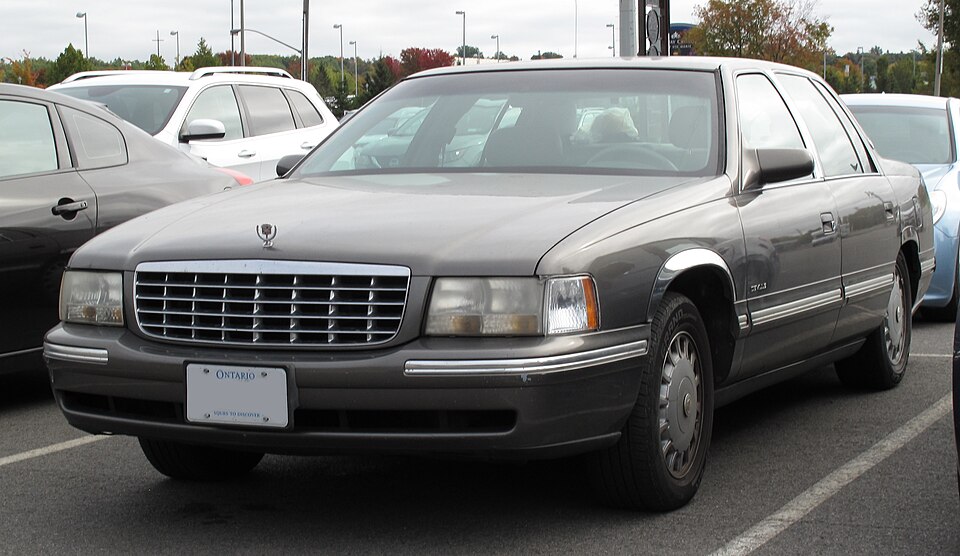
The 2000 Cadillac Deville has 5 recalls and 225 owner complaints on file with NHTSA; the most reported problem area is engine.
Pictured: a 1999 model; the 2000 may differ in details. Photo: 1999 Cadillac Deville by Elise240SX, CC BY-SA 4.0, via Wikimedia Commons
How the 2000 compares
Highest
Fewest complaintsMost complaints
Highest complaint count among 6 Deville model years — the most of any year.
5recalls
225complaints
25crashes
4fires
30injuries
70,000median miles
Owner complaints filed with NHTSA, not verified and not adjusted for sales. Ranking compares this model's own years only.
Does your car have an open recall? Recalls apply to specific vehicles. Only a VIN lookup on NHTSA's official site shows whether yours is affected and still unrepaired.
Jun 23, 2014 · NHTSA campaign 14V355000 · 3,141,731 vehicles
Problem: This defect can affect the safe operation of the airbag system. Until this recall is performed, customers should remove all items from their key rings, leaving only the ignition key. The key fob (if applicable), should also be removed from the key ring. General Motors LLC (GM) is recalling certain model year 2005-2009 Buick LaCrosse, 2006-2011 Buick Lucerne, 2000-2005 Cadillac DeVille, 2006-2011 Cadillac DTS, 2006-2014 Chevrolet Impala, and 2006-2007 Chevrolet Monte Carlo vehicles. In the affected vehicles, the weight on the key ring and road conditions or some other jarring event may cause the ignition switch to move out of the run position, turning off the engine.
Risk: If the key is not in the run position, the air bags may not deploy if the vehicle is involved in a crash, increasing the risk of injury. Additionally, a key knocked out of the run position will cause loss of engine power, power steering, and power braking, increasing the risk of a vehicle crash.
Remedy & notes
GM will notify owners, and dealers will install two key rings and an insert in the key slot or a cover over the key head on all ignition keys, free of charge. The recall began on September 23, 2014. Owners may contact General Motors customer service at 1-800-521-7300 (Buick), 1-800-458-8006 (Cadillac), and 1-800-222-1020 (Chevrolet). GM's number for this recall is 14299.
Owners may also contact the National Highway Traffic Safety Administration Vehicle Safety Hotline at 1-888-327-4236 (TTY 1-800-424-9153), or go to www.safercar.gov.
Problem: Certain passenger vehicles contain driver and front passenger lap and/or shoulder belt retractors that May not remain locked up as designed during a crash in which the belt pretensioners deploy.
Original NHTSA wording
CERTAIN PASSENGER VEHICLES CONTAIN DRIVER AND FRONT PASSENGER LAP AND/OR SHOULDER BELT RETRACTORS THAT MAY NOT REMAIN LOCKED UP AS DESIGNED DURING A CRASH IN WHICH THE BELT PRETENSIONERS DEPLOY.
Risk: In such a crash, this could result in an increase in injury for that occupant.
Original NHTSA wording
IN SUCH A CRASH, THIS COULD RESULT IN AN INCREASE IN INJURY FOR THAT OCCUPANT.
Remedy & notes
Dealers will install a retainer kit in the driver and passenger safety belt pretensioner. Owner notification began January 31, 2003. Owners who take their vehicles to an authorized dealer on an agreed upon service date and do not receive the free remedy within a reasonable time should contact Cadillac at 1-800-458-8006.
Gm recall no. 02031. Also, customers can contact the national highway traffic safety administration's auto safety hotline at 1-888-DASH-2-DOT (1-888-327-4236).
Seat Belts
Oct 30, 2000 · NHTSA campaign 00V347000 · 116,682 vehicles
Problem: Vehicle description: Passenger vehicles, hearse, and limousines. Some of these vehicles fail to comply with the requirements of FMVSS no. 209, "seat belt assemblies." these vehicles have seat belts that May not meet the 30-POUND push button release effort requirement of the standard.
Original NHTSA wording
VEHICLE DESCRIPTION: PASSENGER VEHICLES, HEARSE, AND LIMOUSINES. SOME OF THESE VEHICLES FAIL TO COMPLY WITH THE REQUIREMENTS OF FMVSS NO. 209, "SEAT BELT ASSEMBLIES." THESE VEHICLES HAVE SEAT BELTS THAT MAY NOT MEET THE 30-POUND PUSH BUTTON RELEASE EFFORT REQUIREMENT OF THE STANDARD.
Risk: High release efforts could make it more difficult for a crash victim to release the belt and exit the vehicle.
Original NHTSA wording
HIGH RELEASE EFFORTS COULD MAKE IT MORE DIFFICULT FOR A CRASH VICTIM TO RELEASE THE BELT AND EXIT THE VEHICLE.
Remedy & notes
Dealers will inspect the seat belts and, if necessary, modify the latch plates or replace the retractor. Dealers will also add "snap on" latch clips to eliminate the potential of inverted latch plate insertion. Owner notification is being conducted in phases. The first phase began May 29, 2001, and the second phase began July 6, 2001. Owners who take their vehicles to an authorized dealer on an agreed upon service date and do not receive the free remedy within a reasonable time should contact Cadillac at 1-800-458-8006.
Also contact the national highway traffic safety administration's auto safety hotline at 1-888-DASH-2-DOT (1-888-327-4236).
Problem: Vehicle description: Passenger vehicles. Some of these vehicles have internal fluid leaks in the brake hydraulic control unit.
Original NHTSA wording
VEHICLE DESCRIPTION: PASSENGER VEHICLES. SOME OF THESE VEHICLES HAVE INTERNAL FLUID LEAKS IN THE BRAKE HYDRAULIC CONTROL UNIT.
Risk: When the rear brake proportioning, antilock brake, traction control, or stability control feature is activated in some driving situations, the feature May not perform as designed.
Original NHTSA wording
WHEN THE REAR BRAKE PROPORTIONING, ANTILOCK BRAKE, TRACTION CONTROL, OR STABILITY CONTROL FEATURE IS ACTIVATED IN SOME DRIVING SITUATIONS, THE FEATURE MAY NOT PERFORM AS DESIGNED.
Remedy & notes
Dealers will inspect the ABS hydraulic modulator unit and if necessary, replace the hydraulic modulator.
Owner notification began June 21, 2000. Owners who take their vehicles to an authorized dealer on an agreed upon service date and do not receive the free remedy within a reasonable time should contact Buick at 1-800-521-7300, Pontiac at 1-800-762-2737, Oldsmobile at 1-800-442-6537, and Cadillac at 1-800-458-8006.also contact the national highway traffic safety administration's auto safety hotline at 1-888-DASH-2-DOT (1-888-327-4236).
Vehicle Speed Control
Jan 26, 2000 · NHTSA campaign 00V021000 · 61 vehicles
Problem: Vehicle description: Limousines. During normal engine roll, the plastic end fitting of the cruise control cable could contact the brake master cylinder and fracture. This does not meet the requirements of FMVSS no. 124, "accelerator control systems."
Original NHTSA wording
VEHICLE DESCRIPTION: LIMOUSINES. DURING NORMAL ENGINE ROLL, THE PLASTIC END FITTING OF THE CRUISE CONTROL CABLE COULD CONTACT THE BRAKE MASTER CYLINDER AND FRACTURE. THIS DOES NOT MEET THE REQUIREMENTS OF FMVSS NO. 124, "ACCELERATOR CONTROL SYSTEMS."
Risk: The fracture could prevent full closing of the throttle and cause a small increase in engine rpm in drive with the brake applied.
Original NHTSA wording
THE FRACTURE COULD PREVENT FULL CLOSING OF THE THROTTLE AND CAUSE A SMALL INCREASE IN ENGINE RPM IN DRIVE WITH THE BRAKE APPLIED.
Remedy & notes
Dealers will install a new cruise control bracket and, if necessary, will replace the cruise control cable.
Gm recall no. 00001.owner notification began March 23, 2000.owners who take their vehicles to an authorized dealer on an agreed upon service date and do not receive the free remedy within a reasonable time should contact Cadillac at 1-800-458-8006.also contact the national highway traffic safety administration's auto safety hotline at 1-888-DASH-2-DOT (1-888-327-4236).
Recall text as published by NHTSA and the manufacturer.
Owner complaints filed with NHTSA; one complaint can name several areas. Not verified by NHTSA.
Complaints by year filed
NHTSA investigations
FAILING SEAT BELT BUCKLES
PE04060 · opened Aug 17, 2004 · closed Feb 3, 2005
Summary
ON AUGUST 17, 2004, ODI OPENED AN INVESTIGATION BASED ON TWO COMPLAINTS AND ONE INSURANCE COMPANY REPORT ALLEGING DRIVER AND/OR FRONT PASSENGER SEATBELT UNBUCKLING DURING CRASHES ON MODEL YEAR (MY) 2000 AND 2001 CADILLAC DEVILLE SEDANS.ON OCTOBER 8, 2004, GM SUBMITTED DATA TO ODI RELATED TO THE ALLEGED DEFECT FOR THE SUBJECT VEHICLES.THIS DATA CONTAINED INFORMATION ABOUT SYSTEM DESIGN, SYSTEM OPERATION, SEAT BELT BUCKLE TESTING AND CONSUMER COMPLAINTS.BASED ON ITS ANALYSIS OF THE DATA, ODI HAS DETERMINED THAT A SAFETY-RELATED DEFECT TREND HAS NOT BEEN IDENTIFIED REGARDING SPECIFIC ALLEGATIONS OF UNWANTED SEATBELT UNBUCKLING DURING A CRASH.AT THIS TIME, FURTHER USE OF AGENCY RESOURCES DOES NOT APPEAR TO BE WARRANTED.THE CLOSING OF THIS INVESTIGATION DOES NOT CONSTITUTE A FINDING BY NHTSA THAT NO SAFETY-RELATED DEFECT EXISTS.THE AGENCY RESERVES THE RIGHT TO TAKE FURTHER ACTION IF WARRANTED BY THE CIRCUMSTANCESSEE ATTACHED SUMMARY REPORT
2000 vs. other Cadillac Deville years
Owner complaints by model year; the darker bar is the 2000. Click a bar to switch year.
Questions
Does the 2000 Cadillac Deville have recalls?
Yes — NHTSA lists 5 recall campaigns covering the 2000 Cadillac Deville, the latest from Jun 23, 2014 (electrical system). A recall applies to specific vehicles: enter your VIN at nhtsa.gov/recalls to see whether yours is affected and still open.
What are the most common problems with the 2000 Cadillac Deville?
Owner complaints filed with NHTSA most often mention engine (61), electrical system (60), visibility (28). Complaints are consumer reports and are not verified by NHTSA.
 Recalls by Model