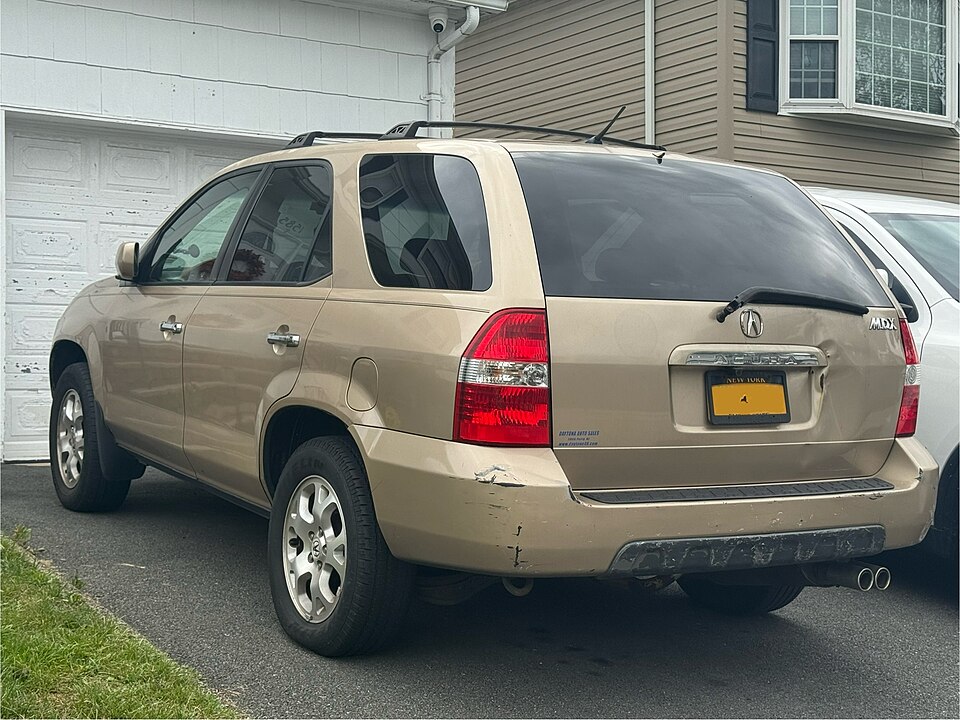
2001 Acura MDX recalls and problems

The 2001 Acura MDX has 4 recalls and 224 owner complaints on file with NHTSA; the most reported problem area is power train.

2001 Acura Mdx
Photo: 2001 Acura Mdx by Clock38030, CC BY 4.0, via Wikimedia Commons
How the 2001 compares
Fewest complaintsMost complaints

Highest complaint count among 25 MDX model years — 4th most.

4recalls
224complaints
9crashes
1fires
10injuries
100,000median miles

Owner complaints filed with NHTSA, not verified and not adjusted for sales. Ranking compares this model's own years only.

Does your car have an open recall?
Recalls apply to specific vehicles. Only a VIN lookup on NHTSA's official site shows whether yours is affected and still unrepaired.
Check your VIN →

4 recalls

Air Bags

Jan 17, 2020 · NHTSA campaign 20V027000 · 875,966 vehicles

Problem: Honda (American Honda Motor Co.) is recalling certain 2001-2002 Acura 3.2CL, 2000-2003 Acura 3.5RL, 2000-2001 Acura 3.2TL, Honda CR-V and Honda Odyssey, 2001-2002 Acura MDX and 2000 Accord Coupe, Accord Sedan, Civic Coupe, and Civic Sedan vehicles. These vehicles may have received a replacement driver frontal air bag module as part of a vehicle repair. Due to a manufacturing issue, the replacement NADI inflator may absorb moisture, causing the inflator to rupture or the air bag cushion to underinflate.

Risk: In the event of a crash necessitating air bag deployment, an inflator rupture may result in metal fragments striking the driver or other occupants. An underinflated air bag cushion may not properly protect the occupant. These scenarios increase the risk of serious injury or death.

Remedy & notes

Honda will notify owners, and dealers will inspect the air bags in the vehicles, replacing the driver frontal air bag inflator with an inflator of a different design, as necessary, free of charge. The recall began October 1, 2020. Owners may contact American Honda's Customer Support & Campaign Center at 1-888-234-2138.

Owners may also contact the National Highway Traffic Safety Administration Vehicle Safety Hotline at 1-888-327-4236 (TTY 1-800-424-9153), or go to www.safercar.gov.

Air Bags

Jan 17, 2020 · NHTSA campaign 20V026000 · 1,439,841 vehicles

Problem: Honda (American Honda Motor Co.) is recalling certain 1998 Acura 2.2CL, 1998-1999 Acura 2.3CL, 1998-1999 Acura 3.0CL, 2001 Acura 3.2CL and Acura MDX, 1998-2000 Honda Accord Coupe, Accord Sedan, Civic Sedan, Odyssey and Acura 3.5RL, 1999-2000 Acura 3.2TL, 1996-2000 Civic Coupe, 1997-2000 CR-V, 1997-1998 EV Plus, and 1998-1999 Isuzu Oasis vehicles. These vehicles were equipped with Non-Azide Driver air bag Inflators (NADI) and do not contain phase stabilized ammonium nitrate (PSAN) propellant. Due to a manufacturing issue, the NADI inflators may absorb moisture, causing the inflators to rupture or the air bag cushion to underinflate.

Risk: In the event of a crash necessitating air bag deployment, an inflator rupture may result in metal fragments striking the driver or other occupants. An underinflated air bag cushion may not properly protect the occupant. These scenarios increase the risk of serious injury or death.

Remedy & notes

Honda will notify owners, and dealers will inspect the driver frontal air bag inflator, and replace it if necessary, with an inflator of a different design, free of charge. The recall began October 1, 2020. Owners may contact American Honda's Customer Support & Campaign Center at 1-888-234-2138 or Isuzu customer service at 1-800-255-6727.

Owners may also contact the National Highway Traffic Safety Administration Vehicle Safety Hotline at 1-888-327-4236 (TTY 1-800-424-9153), or go to www.safercar.gov.

Suspension

Sep 1, 2005 · NHTSA campaign 05V385000 · 22,861 vehicles

Problem: On certain sport utility vehicles originally sold in or currently registered in the states of Connecticut, Delaware, Illinois, Indiana, Iowa, Kentucky, Maine, Maryland, Massachusetts, Michigan, Minnesota, Missouri, New Hampshire, New Jersey, New York, Ohio, Pennsylvania, Rhode Island, Vermont, Virginia, West Virginia, Wisconsin and the District of Columbia. In areas where large quantities of road salt are used, the front suspension coil springs have insufficient corrosion protection, and May be susceptible to corrosion.

Original NHTSA wording

ON CERTAIN SPORT UTILITY VEHICLES ORIGINALLY SOLD IN OR CURRENTLY REGISTERED IN THE STATES OF CONNECTICUT, DELAWARE, ILLINOIS, INDIANA, IOWA, KENTUCKY, MAINE, MARYLAND, MASSACHUSETTS, MICHIGAN, MINNESOTA, MISSOURI, NEW HAMPSHIRE, NEW JERSEY, NEW YORK, OHIO, PENNSYLVANIA, RHODE ISLAND, VERMONT, VIRGINIA, WEST VIRGINIA, WISCONSIN AND THE DISTRICT OF COLUMBIA. IN AREAS WHERE LARGE QUANTITIES OF ROAD SALT ARE USED, THE FRONT SUSPENSION COIL SPRINGS HAVE INSUFFICIENT CORROSION PROTECTION, AND MAY BE SUSCEPTIBLE TO CORROSION.

Risk: Excessive corrosion can cause spring failure and a broken spring could puncture a front tire, which increases the risk of a crash.

Original NHTSA wording

EXCESSIVE CORROSION CAN CAUSE SPRING FAILURE AND A BROKEN SPRING COULD PUNCTURE A FRONT TIRE, WHICH INCREASES THE RISK OF A CRASH.

Remedy & notes

Dealers will replace both front springs with improved springs. The recall began on October 11, 2005. Owners May contact Acura at 800-382-2238.

Honda/Acura recall no. P92.customers May also contact the national highway traffic safety administration's vehicle safety hotline at 1-888-327-4236 (tty 1-800-424-9153), or go to http://www.safercar.gov.

Power Train

Apr 15, 2004 · NHTSA campaign 04V176000 · 1,099,796 vehicles

Problem: On some MINI vans, sport utility and passenger vehicles, certain operating conditions can result in heat build-up between the countershaft and secondary shaft second gears in the automatic transmission, eventually leading to gear tooth chipping or gear breakage.

Original NHTSA wording

ON SOME MINI VANS, SPORT UTILITY AND PASSENGER VEHICLES, CERTAIN OPERATING CONDITIONS CAN RESULT IN HEAT BUILD-UP BETWEEN THE COUNTERSHAFT AND SECONDARY SHAFT SECOND GEARS IN THE AUTOMATIC TRANSMISSION, EVENTUALLY LEADING TO GEAR TOOTH CHIPPING OR GEAR BREAKAGE.

Risk: Gear failure could result in transmission lockup, which could result in a crash.

Original NHTSA wording

GEAR FAILURE COULD RESULT IN TRANSMISSION LOCKUP, WHICH COULD RESULT IN A CRASH.

Remedy & notes

On vehicles with 15,000 miles or less, the dealer will update the transmission with a simple revision to the oil cooler return line to increase lubrication to the second gear. On vehicles with more than 15,000 miles, the dealer will inspect the transmission to identify gears that have already experienced discoloration due to overheating. If discoloration exists, the transmission will be replaced if discoloration is not present, the dealer will perform the revision to the oil cooler return line. The recall began on April 21, 2004, for pilot, odyssey, and mdx owners. Owners of the accord vehicles will start receiving letters on June 28, 2004, and on June 29, 2004, for owners of the tl and cl vehicles. Owners should contact Honda at 1-800-999-1009 or Acura at 1-800-382-2238.

Honda recall nos. P30 (odyssey and pilot),P31 (mdx), P38 (accord) and P39 (Acura).customers can also contact the national highway traffic safety administration's auto safety hotline at 1-888-DASH-2-DOT (1-888-327-4236).

Recall text as published by NHTSA and the manufacturer.

What owners complain about

Owner complaints filed with NHTSA; one complaint can name several areas. Not verified by NHTSA.

Complaints by year filed

2001: 4 complaints20012002: 10 complaints2003: 8 complaints20032004: 23 complaints2005: 15 complaints20052006: 16 complaints2007: 16 complaints20072008: 15 complaints2009: 16 complaints20092010: 28 complaints282011: 7 complaints20112012: 8 complaints2013: 7 complaints20132014: 10 complaints2015: 11 complaints20152016: 7 complaints2018: 1 complaints20182019: 8 complaints2020: 4 complaints20202021: 7 complaints2023: 2 complaints20232024: 1 complaints20241

NHTSA investigations

FRONT COIL SPRING BREAKAGE

PE05040 · opened Jul 14, 2005 · closed Sep 14, 2005 · led to recall 05V385000
Summary

IN AN AUGUST 29, 2005 LETTER, HONDA NOTIFIED NHTSA THAT IT HAD IDENTIFIED A DEFECT IN THE FRONT COIL SPRINGS OF CERTAIN MODEL YEAR 2001 AND EARLY-2002 ACURA MDX SPORT UTILITY VEHICLES.ACCORDING TO HONDA, SOME FRONT SUSPENSION COIL SPRINGS HAVE INSUFFICIENT CORROSION PROTECTION AND, IN AREAS WHERE ROAD SALTS ARE USED, MAY BE SUSCEPTIBLE TO CORROSION.RUBBER SLEEVES APPLIED NEAR THE TOP AND BOTTOM OF SOME SPRINGS TO ELIMINATE NOISE CAN TRAP SALT WATER, INCREASING THE POTENTIAL FOR EXCESSIVE CORROSION.OVER TIME, EXCESSIVE CORROSION CAN CAUSE SPRING FAILURE.IN SOME CASES, A BROKEN SPRING COULD PUNCTURE A FRONT TIRE, WHICH INCREASES THE RISK OF A CRASH.EVIDENCE OF TIRE DAMAGE WAS IDENTIFIED IN AT LEAST 4 (29%) OF THE SPRING FRACTURE REPORTS AND 13 (21%) OF THE WARRANTY CLAIMS.ONE REPORT ALSO INDICATED THAT A FRACTURED SPRING DAMAGED A BRAKE LINE FAILURE, RESULTING IN EXTENDED STOPPING DISTANCE. TO CORRECT THE CONDITION, HONDA IS RECALLING APPROXIMATELY 22,861 MDX VEHICLES SOLD OR CURRENTLY REGISTERED IN THE STATES OF CONNECTICUT, DELAWARE, ILLINOIS, INDIANA, IOWA, KENTUCKY, MAINE, MARYLAND, MASSACHUSETTS, MICHIGAN, MINNESOTA, MISSOURI, NEW HAMPSHIRE, NEW JERSEY, NEW YORK, OHIO, PENNSYLVANIA, RHODE ISLAND, VERMONT, VIRGINIA, WEST VIRGINIA, WISCONSIN AND THE DISTRICT OF COLUMBIA WHERE LARGE QUANTITIES OF ROAD SALT ARE USED (HONDA RECALL P92, NHTSA RECALL 05V-385).THERE WERE NO COMPLAINTS OR WARRANTY CLAIMS INVOLVING VEHICLES FROM OUTSIDE THE RECALL REGION.DEALERS WILL REPLACE BOTH FR…

2001 vs. other Acura MDX years

Owner complaints by model year; the darker bar is the 2001. Click a bar to switch year.

Questions

Does the 2001 Acura MDX have recalls?

Yes — NHTSA lists 4 recall campaigns covering the 2001 Acura MDX, the latest from Jan 17, 2020 (air bags). A recall applies to specific vehicles: enter your VIN at nhtsa.gov/recalls to see whether yours is affected and still open.

What are the most common problems with the 2001 Acura MDX?

Owner complaints filed with NHTSA most often mention power train (131), engine (22), suspension (19). Complaints are consumer reports and are not verified by NHTSA.